John Passos - Three Soldiers
Здесь есть возможность читать онлайн «John Passos - Three Soldiers» весь текст электронной книги совершенно бесплатно (целиком полную версию без сокращений). В некоторых случаях можно слушать аудио, скачать через торрент в формате fb2 и присутствует краткое содержание. Жанр: Историческая проза, Детектив, на английском языке. Описание произведения, (предисловие) а так же отзывы посетителей доступны на портале библиотеки ЛибКат.
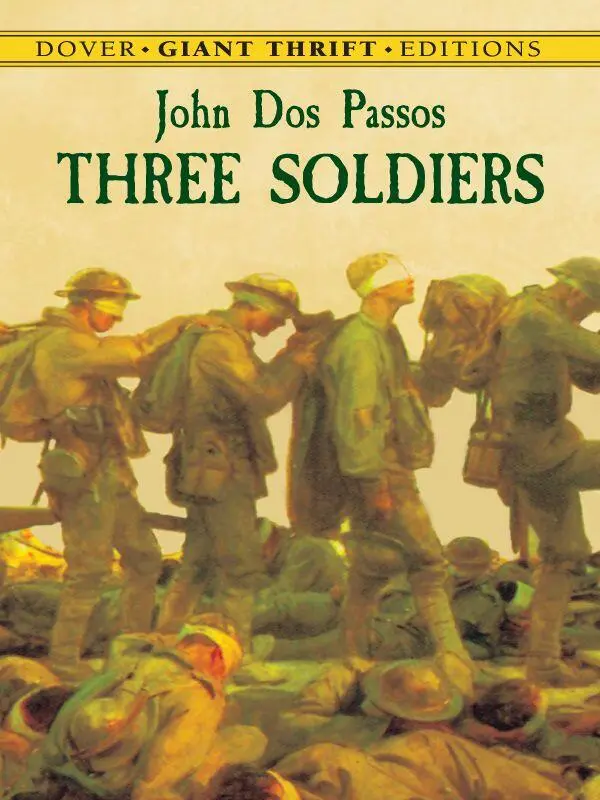
- Название:Three Soldiers
- Автор:
- Жанр:
- Год:неизвестен
- ISBN:нет данных
- Рейтинг книги:3 / 5. Голосов: 1
-
Избранное:Добавить в избранное
- Отзывы:
-
Ваша оценка:
Three Soldiers: краткое содержание, описание и аннотация
Предлагаем к чтению аннотацию, описание, краткое содержание или предисловие (зависит от того, что написал сам автор книги «Three Soldiers»). Если вы не нашли необходимую информацию о книге — напишите в комментариях, мы постараемся отыскать её.
Three Soldiers — читать онлайн бесплатно полную книгу (весь текст) целиком
Ниже представлен текст книги, разбитый по страницам. Система сохранения места последней прочитанной страницы, позволяет с удобством читать онлайн бесплатно книгу «Three Soldiers», без необходимости каждый раз заново искать на чём Вы остановились. Поставьте закладку, и сможете в любой момент перейти на страницу, на которой закончили чтение.
Интервал:
Закладка:
“It is the end of the good old times,” he said.
“Damnation to the good old times,” said Henslowe. “Here’s to the good old new roughhousy circus parades.”
“I wonder how many people they are good for, those circus parades of yours,” said Andrews.
“Where are you going to spend the night?” said Henslowe.
“I don’t know… I suppose I can find a hotel or something.”
“Why don’t you come with me and see Berthe; she probably has friends.”
“I want to wander about alone, not that I scorn Berthe’s friends,” said Andrews… “But I am so greedy for solitude.”
John Andrews was walking alone down streets full of drifting fog. Now and then a taxi dashed past him and clattered off into the obscurity. Scattered groups of people, their footsteps hollow in the muffling fog, floated about him. He did not care which way he walked, but went on and on, crossing large crowded avenues where the lights embroidered patterns of gold and orange on the fog, rolling in wide deserted squares, diving into narrow streets where other steps sounded sharply for a second now and then and faded leaving nothing in his ears when he stopped still to listen but the city’s distant muffled breathing. At last he came out along the river, where the fog was densest and coldest and where he could hear faintly the sound of water gurgling past the piers of bridges. The glow of the lights glared and dimmed, glared and dimmed, as he walked along, and sometimes he could make out the bare branches of trees blurred across the halos of the lamps. The fog caressed him soothingly and shadows kept flicking past him, giving him glimpses of smooth curves of cheeks and glints of eyes bright from the mist and darkness. Friendly, familiar people seemed to fill the fog just out of his sight. The muffled murmur of the city stirred him like the sound of the voices of friends.
From the girl at the cross-roads singing under her street-lamp to the patrician pulling roses to pieces from the height of her litter… all the imagining of your desire…
The murmur of life about him kept forming itself into long modulated sentences in his ears, — sentences that gave him by their form a sense of quiet well-being as if he were looking at a low relief of people dancing, carved out of Parian in some workshop in Attica.
Once he stopped and leaned for a long while against the moisture-beaded stern of a street-lamp. Two shadows defined, as they strolled towards him, into the forms of a pale boy and a bareheaded girl, walking tightly laced in each other’s arms. The boy limped a little and his violet eyes were contracted to wistfulness. John Andrews was suddenly filled with throbbing expectation, as if those two would come up to him and put their hands on his arms and make some revelation of vast import to his life. But when they reached the full glow of the lamp, Andrews saw that he was mistaken. They were not the boy and girl he had talked to on the Butte.
He walked off hurriedly and plunged again into tortuous streets, where he strode over the cobblestone pavements, stopping now and then to peer through the window of a shop at the light in the rear where a group of people sat quietly about a table under a light, or into a bar where a tired little boy with heavy eyelids and sleeves rolled up from thin grey arms was washing glasses, or an old woman, a shapeless bundle of black clothes, was swabbing the floor. From doorways he heard talking and soft laughs. Upper windows sent yellow rays of light across the fog.
In one doorway the vague light from a lamp bracketed in the wall showed two figures, pressed into one by their close embrace. As Andrews walked past, his heavy army boots clattering loud on the wet pavement, they lifted their heads slowly. The boy had violet eyes and pale beardless cheeks; the girl was bareheaded and kept her brown eyes fixed on the boy’s face. Andrews’s heart thumped within him. At last he had found them. He made a step towards them, and then strode on losing himself fast in the cool effacing fog. Again he had been mistaken. The fog swirled about him, hiding wistful friendly faces, hands ready to meet his hands, eyes ready to take fire with his glance, lips cold with the mist, to be crushed under his lips. From the girl at the cross-roads singing under her street-lamp…
And he walked on alone through the drifting fog.
IV
ANDREWS left the station reluctantly, shivering in the raw grey mist under which the houses of the village street and the rows of motor trucks and the few figures of French soldiers swathed in long formless coats, showed as vague dark blurs in the confused dawnlight. His body felt flushed and sticky from a night spent huddled in the warm fetid air of an overcrowded compartment. He yawned and stretched himself and stood irresolutely in the middle of the street with his pack biting into his shoulders. Out of sight, behind the dark mass, in which a few ruddy lights glowed, of the station buildings, the engine whistled and the train clanked off into, the distance. Andrews listened to its faint reverberation through the mist with a sick feeling of despair. It was the train that had brought him from Paris back to his division.
As he stood shivering in the grey mist he remembered the curious despairing reluctance he used to suffer when he went back to boarding school after a holiday. How he used to go from the station to the school by the longest road possible, taking frantic account of every moment of liberty left him. Today his feet had the same leaden reluctance as when they used to all but refuse to take him up the long sandy hill to the school.
He wandered aimlessly for a while about the silent village hoping to find a café where he could sit for a few minutes to take a last look at himself before plunging again into the grovelling promiscuity of the army. Not a light showed. All the shutters of the shabby little brick and plaster houses were closed. With dull springless steps he walked down the road they had pointed out to him from the R.T.O.
Overhead the sky was brightening giving the mist that clung to the earth in every direction ruddy billowing outlines. The frozen road gave out a faint hard resonance under his footsteps. Occasionally the silhouette of a tree by the roadside loomed up in the mist ahead, its uppermost branches clear and ruddy with sunlight.
Andrews was telling himself that the war was over, and that in a few months he would be free in any case. What did a few months more or less matter? But the sane thoughts were swept recklessly away in the blind panic that was like a stampede of wild steers within him. There was no arguing. His spirit was contorted with revolt so that his flesh twitched and dark splotches danced before his eyes. He wondered vaguely whether he had gone mad. Enormous plans kept rising up out of the tumult of his mind and dissolving suddenly like smoke in a high wind. He would run away and if they caught him, kill himself. He would start a mutiny in his company, he would lash all these men to frenzy by his words, so that they too should refuse to form into Guns, so that they should laugh when the officers got red in the face shouting orders at them, so that the whole division should march off over the frosty hills, without arms, without flags, calling all the men of all the armies to join them, to march on singing, to laugh the nightmare out of their blood. Would not some lightning flash of vision sear people’s consciousness into life again? What was the good of stopping the war if the armies continued?
But that was just rhetoric. His mind was flooding itself with rhetoric that it might keep its sanity. His mind was squeezing out rhetoric like a sponge that he might not see dry madness face to face.
And all the while his hard footsteps along the frozen road beat in his ears bringing him nearer to the village where the division was quartered. He was climbing a long hill. The mist thinned about him and became brilliant with sunlight. Then he was walking in the full sun over the crest of a hill with pale blue sky above his head. Behind him and before him were mist-filled valleys and beyond other ranges of long hills, with reddish-violet patches of woodland, glowing faintly in the sunlight. In the valley at his feet he could see, in the shadow of the hill he stood on, a church tower and a few roofs rising out of the mist, as out of water.
Читать дальшеИнтервал:
Закладка:
Похожие книги на «Three Soldiers»
Представляем Вашему вниманию похожие книги на «Three Soldiers» списком для выбора. Мы отобрали схожую по названию и смыслу литературу в надежде предоставить читателям больше вариантов отыскать новые, интересные, ещё непрочитанные произведения.




Обсуждение, отзывы о книге «Three Soldiers» и просто собственные мнения читателей. Оставьте ваши комментарии, напишите, что Вы думаете о произведении, его смысле или главных героях. Укажите что конкретно понравилось, а что нет, и почему Вы так считаете.