John Passos - Three Soldiers
Здесь есть возможность читать онлайн «John Passos - Three Soldiers» весь текст электронной книги совершенно бесплатно (целиком полную версию без сокращений). В некоторых случаях можно слушать аудио, скачать через торрент в формате fb2 и присутствует краткое содержание. Жанр: Историческая проза, Детектив, на английском языке. Описание произведения, (предисловие) а так же отзывы посетителей доступны на портале библиотеки ЛибКат.
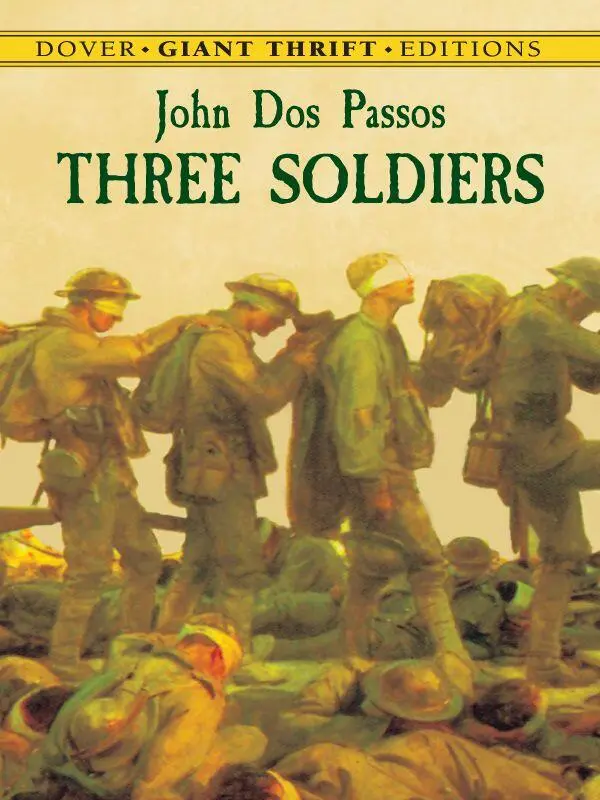
- Название:Three Soldiers
- Автор:
- Жанр:
- Год:неизвестен
- ISBN:нет данных
- Рейтинг книги:3 / 5. Голосов: 1
-
Избранное:Добавить в избранное
- Отзывы:
-
Ваша оценка:
Three Soldiers: краткое содержание, описание и аннотация
Предлагаем к чтению аннотацию, описание, краткое содержание или предисловие (зависит от того, что написал сам автор книги «Three Soldiers»). Если вы не нашли необходимую информацию о книге — напишите в комментариях, мы постараемся отыскать её.
Three Soldiers — читать онлайн бесплатно полную книгу (весь текст) целиком
Ниже представлен текст книги, разбитый по страницам. Система сохранения места последней прочитанной страницы, позволяет с удобством читать онлайн бесплатно книгу «Three Soldiers», без необходимости каждый раз заново искать на чём Вы остановились. Поставьте закладку, и сможете в любой момент перейти на страницу, на которой закончили чтение.
Интервал:
Закладка:
In the deserted tea room, among the dismal upturned chairs, his crassened fingers moved stiffly over the keys. He forgot everything else. Locked doors in his mind were swinging wide, revealing forgotten sumptuous halls of his imagination. The Queen of Sheba, grotesque as a satyr, white and flaming with worlds of desire, as the great implacable Aphrodite, stood with her hand on his shoulder sending shivers of warm sweetness rippling through his body, while her voice intoned in his ears all the inexhaustible voluptuousness of life.
An asthmatic clock stuck somewhere in the obscurity of the room. “Seven!” John Andrews paid, said good-bye to the old woman with the mustache, and hurried out into the street. “Like Cinderella at the ball,” he thought. As he went towards the hospital, down faintly lighted streets, his steps got slower and slower. “Why go back?” a voice kept saying inside him. “Anything is better than that.” Better throw himself in the river, even, than go back. He could see the olive-drab clothes in a heap among the dry bullrushes on the river bank… He thought of himself crashing naked through the film of ice into water black as Chinese lacquer. And when he climbed out numb and panting on the other side, wouldn’t he be able to take up life again as if he had just been born? How strong he would be if he could begin life a second time! How madly, how joyously he would live now that there was no more war… He had reached the door of the hospital. Furious shudders of disgust went through him.
He was standing dumbly humble while a sergeant bawled him out for being late.
Andrews stared for a long while at the line of shields that supported the dark ceiling beams on the wall opposite his cot. The emblems had been erased and the grey stone figures that crowded under the shields, — the satyr with his shaggy goat’s legs, the townsman with his square hat, the warrior with the sword between his legs, — had been clipped and scratched long ago in other wars. In the strong afternoon light they were so dilapidated he could hardly make them out. He wondered how they had seemed so vivid to him when he had lain in his cot, comforted by their comradeship, while his healing wounds itched and tingled. Still he glanced tenderly at the grey stone figures as he left the ward.
Downstairs in the office where the atmosphere was stuffy with a smell of varnish and dusty papers and cigarette smoke, he waited a long time, shifting his weight restlessly from one foot to the other.
“What do you want?” said a red-haired sergeant, without looking up from the pile of papers on his desk.
“Waiting for travel orders.”
“Aren’t you the guy I told to come back at three?”
“It is three.”
“H’m!” The sergeant kept his eyes fixed on the papers, which rustled as he moved them from one pile to another. In the end of the room a typewriter clicked slowly and jerkily. Andrews could see the dark back of a head between bored shoulders in a woolen shirt leaning over the machine. Beside the cylindrical black stove against the wall a man with large mustaches and the complicated stripes of a hospital sergeant was reading a novel in a red cover. After a long silence the red-headed sergeant looked up from his papers and said suddenly:
“Ted.” The man at the typewriter turned slowly round, showing a large red face and blue eyes.
“We-ell,” he drawled.
“Go in an’ see if the loot has signed them papers yet.”
The man got up, stretched himself deliberately, and slouched out through a door beside the stove. The red-haired sergeant leaned back in his swivel chair and lit a cigarette.
“Hell,” he said, yawning.
The man with the mustache beside the stove let the book slip from his knees to the floor, and yawned too.
“This goddam armistice sure does take the ambition out of a feller,” he said.
“Hell of a note,” said the red-haired sergeant. “D’you know that they had my name in for an O.T.C.? Hell of a note goin’ home without a Sam Brown.”
The other man came back and sank down into his chair in front of the typewriter again. The slow, jerky clicking recommended.
Andrews made a scraping noise with his foot on the ground.
“Well, what about that travel order?” said the red-haired sergeant.
“Loot’s out,” said the other man, still typewriting.
“Well, didn’t he leave it on his desk?” shouted the redhaired sergeant angrily.
“Couldn’t find it.”
“I suppose I’ve got to go look for it God!” The red-haired sergeant stamped out of the room. A moment later he came back with a bunch of papers in his hand.
“Your name Jones?” he snapped to Andrews.
“No.”
“Snivisky?”
“No… Andrews, John.”
“Why the hell couldn’t you say so?”
The man with the mustaches beside the stove got to his feet suddenly. An alert, smiling expression came over his face. “Good afternoon, Captain Higginsworth,” he said cheerfully.
An oval man with a cigar slanting out of his broad mouth came into the room. When he talked the cigar wobbled in his mouth. He wore greenish kid gloves, very tight for his large hands, and his puttees shone with a dark lustre like mahogany.
The red-haired sergeant turned round and half-saluted.
“Goin’ to another swell party, Captain?” he asked.
The Captain grinned.
“Say, have you boys got any Red Cross cigarettes? I ain’t only got cigars, an’ you can’t hand a cigar to a lady, can you?” The Captain grinned again. An appreciative giggle went round.
“Will a couple of packages do you? Because I’ve got some here,” said the red-haired sergeant reaching in the drawer of his desk.
“Fine.” The captain slipped them into his pocket and swaggered out doing up the buttons of his buff-colored coat.
The sergeant settled himself at his desk again with an important smile.
“Did you find the travel order?” asked Andrews timidly. “I’m supposed to take the train at four-two.”
“Can’t make it… Did you say your name was Anderson?”
“Andrews… John Andrews.”
“Here it is Why didn’t you come earlier?”
The sharp air of the ruddy winter evening, sparkling in John Andrews’s nostrils, vastly refreshing after the stale odors of the hospital, gave him a sense of liberation. Walking with rapid steps through the grey streets of the town, where in windows lamps already glowed orange, he kept telling himself that another epoch was closed. It was with relief that he felt that he would never see the hospital again or any of the people in it. He thought of Chrisfield. It was weeks and weeks since Chrisfield had come to his mind at all. Now it was with a sudden clench of affection that the Indiana boy’s face rose up before him. An oval, heavily-tanned face with a little of childish roundness about it yet, with black eyebrows and long black eyelashes. But he did not even know if Chrisfield were still alive. Furious joy took possession of him. He, John Andrews, was alive; what did it matter if everyone he knew died? There were jollier companions than ever he had known, to be found in the world, cleverer people to talk to, more vigorous people to learn from. The cold air circulated through his nose and lungs; his arms felt strong and supple; he could feel the muscles of his legs stretch and contract as he walked, while his feet beat jauntily on the irregular cobble stones of the street. The waiting room at the station was cold and stuffy, full of a smell of breathed air and unclean uniforms. French soldiers wrapped in their long blue coats, slept on the benches or stood about in groups, eating bread and drinking from their canteens. A gas lamp in the center gave dingy light. Andrews settled himself in a corner with despairing resignation. He had five hours to wait for a train, and already his, legs ached and he had a side feeling of exhaustion. The exhilaration of leaving the hospital and walking free through wine-tinted streets in the sparkling evening air gave way gradually to despair. His life would continue to be this slavery of unclean bodies packed together in places where the air had been breathed over and over, cogs in the great slow-moving Juggernaut of armies. What did it matter if the fighting had stopped? The armies would go on grinding out lives with lives, crushing flesh with flesh. Would he ever again stand free and solitary to live out joyous hours which would make up for all the boredom of the treadmill? He had no hope. His life would continue like this dingy, ill-smelling waiting room where men in uniform slept in the fetid air until they should be ordered out to march or to stand in motionless rows, endlessly, futilely, like toy soldiers a child has forgotten in an attic.
Читать дальшеИнтервал:
Закладка:
Похожие книги на «Three Soldiers»
Представляем Вашему вниманию похожие книги на «Three Soldiers» списком для выбора. Мы отобрали схожую по названию и смыслу литературу в надежде предоставить читателям больше вариантов отыскать новые, интересные, ещё непрочитанные произведения.




Обсуждение, отзывы о книге «Three Soldiers» и просто собственные мнения читателей. Оставьте ваши комментарии, напишите, что Вы думаете о произведении, его смысле или главных героях. Укажите что конкретно понравилось, а что нет, и почему Вы так считаете.