John Passos - Three Soldiers
Здесь есть возможность читать онлайн «John Passos - Three Soldiers» весь текст электронной книги совершенно бесплатно (целиком полную версию без сокращений). В некоторых случаях можно слушать аудио, скачать через торрент в формате fb2 и присутствует краткое содержание. Жанр: Историческая проза, Детектив, на английском языке. Описание произведения, (предисловие) а так же отзывы посетителей доступны на портале библиотеки ЛибКат.
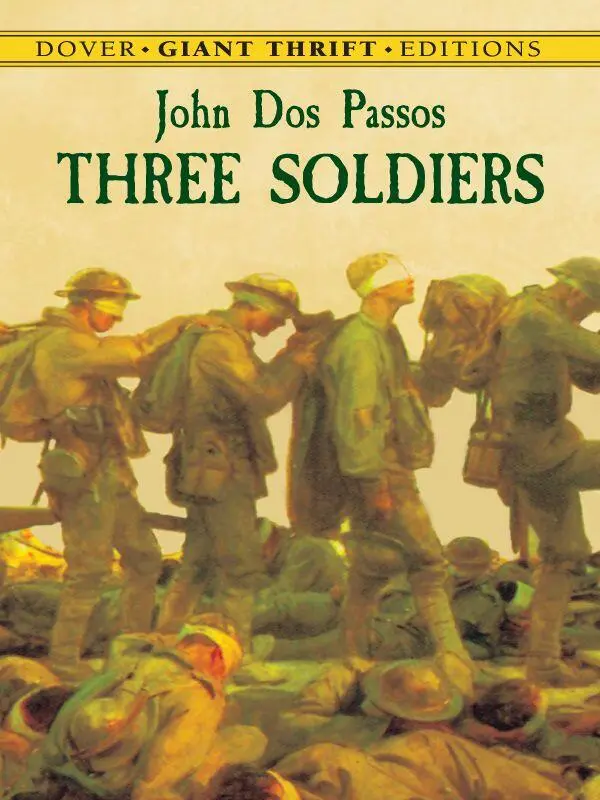
- Название:Three Soldiers
- Автор:
- Жанр:
- Год:неизвестен
- ISBN:нет данных
- Рейтинг книги:3 / 5. Голосов: 1
-
Избранное:Добавить в избранное
- Отзывы:
-
Ваша оценка:
Three Soldiers: краткое содержание, описание и аннотация
Предлагаем к чтению аннотацию, описание, краткое содержание или предисловие (зависит от того, что написал сам автор книги «Three Soldiers»). Если вы не нашли необходимую информацию о книге — напишите в комментариях, мы постараемся отыскать её.
Three Soldiers — читать онлайн бесплатно полную книгу (весь текст) целиком
Ниже представлен текст книги, разбитый по страницам. Система сохранения места последней прочитанной страницы, позволяет с удобством читать онлайн бесплатно книгу «Three Soldiers», без необходимости каждый раз заново искать на чём Вы остановились. Поставьте закладку, и сможете в любой момент перейти на страницу, на которой закончили чтение.
Интервал:
Закладка:
Andrews got up suddenly and went out on the empty platform. A cold wind blew. Somewhere out in the freight yards an engine puffed loudly, and clouds of white steam drifted through the faintly lighted station. He was walking up and down with his chin sunk into his coat and his hands in his pockets, when somebody ran into him.
“Damn,” said a voice, and the figure darted through a grimy glass door that bore the sign: “Buvette.” Andrews followed absent-mindedly. “I’m sorry I ran into you… I thought you were an M.P., that’s why I beat it.” When he spoke, the man, an American private, turned and looked searchingly in Andrews’s face. He had very red cheeks and an impudent little brown mustache. He spoke slowly with a faint Bostonian drawl.
“That’s nothing,” said Andrews.
“Let’s have a drink,” said the other man. “I’m A.W.O.L. Where are you going?”
“To some place near Bar-le-Duc, back to my Division. Been in hospital.”
“Long?”
“Since October.”
“Gee… Have some Curaçoa. It’ll do you good. You look pale… My name’s Henslowe. Ambulance with the French Army.”
They sat down at an unwashed marble table where the soot from the trains made a pattern sticking to the rings left by wine and liqueur glasses.
“I’m going to Paris,” said Henslowe. “My leave expired three days ago. I’m going to Paris and get taken ill with peritonitis or double pneumonia, or maybe I’ll have a cardiac lesion… The army’s a bore.”
“Hospital isn’t any better,” said Andrews with a sigh. “Though I shall never forget the delight with which I realized I was wounded and out of it. I thought I was bad enough to be sent home.”
“Why, I wouldn’t have missed a minute of the war… But now that it’s over… Hell! Travel is the password now. I’ve just had two weeks in the Pyrénées. Nimes, Arles, Les Baux, Carcassonne, Perpignan, Lourdes, Gavarnie, Toulouse! What do you think of that for a trip?… What were you in?”
“Infantry.”
“Must have been hell.”
“Been! It is.”
“Why don’t you come to Paris with me?”
“I don’t want to be picked up,” stammered Andrews.
“Not a chance… I know the ropes… All you have to do is keep away from the Olympia and the railway stations, walk fast and keep your shoes shined… and you’ve got wits, haven’t you?”
“Not many… Let’s drink a bottle of wine. Isn’t there anything to eat to be got here?”
“Not a damn thing, and I aren’t go out of the station on account of the M.P. at the gate… There’ll be a diner on the Marseilles express.”
“But I can’t go to Paris.”
“Sure… Look, how do you call yourself?”
“John Andrews.”
“Well, John Andrews, all I can say is that you’ve let ’em get your goat. Don’t give in. Have a good time, in spite of ’em. To hell with ’em.” He brought the bottle down so hard on the table that it broke and the purple wine flowed over the dirty marble and dripped gleaming on the floor.
Some French soldiers who stood in a group round the bar turned round.
“V’là un gars qui gaspille le bon vin,” said a tall red-faced man, with long sloping whiskers.
“Pour vingt sous j’mangerai la bouteille,” cried a little man lurching forward and leaning drunkenly over the table.
“Done,” said Henslowe. “Say, Andrews, he says he’ll eat the bottle for a franc.”
He placed a shining silver franc on the table beside the remnants of the broken bottle. The man seized the neck of the bottle in a black, claw-like hand and gave it a preparatory flourish. He was a cadaverous little man, incredibly dirty, with mustaches and beard of a moth-eaten tow-color, and a purple flush on his cheeks. His uniform was clotted with mud. When the others crowded round him and tried to dissuade him, he said: “M’en fous, c’est mon métier,” and rolled his eyes so that the whites flashed in the dim light like the eyes of dead codfish.
“Why, he’s really going to do it,” cried Henslowe.
The man’s teeth flashed and crunched down on the jagged edge of the glass. There was a terrific crackling noise. He flourished the bottle-end again. “My God, he’s eating it,” cried Henslowe, roaring with laughter, “and you’re afraid to go to Paris.”
An engine rumbled into the station, with a great hiss of escaping steam.
“Gee, that’s the Paris train! Tiens!” He pressed the franc into the man’s dirt-crusted hand.
“Come along, Andrews.”
As they left the buvette they heard again the crunching crackling noise as the man bit another piece off the bottle.
Andrews followed Henslowe across the steam-filled platform to the door of a first-class carriage. They climbed in. Henslowe immediately pulled down the black cloth over the half globe of the light. The compartment was empty. He threw himself down with a sigh of comfort on the soft buff-colored cushions of the seat.
“But what on earth?” stammered Andrews.
“M’en fous, c’est mon métier,” interrupted Henslowe.
The train pulled out of the station.
III
HENSLOWE poured wine from a brown earthen crock into the glasses, where it shimmered a bright thin red, the color of currants. Andrews leaned back in his chair and looked through half-closed eyes at the table with its white cloth and little burnt umber loaves of bread, and out of the window at the square dimly lit by lemon-yellow gas lamps and at the dark gables of the little houses that huddled round it.
At a table against the wall opposite a lame boy, with white beardless face and gentle violet-colored eyes, sat very close to the bareheaded girl who was with him and who never took her eyes off his face, leaning on his crutch all the while. A stove hummed faintly in the middle of the room, and from the half-open kitchen door came ruddy light and the sound of something frying. On the wall, in brownish colors that seemed to have taken warmth from all the rich scents of food they had absorbed since the day of their painting, were scenes of the Butte as it was fancied to have once been, with windmills and wide fields.
“I want to travel,” Henslowe was saying, dragging out his words drowsily. “Abyssinia, Patagonia, Turkestan, the Caucasus, anywhere and everywhere. What do you say you and I go out to New Zealand and raise sheep?”
“But why not stay here? There can’t be anywhere as wonderful as this.”
“Then I’ll put off starting for New Guinea for a week. But hell, I’d go crazy staying anywhere after this. It’s got into my blood… all this murder. It’s made a wanderer of me, that’s what it’s done. I’m an adventurer.”
“God, I wish it had made me into anything so interesting.”
“Tie a rock on to your scruples and throw ’em off the Pont Neuf and set out… O boy, this is the golden age for living by your wits.”
“You’re not out of the army yet.”
“I should worry… I’ll join the Red Cross.”
“How?”
“I’ve got a tip about it.”
A girl with oval face and faint black down on her upper lip brought them soup, a thick greenish colored soup, that steamed richly into their faces.
“If you tell me how I can get out of the army you’ll probably save my life,” said Andrews seriously.
“There are two ways… Oh, but let me tell you later. Let’s talk about something worth while… So you write music do you?”
Andrews nodded.
An omelet lay between them, pale golden-yellow with flecks of green; a few amber bubbles of burnt butter still clustered round the edges.
“Talk about tone-poems,” said Henslowe.
“But, if you are an adventurer and have no scruples, how is it you are still a private?”
Читать дальшеИнтервал:
Закладка:
Похожие книги на «Three Soldiers»
Представляем Вашему вниманию похожие книги на «Three Soldiers» списком для выбора. Мы отобрали схожую по названию и смыслу литературу в надежде предоставить читателям больше вариантов отыскать новые, интересные, ещё непрочитанные произведения.






Обсуждение, отзывы о книге «Three Soldiers» и просто собственные мнения читателей. Оставьте ваши комментарии, напишите, что Вы думаете о произведении, его смысле или главных героях. Укажите что конкретно понравилось, а что нет, и почему Вы так считаете.