John Passos - Three Soldiers
Здесь есть возможность читать онлайн «John Passos - Three Soldiers» весь текст электронной книги совершенно бесплатно (целиком полную версию без сокращений). В некоторых случаях можно слушать аудио, скачать через торрент в формате fb2 и присутствует краткое содержание. Жанр: Историческая проза, Детектив, на английском языке. Описание произведения, (предисловие) а так же отзывы посетителей доступны на портале библиотеки ЛибКат.
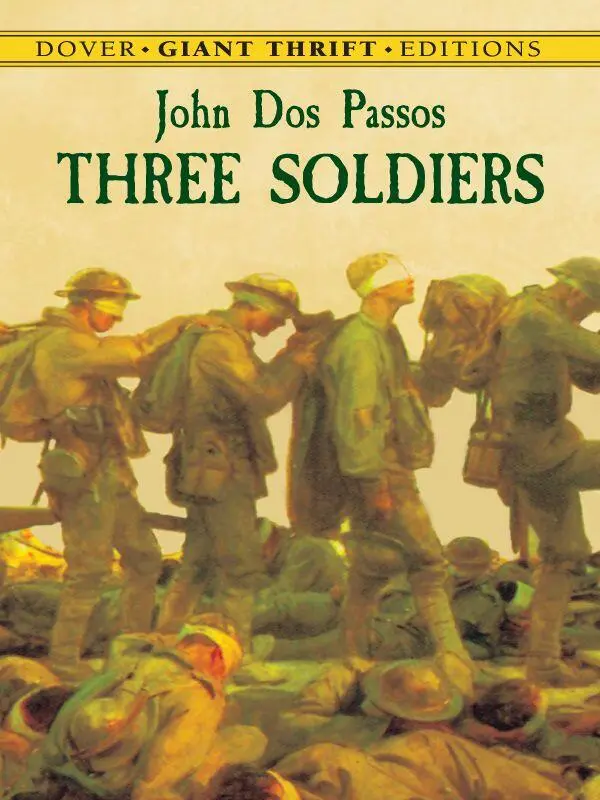
- Название:Three Soldiers
- Автор:
- Жанр:
- Год:неизвестен
- ISBN:нет данных
- Рейтинг книги:3 / 5. Голосов: 1
-
Избранное:Добавить в избранное
- Отзывы:
-
Ваша оценка:
Three Soldiers: краткое содержание, описание и аннотация
Предлагаем к чтению аннотацию, описание, краткое содержание или предисловие (зависит от того, что написал сам автор книги «Three Soldiers»). Если вы не нашли необходимую информацию о книге — напишите в комментариях, мы постараемся отыскать её.
Three Soldiers — читать онлайн бесплатно полную книгу (весь текст) целиком
Ниже представлен текст книги, разбитый по страницам. Система сохранения места последней прочитанной страницы, позволяет с удобством читать онлайн бесплатно книгу «Three Soldiers», без необходимости каждый раз заново искать на чём Вы остановились. Поставьте закладку, и сможете в любой момент перейти на страницу, на которой закончили чтение.
Интервал:
Закладка:
Among the houses bugles were blowing mess-call. The jauntiness of the brassy notes ringing up through the silence was agony to him. How long the day would be. He looked at his watch. It was seven thirty. How did they come to be having mess so late?
The mist seemed doubly cold and dark when he was buried in it again after his moment of sunlight. The sweat was chilled on his face and streaks of cold went through his clothes, soaked from the effort of carrying the pack. In the village street Andrews met a man he did not know and asked him where the office was. The man, who was chewing something, pointed silently to a house with green shutters on the opposite side of the street.
At a desk sat Chrisfield smoking a cigarette. When he jumped up Andrews noticed that he had a corporal’s two stripes on his arm
“Hello, Andy.”
They shook hands warmly.
“A’ you all right now, ole boy?”
“Sure, I’m fine,” said Andrews. A sudden constraint fell upon them.
“That’s good,” said Chrisfield.
“You’re a corporal now. Congratulations.”
“Um hum. Made me more’n a month ago.”
They were silent. Chrisfield sat down in his chair again.
“What sort of a town is this?”
“It’s a hell-hole, this dump is, a hell-hole.”
“That’s nice.
“Goin’ to move soon, tell me… Army o’ Occupation. But Ah hadn’t ought to have told you that… Don’t tell any of the fellers.”
“Where’s the outfit quartered?”
“Ye won’t know it; we’ve got fifteen new men. No account all of ’em. Second draft men.”
“Civilians in the town?”
“You bet… Come with me, Andy, an Ah’ll tell ’em to give you some grub at the cookshack. No… wait a minute an’ you’ll miss the hike… Hikes every day since the goddam armistice. They sent out a general order telling ’em to double up on the drill.” They heard a voice shouting orders outside and the narrow street filled up suddenly with a sound of boots beating the ground in unison. Andrews kept his back to the window. Something in his legs seemed to be tramping in time with the other legs.
“There they go,” said Chrisfield. “Loot’s with ’em today… Want some grub? If it ain’t been punk since the armistice.”
The “Y” hut was empty and dark; through the grimy windowpanes could be seen fields and a leaden sky full of heavy ocherous light, in which the leafless trees and the fields full of stubble were different shades of dead, greyish brown. Andrews sat at the piano without playing. He was thinking how once he had thought to express all the cramped boredom of this life; the thwarted limbs regimented together, lashed into straight lines, the monotony of servitude. Unconsciously as he thought of it, the fingers of one hand sought a chord, which jangled in the badly tuned piano. “God, how silly!” he muttered aloud, pulling his hands away. Suddenly he began to play snatches of things he knew, distorting them, willfully mutilating the rhythms, mixing into them snatches of ragtime. The piano jangled under his hands, filling the empty hut with clamor. He stopped suddenly, letting his fingers slide from bass to treble, and began to play in earnest.
There was a cough behind him that had an artificial, discreet ring to it. He went on playing without turning round. Then a voice said:
“Beautiful, beautiful.”
Andrews turned to find himself staring into a face of vaguely triangular shape with a wide forehead and prominent eyelids over protruding brown eyes. The man wore a Y.M.C.A. uniform which was very tight for him, so that there were creases running from each button across the front of his tunic.
“Oh, do go on playing. It’s years since I heard any Debussy.”
“It wasn’t Debussy.”
“Oh, wasn’t it? Anyway it was just lovely. Do go on. I’ll just stand here and listen.” Andrews went on playing for a moment, made a mistake, started over, made the same mistake, banged on the keys with his fist and turned round again.
“I can’t play,” he said peevishly.
“Oh, you can, my boy, you can… Where did you learn? I would give a million dollars to play like that, if I had it.”
Andrews glared at him silently.
“You are one of the men just back from hospital, I presume.”
“Yes, worse luck.”
“Oh, I don’t blame you. These French towns are the dullest places; though I just love France, don’t you?” The “Y” man had a faintly whining voice.
“Anywhere’s dull in the army.”
“Look, we must get to know each other real well. My name’s Spencer Sheffield… Spencer B. Sheffield… And between you and me there’s not a soul in the division you can talk to. It’s dreadful not to have intellectual people about one. I suppose you’re from New York.”
Andrews nodded.
“Um hum, so am I. You’ve probably read some of my things in Vain Endeavor… What, you’ve never read Vain Endeavor? I guess you didn’t go round with the intellectual set… Musical people often don’t… Of course I don’t mean the Village. All anarchists and society women there”
“I’ve never gone round with any set, and I never… ”
“Never mind, we’ll fix that when we all get back to New York. And now you just sit down at that piano and play me Debussy’s ‘Arabesque.’… I know you love it just as much as I do. But first what’s your name?”
“Andrews.”
“Folks come from Virginia?”
“Yes.” Andrews got to his feet.
“Then you’re related to the Penneltons.”
“I may be related to the Kaiser for all I know.”
“The Penneltons… that’s it. You see my mother was a Miss Spencer from Spencer Falls, Virginia, and her mother was a Miss Pennelton, so you and I are cousins. Now isn’t that a coincidence?”
“Distant cousins. But I must go back to the barracks.”
“Come in and see me any time,” Spencer B. Sheffield shouted after him. “You know where; back of the shack. And knock twice so I’ll know it’s you.”
Outside the house where he was quartered Andrews met the new top sergeant, a lean man with spectacles and a little mustache of the color and texture of a scrubbing brush.
“Here’s a letter for you,” the top sergeant said. “Better look at the new K.P. list I’ve just posted.”
The letter was from Henslowe. Andrews read it with a smile of pleasure in the faint afternoon light, remembering Henslowe’s constant drawling talk about distant places he had never been to, and the man who had eaten glass, and the day and a half in Paris.
“Andy,” the letter began, “I’ve got the dope at last. Courses begin in Paris February fifteenth. Apply at once to your C.O. to study somethin’ at University of Paris. Any amount of lies will go. Apply all pull possible via sergeants, lieutenants and their mistresses and laundresses. Yours, Henslowe.”
His heart thumping, Andrews ran after the sergeant, passing, in his excitement, a lieutenant without saluting him.
“Look here,” snarled the lieutenant.
Andrews saluted, and stood stiffly at attention.
“Why didn’t you salute me?”
“I was in a hurry, sir, and didn’t see you. I was going on very urgent company business, sir.”
“Remember that just because the armistice is signed you needn’t think you’re out of the army; at ease.”
Andrews saluted. The lieutenant saluted, turned swiftly on his heel and walked away.
Andrews caught up to the sergeant.
“Sergeant Coffin. Can I speak to you a minute?”
“I’m in a hell of a hurry.”
“Have you heard anything about this army students’ corps to send men to universities here in France? Something the Y.M.C.A.’s getting up.”
“Can’t be for enlisted men. No I ain’t heard a word about it. D’you want to go to school again?”
Читать дальшеИнтервал:
Закладка:
Похожие книги на «Three Soldiers»
Представляем Вашему вниманию похожие книги на «Three Soldiers» списком для выбора. Мы отобрали схожую по названию и смыслу литературу в надежде предоставить читателям больше вариантов отыскать новые, интересные, ещё непрочитанные произведения.





Обсуждение, отзывы о книге «Three Soldiers» и просто собственные мнения читателей. Оставьте ваши комментарии, напишите, что Вы думаете о произведении, его смысле или главных героях. Укажите что конкретно понравилось, а что нет, и почему Вы так считаете.