John Passos - Three Soldiers
Здесь есть возможность читать онлайн «John Passos - Three Soldiers» весь текст электронной книги совершенно бесплатно (целиком полную версию без сокращений). В некоторых случаях можно слушать аудио, скачать через торрент в формате fb2 и присутствует краткое содержание. Жанр: Историческая проза, Детектив, на английском языке. Описание произведения, (предисловие) а так же отзывы посетителей доступны на портале библиотеки ЛибКат.
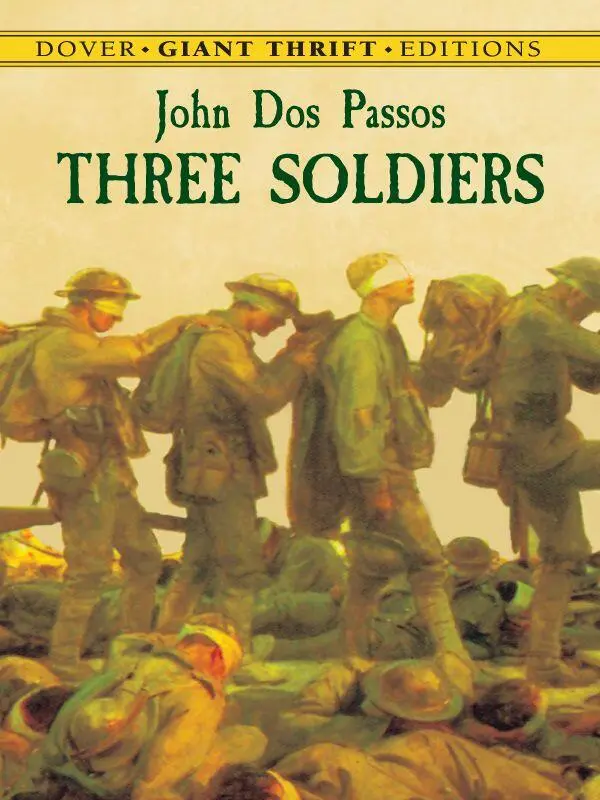
- Название:Three Soldiers
- Автор:
- Жанр:
- Год:неизвестен
- ISBN:нет данных
- Рейтинг книги:3 / 5. Голосов: 1
-
Избранное:Добавить в избранное
- Отзывы:
-
Ваша оценка:
Three Soldiers: краткое содержание, описание и аннотация
Предлагаем к чтению аннотацию, описание, краткое содержание или предисловие (зависит от того, что написал сам автор книги «Three Soldiers»). Если вы не нашли необходимую информацию о книге — напишите в комментариях, мы постараемся отыскать её.
Three Soldiers — читать онлайн бесплатно полную книгу (весь текст) целиком
Ниже представлен текст книги, разбитый по страницам. Система сохранения места последней прочитанной страницы, позволяет с удобством читать онлайн бесплатно книгу «Three Soldiers», без необходимости каждый раз заново искать на чём Вы остановились. Поставьте закладку, и сможете в любой момент перейти на страницу, на которой закончили чтение.
Интервал:
Закладка:
“From a fellow in Paris.”
“You’ve been to Paris, have you?” said Walters admiringly. “Is it the way they say it is? Gee, these French are immoral. Look at this woman here. She’ll sleep with a feller soon as not. Got a baby too!”
“But who do the applications go in to?”
“To the colonel, or whoever he appoints to handle it. You a Catholic?”
“No.”
“Neither am I. That’s the hell of it. The regimental sergeant-major is.”
“Well?”
“I guess you haven’t noticed the way things run up at divisional headquarters. It’s a regular cathedral. Isn’t a mason in it… But I must beat it… Better pretend you don’t know me if you meet me on the street; see?”
“All right.”
Walters hurried out of the door. Andrews sat alone looking at the flutter of little flames about the pile of sticks on the hearth, while he sipped chocolate from the warm bowl held between the palms of both hands.
He remembered a speech out of some very bad romantic play he had heard when he was very small.
“About your head I fling… the Cross of Ro-me.”
He started to laugh, sliding back and forth on the smooth bench which had been polished by the breeches of generations warming their feet at the fire. The red-faced woman stood with her hands on her hips looking at him in astonishment, while he laughed and laughed.
“Mais quelle gaité, quelle gaité,” she kept saying.
The straw under him rustled faintly with every sleepy movement Andrews made in his blankets. In a minute the bugle was going to blow and he was going to jump out of his blankets, throw on his clothes and fall into line for roll call in the black mud of the village street. It couldn’t be that only a month had gone by since he had got back from hospital. No, he had spent a lifetime in this village being dragged out of his warm blankets every morning by the bugle, shivering as he stood in line for roll call, shuffling in a line that moved slowly past the cookshack, shuffling along in another line to throw what was left of his food into garbage cans, to wash his mess kit in the greasy water a hundred other men had washed their mess kits in; lining up to drill, to march on along muddy roads, splattered by the endless trains of motor trucks; lining up twice more for mess, and at last being forced by another bugle into his blankets again to sleep heavily while a smell hung in his nostrils of sweating woolen clothing and breathed-out air and dusty blankets. In a minute the bugle was going to blow, to snatch him out of even these miserable thoughts, and throw him into an automaton under other men’s orders. Childish spiteful desires surged into his mind. If the bugler would only die. He could picture him, a little man with a broad face and putty-colored cheeks, a small rusty mustache and bow-legs lying like a calf on a marble slab in a butcher’s shop on top of his blankets. What nonsense! There were other buglers. He wondered how many buglers there were in the army. He could picture them all, in dirty little villages, in stone barracks, in towns, in great camps that served the country for miles with rows of black warehouses and narrow barrack buildings standing with their feet a little apart; giving their little brass bugles a preliminary tap before putting out their cheeks and blowing in them and stealing a million and a half (or was it two million or three million) lives, and throwing the warm sentient bodies into coarse automatons who must be kept busy, lest they grow restive, till killing time began again.
The bugle blew. With the last jaunty notes, a stir went through the barn.
Corporal Chrisfield stood on the ladder that led up from the yard, his head on a level with the floor shouting:
“Shake it up, fellers! If a guy’s late to roll call, it’s K.P. for a week.”
As Andrews, while buttoning his tunic, passed him on the ladder, he whispered:
“Tell me we’re going to see service again, Andy… Army o’ Occupation.” While he stood stiffly at attention waiting to answer when the sergeant called his name, Andrews’ mind was whirling in crazy circles of anxiety. What if they should leave before the General Order came on the University plan? The application would certainly be lost in the confusion of moving the Division, and he would be condemned to keep up this life for more dreary weeks and months. Would any years of work and happiness in some future existence make up for the humiliating agony of this servitude?
“Dismissed!”
He ran up the ladder to fetch his mess kit and in a few minutes was in line again in the rutted village street where the grey houses were just forming outlines as light crept slowly into the leaden sky, while a faint odor of bacon and coffee came to him, making him eager for food, eager to drown his thoughts in the heaviness of swiftly-eaten greasy food and in the warmth of watery coffee gulped down out of a tin-curved cup. He was telling himself desperately that he must do something-that he must make an effort to save himself, that he must fight against the deadening routine that numbed him.
Later, while he was sweeping the rough board floor of the company’s quarters, the theme came to him which had come to him long ago, in a former incarnation it seemed, when he was smearing windows with soap from a gritty sponge along the endless side of the barracks in the training camp. Time and time again in the past year he had thought of it, and dreamed of weaving it into a fabric of sound which would express the trudging monotony of days bowed under the yoke. “Under the Yoke”; that would be a title for it. He imagined the sharp tap of the conductor’s baton, the silence of a crowded hall, the first notes rasping bitterly upon the tense ears of men and women. But as he tried to concentrate his mind on the music, other things intruded upon it, blurred it. He kept feeling the rhythm of the Queen of Sheba slipping from the shoulders of her gaudily caparisoned elephant, advancing towards him through the torchlight, putting her hand, fantastic with rings and long gilded fingernails, upon his shoulders so that ripples of delight, at all the voluptuous images of his desire, went through his whole body, making it quiver like a flame with yearning for unimaginable things. It all muddled into fantastic gibberish-into sounds of horns and trombones and double basses blown off key while a piccolo shrilled the first bars of “The Star Spangled Banner.”
He had stopped sweeping and looked about him dazedly. He was alone. Outside, he heard a sharp voice call “Atten-shun!” He ran down the ladder and fell in at the end of the line under the angry glare of the lieutenant’s small eyes, which were placed very close together on either side of a lean nose, black and hard, like the eyes of a crab.
The company marched off through the mud to the drill field.
After retreat Andrews knocked at the door at the back of the Y.M.C.A., but as there was no reply, he strode off with a long, determined stride to Sheffield’s room.
In the moment that elapsed between his knock and an answer, he could feel his heart thumping. A little sweat broke out on his temples.
“Why, what’s the matter, boy? You look all wrought up,” said Sheffield, holding the door half open, and blocking, with his lean form, entrance to the room.
“May I come in? I want to talk to you,” said Andrews.
“Oh, I suppose it’ll be all right… You see I have an officer with me… ” then there was a flutter in Sheffield’s voice. “Oh, do come in”; he went on, with sudden enthusiasm. “Lieutenant Bleezer is fond of music too… Lieutenant, this is the boy I was telling you about. We must get him to play for us. If he had the opportunities, I am sure he’d be a famous musician.”
Lieutenant Bleezer was a dark youth with a hooked nose and pince-nez. His tunic was unbuttoned and he held a cigar in his hand. He smiled in an evident attempt to put this enlisted man at his ease.
Читать дальшеИнтервал:
Закладка:
Похожие книги на «Three Soldiers»
Представляем Вашему вниманию похожие книги на «Three Soldiers» списком для выбора. Мы отобрали схожую по названию и смыслу литературу в надежде предоставить читателям больше вариантов отыскать новые, интересные, ещё непрочитанные произведения.







Обсуждение, отзывы о книге «Three Soldiers» и просто собственные мнения читателей. Оставьте ваши комментарии, напишите, что Вы думаете о произведении, его смысле или главных героях. Укажите что конкретно понравилось, а что нет, и почему Вы так считаете.