John Passos - Three Soldiers
Здесь есть возможность читать онлайн «John Passos - Three Soldiers» весь текст электронной книги совершенно бесплатно (целиком полную версию без сокращений). В некоторых случаях можно слушать аудио, скачать через торрент в формате fb2 и присутствует краткое содержание. Жанр: Историческая проза, Детектив, на английском языке. Описание произведения, (предисловие) а так же отзывы посетителей доступны на портале библиотеки ЛибКат.
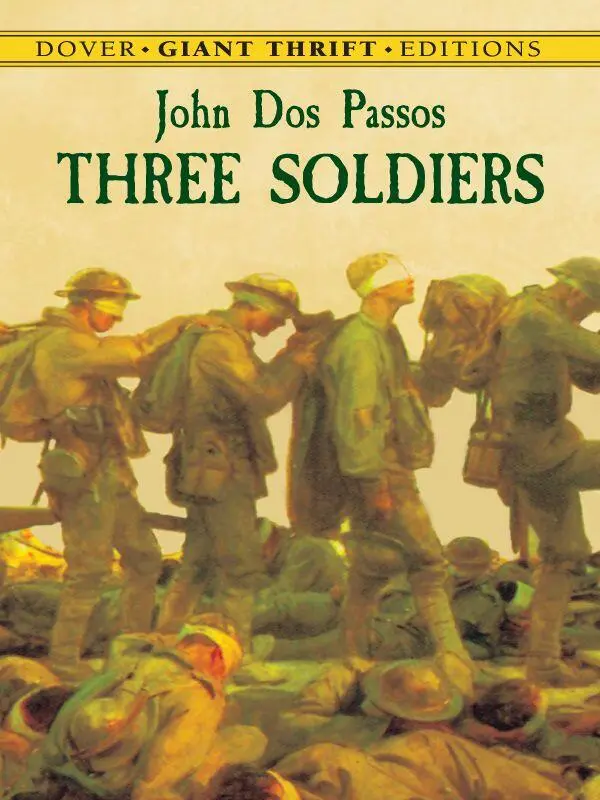
- Название:Three Soldiers
- Автор:
- Жанр:
- Год:неизвестен
- ISBN:нет данных
- Рейтинг книги:3 / 5. Голосов: 1
-
Избранное:Добавить в избранное
- Отзывы:
-
Ваша оценка:
Three Soldiers: краткое содержание, описание и аннотация
Предлагаем к чтению аннотацию, описание, краткое содержание или предисловие (зависит от того, что написал сам автор книги «Three Soldiers»). Если вы не нашли необходимую информацию о книге — напишите в комментариях, мы постараемся отыскать её.
Three Soldiers — читать онлайн бесплатно полную книгу (весь текст) целиком
Ниже представлен текст книги, разбитый по страницам. Система сохранения места последней прочитанной страницы, позволяет с удобством читать онлайн бесплатно книгу «Three Soldiers», без необходимости каждый раз заново искать на чём Вы остановились. Поставьте закладку, и сможете в любой момент перейти на страницу, на которой закончили чтение.
Интервал:
Закладка:
“Yes, I am very fond of music, modern music,” he said, leaning against the mantelpiece. “Are you a musician by profession?”
“Not exactly… nearly.” Andrews thrust his hands into the bottoms of his trouser pockets and looked from one to the other with a certain defiance.
“I suppose you’ve played in some orchestra? How is it you are not in the regimental band?”
“No, except the Pierian.”
“The Pierian? Were you at Harvard?”
Andrews nodded.
“So was I.”
“Isn’t that a coincidence?” said Sheffield. “I’m so glad I just insisted on your coming in.”
“What year were you?” asked Lieutenant Bleezer, with a faint change of tone, drawing a finger along his scant black moustache.
“Fifteen.”
“I haven’t graduated yet,” said the lieutenant with a laugh.
“What I wanted to ask you, Mr. Sheffield… ”
“Oh, my boy; my boy, you know you’ve known me long enough to call me Spence,” broke in Sheffield.
“I want to know,” went on Andrews speaking slowly, “can you help me to get put on the list to be sent to the University of Paris?… I know that a list has been made out, although the General Order has not come yet. I am disliked by most of the non-coms and I don’t see how I can get on without somebody’s help… I simply can’t go this life any longer.” Andrews closed his lips firmly and looked at the ground, his face flushing.
“Well, a man of your attainments certainly ought to go,” said Lieutenant Bleezer, with a faint tremor of hesitation in his voice. “I’m going to Oxford myself.”
“Trust me, my boy,” said Sheffield. “I’ll fix it up for you, I promise. Let’s shake hands on it.” He seized Andrews’s hand and pressed it warmly in a moist palm. “If it’s within human power, within human power,” he added.
“Well, I must go,” said Lieutenant Bleezer, suddenly striding to the door. “I promised the Marquise I’d drop in. Good-bye… Take a cigar, won’t you?” He held out three cigars in the direction of Andrews.
“No, thank you.”
“Oh, don’t you think the old aristocracy of France is just too wonderful? Lieutenant Bleezer goes almost every evening to call on the Marquise de Rompemouville. He says she is just too spirituelle for words… He often meets the Commanding Officer there.”
Andrews had dropped into a chair and sat with his face buried in his hands, looking through his fingers at the fire, where a few white fingers of flame were clutching intermittently at a grey beech log. His mind was searching desperately for expedients.
He got to his feet and shouted shrilly:
“I can’t go this life any more, do you hear that? No possible future is worth all this. If I can get to Paris, all right. If not, I’ll desert and damn the consequences.”
“But I’ve already promised I’ll do all I can… ”
“Well, do it now,” interrupted Andrews brutally.
“All right, I’ll go and see the colonel and tell him what a great musician you are.”
“Let’s go together, now.”
“But that’ld look queer, dear boy.”
“I don’t give a damn, come along… You can talk to him. You seem to be thick with all the officers.”
“You must wait till I tidy up,” said Sheffield.
“All right.”
Andrews strode up and down in the mud in front of the house, snapping his fingers with impatience, until Sheffield came out, then they walked off in silence.
“Now wait outside a minute,” whispered Sheffield when they came to the white house with bare grapevines over the front, where the colonel lived.
After a wait, Andrews found himself at the door of a brilliantly-lighted drawing room. There was a dense smell of cigar smoke. The colonel, an elderly man with a benevolent beard, stood before him with a coffee cup in his hand. Andrews saluted punctiliously.
“They tell me you are quite a pianist… Sorry I didn’t know it before,” said the colonel in a kindly tone. “You want to go to Paris to study under this new scheme?”
“Yes, sir.”
“What a shame I didn’t know before. The list of the men going is all made out… Of course perhaps at the last minute… if somebody else doesn’t go… your name can go in.”
The colonel smiled graciously and turned back into the room.
“Thank you, Colonel,” said Andrews, saluting.
Without a word to Sheffield, he strode off down the dark village street towards his quarters.
Andrews stood on the broad village street, where the mud was nearly dry, and a wind streaked with warmth ruffled the few puddles; he was looking into the window of the café to see if there was anyone he knew inside from whom he could borrow money for a drink. It was two months since he had had any pay, and his pockets were empty. The sun had just set on a premature spring afternoon, flooding the sky and the grey houses and the tumultuous tiled roofs with warm violet light. The faint premonition of the stirring of life in the cold earth, that came to Andrews with every breath he drew of the sparkling wind, stung his dull boredom to fury. It was the first of March, he was telling himself over and over again. The fifteenth of February, he had expected to be in Paris, free, or half-free; at least able to work. It was the first of March and here he was still helpless, still tied to the monotonous wheel of routine, incapable of any real effort, spending his spare time wandering like a lost dog up and down this muddy street, from the Y.M.C.A. hut at one end of the village to the church and the fountain in the middle, and to the Divisional Headquarters at the other end, then back again, looking listlessly into windows, staring in people’s faces without seeing them. He had given up all hope of being sent to Paris. He had given up thinking about it or about anything; the same dull irritation of despair droned constantly in his head, grinding round and round like a broken phonograph record.
After looking a long while in the window of the café of the Braves Alliés, he walked a little down the street and stood in the same position staring into, the Repos du Poilu, where a large sign “American spoken” blocked up half the window. Two officers passed. His hand snapped up to the salute automatically, like a mechanical signal. It was nearly dark. After a while he began to feel serious coolness in the wind, shivered and started to wander aimlessly down the street.
He recognized Walters coming towards him and was going to pass him without speaking when Walters bumped into him, muttered in his ear “Come to Baboon’s,” and hurried off with his swift business-like stride. Andrews stood irresolutely for a while with his head bent, then went with unresilient steps up the alley, through the hole in the hedge and into Babette’s kitchen. There was no fire. He stared morosely at the grey ashes until he heard Walters’s voice beside him:
“I’ve got you all fixed up.”
“What do you mean?”
“Mean… are you asleep, Andrews? They’ve cut a name off the school list, that’s all. Now if you shake a leg and somebody doesn’t get in ahead of you, you’ll be in Paris before you know it.”
“That’s damn decent of you to come and tell me.”
“Here’s your application,” said Walters, drawing a paper out of his pockets. “Take it to the colonel; get him to O. K. it and then rush it up to the sergeant-major’s office yourself. They are making out travel orders now. So long.”
Walters had vanished. Andrews was alone again, staring at the grey ashes. Suddenly he jumped to his feet and hurried off towards headquarters. In the anteroom to the colonel’s office he waited a long while, looking at his boots that were thickly coated with mud. “Those boots will make a bad impression; those boots will make a bad impression,” a voice was saying over and over again inside of him. A lieutenant was also waiting to see the colonel, a young man with pink cheeks and a milky-white forehead, who held his hat in one hand with a pair of khaki-colored kid gloves, and kept passing a hand over his light well-brushed hair. Andrews felt dirty and ill-smelling in his badly-fitting uniform. The sight of this perfect young man in his whipcord breeches, with his manicured nails and immaculately polished puttees exasperated him. He would have liked to fight him, to prove that he was the better man, to outwit him, to make him forget his rank and his important air… The lieutenant had gone in to see the colonel. Andrews found himself reading a chart of some sort tacked up on the wall. There were names and dates and figures, but he could not make out what it was about.
Читать дальшеИнтервал:
Закладка:
Похожие книги на «Three Soldiers»
Представляем Вашему вниманию похожие книги на «Three Soldiers» списком для выбора. Мы отобрали схожую по названию и смыслу литературу в надежде предоставить читателям больше вариантов отыскать новые, интересные, ещё непрочитанные произведения.









Обсуждение, отзывы о книге «Three Soldiers» и просто собственные мнения читателей. Оставьте ваши комментарии, напишите, что Вы думаете о произведении, его смысле или главных героях. Укажите что конкретно понравилось, а что нет, и почему Вы так считаете.