John Passos - Three Soldiers
Здесь есть возможность читать онлайн «John Passos - Three Soldiers» весь текст электронной книги совершенно бесплатно (целиком полную версию без сокращений). В некоторых случаях можно слушать аудио, скачать через торрент в формате fb2 и присутствует краткое содержание. Жанр: Историческая проза, Детектив, на английском языке. Описание произведения, (предисловие) а так же отзывы посетителей доступны на портале библиотеки ЛибКат.
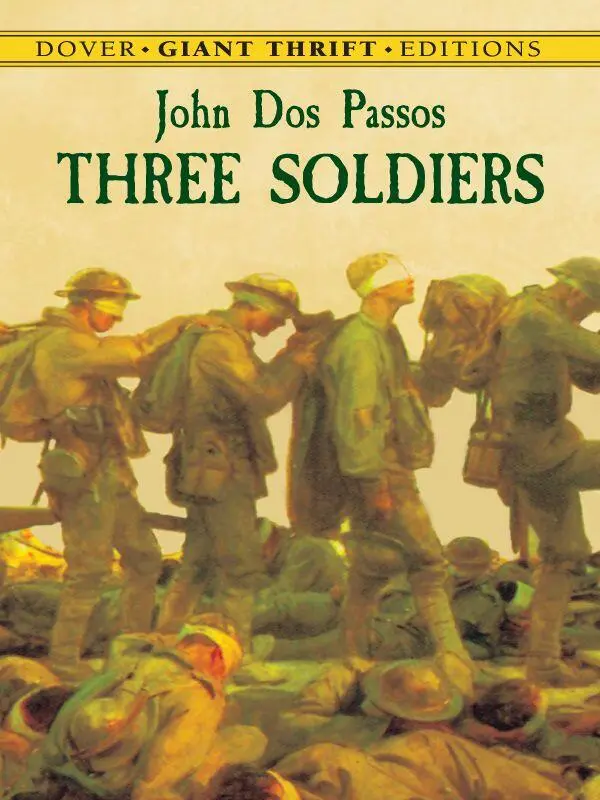
- Название:Three Soldiers
- Автор:
- Жанр:
- Год:неизвестен
- ISBN:нет данных
- Рейтинг книги:3 / 5. Голосов: 1
-
Избранное:Добавить в избранное
- Отзывы:
-
Ваша оценка:
Three Soldiers: краткое содержание, описание и аннотация
Предлагаем к чтению аннотацию, описание, краткое содержание или предисловие (зависит от того, что написал сам автор книги «Three Soldiers»). Если вы не нашли необходимую информацию о книге — напишите в комментариях, мы постараемся отыскать её.
Three Soldiers — читать онлайн бесплатно полную книгу (весь текст) целиком
Ниже представлен текст книги, разбитый по страницам. Система сохранения места последней прочитанной страницы, позволяет с удобством читать онлайн бесплатно книгу «Three Soldiers», без необходимости каждый раз заново искать на чём Вы остановились. Поставьте закладку, и сможете в любой момент перейти на страницу, на которой закончили чтение.
Интервал:
Закладка:
“All right! Go ahead,” whispered the orderly to him; and he was standing with his cap in his hand before the colonel who was looking at him severely, fingering the papers he had on the desk with a heavily veined hand.
Andrews saluted. The colonel made an impatient gesture.
“May I speak to you, Colonel, about the school scheme?”
“I suppose you’ve got permission from somebody to come to me.”
“No, sir.” Andrews’s mind was struggling to find something to say.
“Well, you’ld better go and get it.”
“But, Colonel, there isn’t time; the travel orders are being made out at this minute. I’ve heard that there’s been a name crossed out on the list.”
“Too late.”
“But, Colonel, you don’t know how important it is. I am a musician by trade; if I can’t get into practice again before being demobilized, I shan’t be able to get a job… I have a mother and an old aunt dependent on me. My family has seen better days, you see, sir. It’s only by being high up in my profession that I can earn enough to give them what they are accustomed to. And a man in your position in the world, Colonel, must know what even a few months of study in Paris mean to a pianist.”
The colonel smiled.
“Let’s see your application,” he said.
Andrews handed it to him with a trembling hand. The colonel made a few marks on one corner with a pencil.
“Now if you can get that to the sergeant-major in time to have your name included in the orders, well and good.”
Andrews saluted, and hurried out. A sudden feeling of nausea had come over him. He was hardly able to control a mad desire to tear the paper up. “God, Lord, Lord, Lord, Lord,” he muttered to himself. Still he ran all the way to the Square, isolated building where the regimental office was.
He stopped panting in front of the desk that bore the little red card, Regimental Sergeant-Major. The regimental sergeant-major looked up at him enquiringly.
“Here’s an application for School at the Sorbonne, Sergeant. Colonel Wilkins told me to run up to you with it, said he was very anxious to have it go in at once.”
“Too late,” said the regimental sergeant-major.
“But the colonel said it had to go in.”
“Can’t help it… Too late,” said the regimental sergeant-major.
Andrews felt the room and the men in their olive-drab shirt sleeves at the typewriters and the three nymphs creeping from behind the French War Loan poster whirl round his head. Suddenly he heard a voice behind him:
“Is the name Andrews, John, Sarge?”
“How the hell should I know?” said the regimental sergeant-major.
“Because I’ve got it in the orders already… I don’t know how it got in.” The voice was Walters’s voice, staccatto and business-like.
“Well, then, why d’you want to bother me about it? Give me that paper.” The regimental sergeant-major jerked the paper out of Andrews’s hand and looked at it savagely.
“All right, you leave tomorrow. A copy of the orders’ll go to your company in the morning,” growled the regimental sergeant-major.
Andrews looked hard at Walters as he went out, but got no glance in return. When he stood in the air again, disgust surged up within him, bitterer than before. The fury of his humiliation made tears start in his eyes. He walked away from the village down the main road, splashing carelessly through the puddles, slipping in the wet clay of the ditches. Something within him, like the voice of a wounded man swearing, was whining in his head long strings of filthy names. After walking a long while he stopped suddenly with his fists clenched. It was completely dark, the sky was faintly marbled by a moon behind the clouds. On both sides of the road rose the tall grey skeletons of poplars. When the sound of his footsteps stopped, he heard a faint lisp of running water. Standing still in the middle of the road, he felt his feelings gradually relax. He said aloud in a low voice several times: “You are a damn fool, John Andrews,” and started walking slowly and thoughtfully back to the village.
V
ANDREWS felt an arm put round his shoulder.
“Ah’ve been to hell an’ gone lookin’ for you, Andy,” said Chrisfield’s voice in his ear, jerking him out of the reverie he walked in. He could feel in his face Chrisfield’s breath, heavy with cognac.
“I’m going to Paris tomorrow, Chris,” said Andrews.
“Ah know it, boy. Ah know it. That’s why I was that right smart to talk to you… You doan want to go to Paris… Why doan ye come up to Germany with us? Tell me they live like kings up there.”
“All right,” said Andrews, “let’s go to the back room at Babette’s.”
Chrisfield hung on his shoulder, walking unsteadily beside him. At the hole in the hedge Chrisfield stumbled and nearly pulled them both down. They laughed, and still laughing staggered into the dark kitchen, where they found the red-faced woman with her baby sitting beside the fire with no other light than the flicker of the rare flames that shot up from a little mass of wood embers. The baby started crying shrilly when the two soldiers stamped in. The woman got up and, talking automatically to the baby all the while, went off to get a light and wine.
Andrews looked at Chrisfield’s face by the firelight. His cheeks had lost the faint childish roundness they had had when Andrews had first talked to him, sweeping up cigarette butts off the walk in front of the barracks at the training camp.
“Ah tell you, boy, you ought to come with us to Germany… nauthin’ but whores in Paris.”
“The trouble is, Chris, that I don’t want to live like a king, or a sergeant or a major-general… I want to live like John Andrews.”
“What yer goin’ to do in Paris, Andy?”
“Study music.”
“Ah guess some day Ah’ll go into a movie show an’ when they turn on the lights, who’ll Ah see but ma ole frien’ Andy raggin’ the scales on the pyaner.”
“Something like that… How d’you like being a corporal, Chris?”
“O, Ah doan know.” Chrisfield spat on the floor between his feet. “It’s funny, ain’t it? You an’ me was right smart friends onct… Guess it’s bein’ a non-com.”
Andrews did not answer.
Chrisfield sat silent with his eyes on the fire.
“Well, Ah got him… Gawd, it was easy,” he said suddenly.
“What do you mean?”
“Ah got him, that’s all.”
“You mean…?”
Chrisfield nodded.
“Um-hum, in the Oregon forest,” he said.
Andrews said nothing! He felt suddenly very tired. He thought of men he had seen in attitudes of death.
“Ah wouldn’t ha’ thought it had been so easy,” said Chrisfield.
The woman came through the door at the end of the kitchen with a candle in her hand. Chrisfield stopped speaking suddenly.
“Tomorrow I’m going to Paris,” cried Andrews boisterously. “It’s the end of soldiering for me.”
“Ah bet it’ll be some sport in Germany, Andy… Sarge says we’ll be goin’ up to Coab… what’s its name?”
“Coblenz.”
Chrisfield poured a glass of wine out and drank it off, smacking his lips after it and wiping his mouth on the back of his hand.
“D’ye remember, Andy, we was both of us brushin’ cigarette butts at that bloody trainin’ camp when we first met up with each other?”
“Considerable water has run under the bridge since then.”
“Ah reckon we won’t meet up again, mos’ likely.”
“Hell, why not?”
They were silent again, staring at the fading embers of the fire. In the dim edge of the candlelight the woman stood with her hands on her hips, looking at them fixedly.
“Reckon a feller wouldn’t know what do with himself if he did get out of the army, now, would he, Andy?”
Читать дальшеИнтервал:
Закладка:
Похожие книги на «Three Soldiers»
Представляем Вашему вниманию похожие книги на «Three Soldiers» списком для выбора. Мы отобрали схожую по названию и смыслу литературу в надежде предоставить читателям больше вариантов отыскать новые, интересные, ещё непрочитанные произведения.





Обсуждение, отзывы о книге «Three Soldiers» и просто собственные мнения читателей. Оставьте ваши комментарии, напишите, что Вы думаете о произведении, его смысле или главных героях. Укажите что конкретно понравилось, а что нет, и почему Вы так считаете.