John Passos - Three Soldiers
Здесь есть возможность читать онлайн «John Passos - Three Soldiers» весь текст электронной книги совершенно бесплатно (целиком полную версию без сокращений). В некоторых случаях можно слушать аудио, скачать через торрент в формате fb2 и присутствует краткое содержание. Жанр: Историческая проза, Детектив, на английском языке. Описание произведения, (предисловие) а так же отзывы посетителей доступны на портале библиотеки ЛибКат.
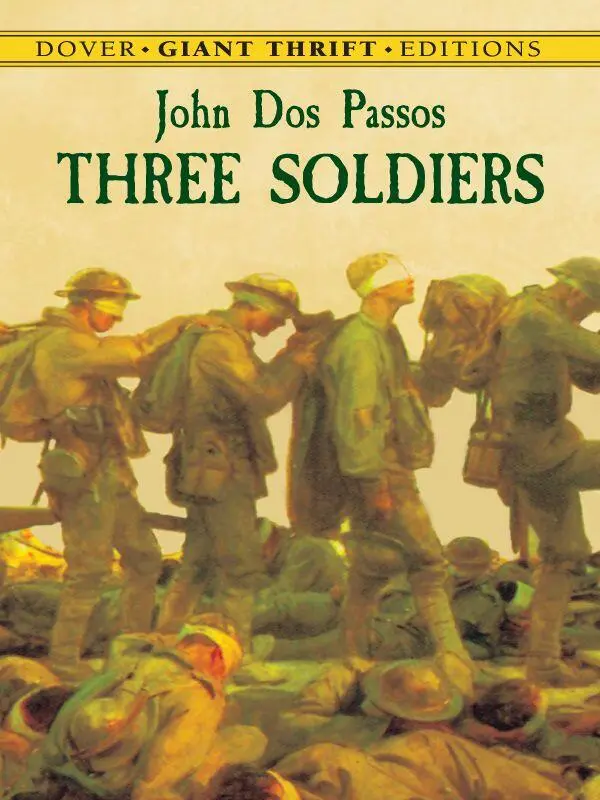
- Название:Three Soldiers
- Автор:
- Жанр:
- Год:неизвестен
- ISBN:нет данных
- Рейтинг книги:3 / 5. Голосов: 1
-
Избранное:Добавить в избранное
- Отзывы:
-
Ваша оценка:
Three Soldiers: краткое содержание, описание и аннотация
Предлагаем к чтению аннотацию, описание, краткое содержание или предисловие (зависит от того, что написал сам автор книги «Three Soldiers»). Если вы не нашли необходимую информацию о книге — напишите в комментариях, мы постараемся отыскать её.
Three Soldiers — читать онлайн бесплатно полную книгу (весь текст) целиком
Ниже представлен текст книги, разбитый по страницам. Система сохранения места последней прочитанной страницы, позволяет с удобством читать онлайн бесплатно книгу «Three Soldiers», без необходимости каждый раз заново искать на чём Вы остановились. Поставьте закладку, и сможете в любой момент перейти на страницу, на которой закончили чтение.
Интервал:
Закладка:
Henslowe took a gulp of wine and laughed uproariously.
“That’s the joke.”
They ate in silence for a little while. They could hear the couple opposite them talking in low soft voices. The stove purred, and from the kitchen came a sound of something being beaten in a bowl. Andrews leaned back in his chair.
“This is so wonderfully quiet and mellow,” he said… “It is so easy to forget that there’s any joy at all in life.”
“Rot… It’s a circus parade.”
“Have you ever seen anything drearier than a circus parade? One of those jokes that aren’t funny.”
“Justine, encore du vin,” called Henslowe.
“So you know her name?”
“I live here… The Butte is the boss on the middle of the shield. It’s the axle of the wheel. That’s why it’s so quiet, like the centre of a cyclone, of a vast whirling rotary circus parade!”
Justine, with her red hands that had washed so many dishes off which other people had dined well, put down between them a scarlet langouste, of which claws and feelers sprawled over the table-cloth that already had a few purplish stains of wine. The sauce was yellow and fluffy like the breast of a canary bird.
“D’you know,” said Andrews suddenly talking fast and excitedly while he brushed the straggling yellow hair off his forehead, “I’d almost be willing to be shot at the end of a year if I could live up here all that time with a piano and a million sheets of music paper… It would be worth it.”
“But this is a place to come back to. Imagine coming back here after the highlands of Thibet, where you’ld nearly got drowned and scalped and had made love to the daughter of an Afghan chief… who had red lips smeared with loukoumi so that the sweet taste stayed in your mouth.” Henslowe stroked softly his little brown mustache.
“But what’s the use of just seeing and feeling things if you can’t express them?”
“What’s the use of living at all? For the fun of it, man; damn ends.”
“But the only profound fun I ever have is that… ” Andrews’s voice broke. “O God, I would give up every joy in the world if I could turn out one page that I felt was adequate… D’you know it’s years since I’ve talked to anybody?”
They both stared silently out of the window at the fog that was packed tightly against it like cotton wool, only softer, and a greenish-gold color.
“The M.P.’s sure won’t get us tonight,” said Henslowe, banging his fist jauntily on the table. “I’ve a great mind to go to Rue St. Anne and leave my card on the Provost Marshall… God damn! D’you remember that man who took the bite out of our wine-bottle?… He didn’t give a hoot in hell, did he? Talk about expression. Why don’t you express that? I think that’s the turning point of your career. That’s what made you come to Paris; you can’t deny it.”
They both laughed loudly rolling about on their chairs. Andrews caught glints of contagion in the pale violet eyes of the lame boy and in the dark eyes of the girl.
“Let’s tell them about it,” he said still laughing, with his face, bloodless after the months in hospital, suddenly flushed.
“Salut,” said Henslowe turning round and elevating his glass. “Nous rions parceque nous sommes gris de vin gris.” Then he told them about the man who ate glass. He got to his feet and recounted slowly in his drawling voice, with gestures. Justine stood by with a dish full of stuffed tomatoes of which the red skins showed vaguely through a mantle of dark brown sauce. When she smiled her cheeks puffed out and gave her face a little of the look of a white cat’s.
“And you live here?” asked Andrews after they had all laughed.
“Always. It is not often that I go down to town… It’s so difficult… I have a withered leg.” He smiled brilliantly like a child telling about a new toy.
“And you?”
“How could I be anywhere else?” answered the girl. “It’s a misfortune, but there it is.” She tapped with the crutch on the floor, making a sound like someone walking with it. The boy laughed and tightened his arm round her shoulder.
“I should like to live here,” said Andrews simply.
“Why don’t you?”
“But don’t you see he’s a soldier,” whispered the girl hurriedly.
A frown wrinkled the boy’s forehead.
“Well, it wasn’t by choice, I suppose,” he said.
Andrews was silent. Unaccountable shame took possession of him before these people who had never been soldiers, who would never be soldiers.
“The Greeks used to say,” he said bitterly, using a phrase that had been a long time on his mind, “that when a man became a slave, on the first day he lost one-half of his virtue.”
“When a man becomes a slave,” repeated the lame boy softly, “on the first day he loses one-half of his virtue.”
“What’s the use of virtue? It is love you need,” said the girl.
“I’ve eaten your tomato, friend Andrews,” said Henslowe. “Justine will get us some more.” He poured out the last of the wine that half filled each of the glasses with its thin sparkle, the color of red currants.
Outside the fog had blotted everything out in even darkness which grew vaguely yellow and red near the sparsely scattered street lamps. Andrews and Henslowe felt their way blindly down the long gleaming flights of steps that led from the quiet darkness of the Butte towards the confused lights and noises of more crowded streets. The fog caught in their throats and tingled in their noses and brushed against their cheeks like moist hands.
“Why did we go away from that restaurant? I’d like to have talked to those people some more,” said Andrews.
“We haven’t had any coffee either… But, man, we’re in Paris. We’re not going to be here long. We can’t afford to stay all the time in one place… It’s nearly closing time already… ”
“The boy was a painter. He said he lived by making toys; he whittles out wooden elephants and camels for Noah’s Arks… Did you hear that?”
They were walking fast down a straight, sloping street. Below them already appeared the golden glare of a boulevard.
Andrews went on talking, almost to himself.
“What a wonderful life that would be to live up here in a small room that would overlook the great rosy grey expanse of the city, to have some absurd work like that to live on, and to spend all your spare time working and going to concerts… A quiet mellow existence… Think of my life beside it. Slaving in that iron, metallic, brazen New York to write ineptitudes about music in the Sunday paper. God! And this.”
They were sitting down at a table in a noisy café, full of yellow light flashing in eyes and on glasses and bottles, of red lips crushed against the thin hard rims of glasses.
“Wouldn’t you like to just rip it off?” Andrews jerked at his tunic with both hands where it bulged out over his chest. “Oh, I’d like to make the buttons fly all over the café, smashing the liqueur glasses, snapping in the faces of all those dandified French officers who look so proud of themselves that they survived long enough to be victorious.”
“The coffee’s famous here,” said Henslowe. “The only place I ever had it better was at a bistro in Nice on this last permission.”
“Somewhere else again!”
“That’s it… For ever and ever, somewhere else! Let’s have some prunelle. Before the war prunelle.”
The waiter was a solemn man, with a beard cut like a prime minister’s. He came with the bottle held out before him, religiously lifted. His lips pursed with an air of intense application, while he poured the white glinting liquid into the glasses. When he had finished he held the bottle upside down with a tragic gesture; not a drop came out.
Читать дальшеИнтервал:
Закладка:
Похожие книги на «Three Soldiers»
Представляем Вашему вниманию похожие книги на «Three Soldiers» списком для выбора. Мы отобрали схожую по названию и смыслу литературу в надежде предоставить читателям больше вариантов отыскать новые, интересные, ещё непрочитанные произведения.




Обсуждение, отзывы о книге «Three Soldiers» и просто собственные мнения читателей. Оставьте ваши комментарии, напишите, что Вы думаете о произведении, его смысле или главных героях. Укажите что конкретно понравилось, а что нет, и почему Вы так считаете.