John Passos - Three Soldiers
Здесь есть возможность читать онлайн «John Passos - Three Soldiers» весь текст электронной книги совершенно бесплатно (целиком полную версию без сокращений). В некоторых случаях можно слушать аудио, скачать через торрент в формате fb2 и присутствует краткое содержание. Жанр: Историческая проза, Детектив, на английском языке. Описание произведения, (предисловие) а так же отзывы посетителей доступны на портале библиотеки ЛибКат.
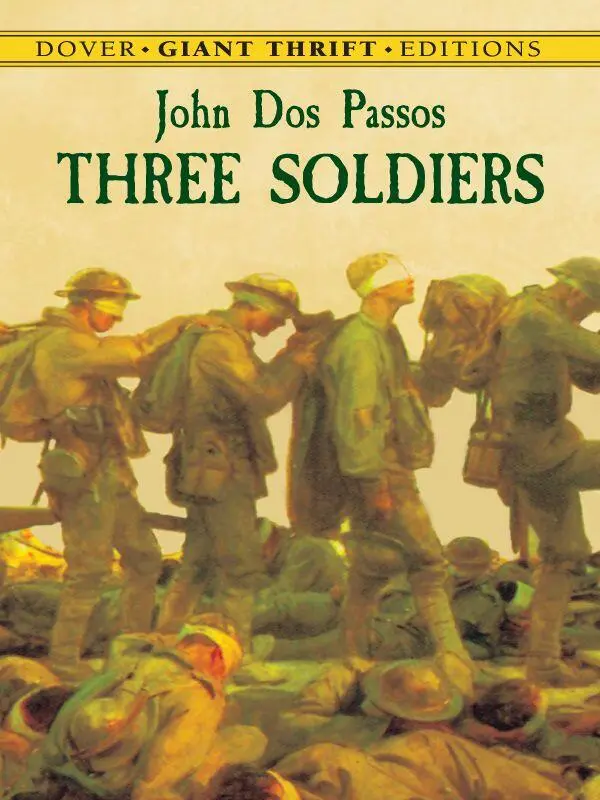
- Название:Three Soldiers
- Автор:
- Жанр:
- Год:неизвестен
- ISBN:нет данных
- Рейтинг книги:3 / 5. Голосов: 1
-
Избранное:Добавить в избранное
- Отзывы:
-
Ваша оценка:
Three Soldiers: краткое содержание, описание и аннотация
Предлагаем к чтению аннотацию, описание, краткое содержание или предисловие (зависит от того, что написал сам автор книги «Three Soldiers»). Если вы не нашли необходимую информацию о книге — напишите в комментариях, мы постараемся отыскать её.
Three Soldiers — читать онлайн бесплатно полную книгу (весь текст) целиком
Ниже представлен текст книги, разбитый по страницам. Система сохранения места последней прочитанной страницы, позволяет с удобством читать онлайн бесплатно книгу «Three Soldiers», без необходимости каждый раз заново искать на чём Вы остановились. Поставьте закладку, и сможете в любой момент перейти на страницу, на которой закончили чтение.
Интервал:
Закладка:
“God, I’d like to have wrung that damn little parson’s neck,” said Andrews suddenly.
“Would you?” The legless man turned brown eyes on Andrews with a smile. “I guess he’s about as much to blame as anybody is… guys like him… I guess they have that kind in Germany, too.”
“You don’t think we’ve made the world quite as safe for Democracy as it might be?” said Andrews in a low voice.
“Hell, how should I know? I bet you never drove an ice wagon… I did, all one summer down home… It was some life. Get up at three o’clock in the morning an’ carry a hundred or two hundred pounds of ice into everybody’s ice box. That was the life to make a feller feel fit. I was goin’ around with a big Norwegian named Olaf, who was the strongest man I ever knew. An’ drink! He was the boy could drink. I once saw him put away twenty-five dry Martini cocktails an’ swim across the lake on top of it… I used to weigh a hundred and eighty pounds, and he could pick me up with one hand and put me across his shoulder… That was the life to make a feller feel fit. Why, after bein’ out late the night before, we’d jump up out of bed at three o’clock feeling springy as a cat.”
“What’s he doing now?” asked Andrews. “He died on the transport coming ’cross here. Died o’ the flu… I met a feller came over in his regiment. They dropped him overboard when they were in sight of the Azores… Well, I didn’t die of the flu. Have another butt?”
“No, thanks,” said Andrews.
They were silent. The fire roared in the stove. No one was talking. The men lolled in chairs somnolently. Now and then someone spat. Outside of the window Andrews could see the soft white dancing of the snowflakes. His limbs felt very heavy; his mind was permeated with dusty stagnation like the stagnation of old garrets and lumber rooms, where, among superannuated bits of machinery and cracked grimy crockery, lie heaps of broken toys.
John Andrews sat on a bench in a square full of linden trees, with the pale winter sunshine full on his face and hands. He had been looking up through his eyelashes at the sun, that was the color of honey, and he let his dazzled glance sink slowly through the black lacework of twigs, down the green trunks of the trees to the bench opposite where sat two nursemaids and, between them, a tiny girl with a face daintily colored and lifeless like a doll’s face, and a frilled dress under which showed small ivory knees and legs encased in white socks and yellow sandals. Above the yellow halo of her hair floated, with the sun shining through it, as through a glass of claret, a bright carmine balloon which the child held by a string. Andrews looked at her for a long time, enraptured by the absurd daintiness of the figure between the big bundles of flesh of the nursemaids. The thought came to him suddenly that months had gone by, — was it only months? — since his hands had touched anything soft, since he had seen any flowers. The last was a flower an old woman had given him in a village in the Argonne, an orange marigold, and he remembered how soft the old woman’s withered lips had been against his cheek when she had leaned over and kissed him. His mind suddenly lit up, as with a strain of music, with a sense of the sweetness of quiet lives worn away monotonously in the fields, in the grey streets of little provincial towns, in old kitchens full of fragrance of herbs and tang of smoke from the hearth, where there are pots on the windowsill full of basil in flower.
Something made him go up to the little girl and take her hand. The child, looking up suddenly and seeing a lanky soldier with pale lean face and light, straw-colored hair escaping from under a cap too small for him, shrieked and let go the string of the balloon, which soared slowly into the air trembling a little in the faint cool wind that blew. The child wailed dismally, and Andrews, quailing under the furious glances of the nursemaids, stood before her, flushed crimson, stammering apologies, not knowing what to do. The white caps of the nursemaids bent over and ribbons fluttered about the child’s head as they tried to console her. Andrews walked away dejectedly, now and then looking up at the balloon, which soared, a black speck against the grey and topaz-colored clouds.
“Sale Américain,” he heard one nursemaid exclaim to the other.
But this was the first hour in months he had had free, the first moment of solitude; he must live; soon he would be sent back to his division. A wave of desire for furious fleshly enjoyments went through him, making him want steaming dishes of food drenched in rich, spice-flavored sauces; making him want to get drunk on strong wine; to roll on thick carpets in the arms of naked, libidinous women. He was walking down the quiet grey street of the provincial town, with its low houses with red chimney pots, and blue slate roofs and its irregular yellowish cobbles. A clock somewhere was striking four with deep booming strokes. Andrews laughed. He had to be in hospital at six.
Already he was tired; his legs ached.
The window of a pastry shop appeared invitingly before him, denuded as it was by wartime. A sign in English said: “Tea.” Walking in, he sat down in a fussy little parlor where the tables had red cloths, and a print, in pinkish and greenish colors, hung in the middle of the imitation brocade paper of each wall. Under a print of a poster bed with curtains in front of which eighteen to twenty people bowed, with the title of “Secret d’Amour,” sat three young officers, who cast cold, irritated glances at this private with a hospital badge on who invaded their tea shop. Andrews stared back at them, flaming with dull anger.
Sipping the hot, fragrant tea, he sat with a blank sheet of music paper before him, listening in spite of himself to what the officers were saying. They were talking about Ronsard. It was with irritated surprise that Andrews heard the name. What right had they to be talking about Ronsard? He knew more about Ronsard than they did. Furious, conceited phrases kept surging up in his mind. He was as sensitive, as humane, as intelligent, as well-read as they were; what right had they to the cold suspicious glance with which they had put him in his place when he had come into the room? Yet that had probably been as unconscious, as unavoidable as was his own biting envy. The thought that if one of those men should come over to him, he would have to stand up and salute and answer humbly, not from civility, but from the fear of being punished, was bitter as wormwood, filled him with a childish desire to prove his worth to them, as when older boys had ill-treated him at school and he had prayed to have the house burn down so that he might heroically save them all. There was a piano in an inner room, where in the dark the chairs, upside down, perched dismally on the table tops. He almost obeyed an impulse to go in there and start playing, by the brilliance of his playing to force these men, who thought of him as a coarse automaton, something between a man and a dog, to recognize him as an equal, a superior.
“But the war’s over. I want to start living. Red wine, the nightingale cries to the rose,” said one of the officers.
“What do you say we go A.W.O.L. to Paris?”
“Dangerous.”
“Well, what can they do? We are not enlisted men; they can only send us home. That’s just what I want.”
“I’ll tell you what; we’ll go to the Cochon Bleu and have a cocktail and think about it.”
“The lion and the lizard keep their courts where… what the devil was his name? Anyway, we’ll glory and drink deep, while Major Peabody keeps his court in Dijon to his heart’s content.”
Spurs jingled as the three officers went out. A fierce disgust took possession of John Andrews. He was ashamed of his spiteful irritation. If, when he had been playing the piano to a roomful of friends in New York, a man dressed as a laborer had shambled in, wouldn’t he have felt a moment of involuntary scorn? It was inevitable that the fortunate should hate the unfortunate because they feared them. But he was so tired of all those thoughts. Drinking down the last of his tea at a gulp, he went into the shop to ask the old woman, with little black whiskers over her bloodless lips, who sat behind the white desk at the end of the counter, if she minded his playing the piano.
Читать дальшеИнтервал:
Закладка:
Похожие книги на «Three Soldiers»
Представляем Вашему вниманию похожие книги на «Three Soldiers» списком для выбора. Мы отобрали схожую по названию и смыслу литературу в надежде предоставить читателям больше вариантов отыскать новые, интересные, ещё непрочитанные произведения.










Обсуждение, отзывы о книге «Three Soldiers» и просто собственные мнения читателей. Оставьте ваши комментарии, напишите, что Вы думаете о произведении, его смысле или главных героях. Укажите что конкретно понравилось, а что нет, и почему Вы так считаете.