Wu Ming - 54
Здесь есть возможность читать онлайн «Wu Ming - 54» весь текст электронной книги совершенно бесплатно (целиком полную версию без сокращений). В некоторых случаях можно слушать аудио, скачать через торрент в формате fb2 и присутствует краткое содержание. Год выпуска: 2006, Издательство: Houghton Mifflin Harcourt, Жанр: Историческая проза, на английском языке. Описание произведения, (предисловие) а так же отзывы посетителей доступны на портале библиотеки ЛибКат.
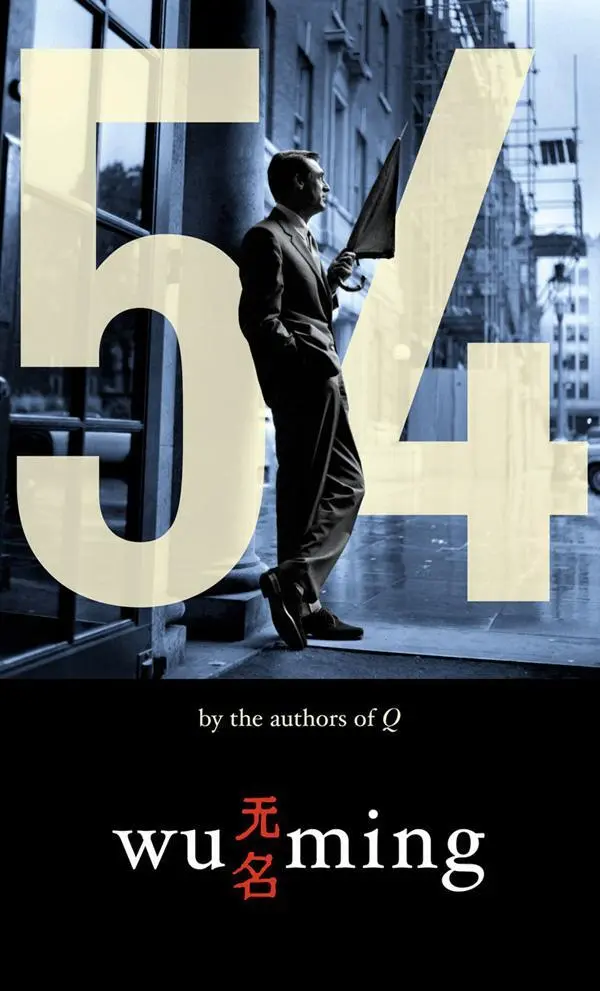
- Название:54
- Автор:
- Издательство:Houghton Mifflin Harcourt
- Жанр:
- Год:2006
- ISBN:нет данных
- Рейтинг книги:5 / 5. Голосов: 1
-
Избранное:Добавить в избранное
- Отзывы:
-
Ваша оценка:
54: краткое содержание, описание и аннотация
Предлагаем к чтению аннотацию, описание, краткое содержание или предисловие (зависит от того, что написал сам автор книги «54»). Если вы не нашли необходимую информацию о книге — напишите в комментариях, мы постараемся отыскать её.
Set during the height of the Cold War-with the world divided into East and West-54 features Italian partisans, KGB agents, Parisian lowlifes, and cameos by David Niven, Marshal Tito, and Grace Kelly. Wu Ming brings us a cinematic romp that is by turns edgy social satire and modern comic send up.
54 — читать онлайн бесплатно полную книгу (весь текст) целиком
Ниже представлен текст книги, разбитый по страницам. Система сохранения места последней прочитанной страницы, позволяет с удобством читать онлайн бесплатно книгу «54», без необходимости каждый раз заново искать на чём Вы остановились. Поставьте закладку, и сможете в любой момент перейти на страницу, на которой закончили чтение.
Интервал:
Закладка:
‘Wait, Robespierre, let me think.’ He sipped his grappa calmly, as though hoping to draw inspiration from it. ‘Listen. Tonight you can sleep here, ok? Tomorrow morning, very early, I must go down to Split, with my cart. If we’re very careful, I can take you with me. At the market in Split we ask friend with lorry if he’s going to Dubrovnik, this much better than coach. Then from Dubrovnik you ask someone, some fisherman, to take you
Sipan, because no ferry, understand?’
‘I understand,’ said Pierre and his stomach rebelled at the mere thought of another crossing. ‘Thanks, Darko. I don’t know how to thank you. Everyone else here was afraid to speak. You weren’t. How come?’
‘If someone was looking for me, Vittorio he do the same. I saw you asking and I knew you were friend. Then when you said the son, then I had to help.’
Pierre ate some cheese and a few olives. He wondered if Sipan would be his destination, or just another stage on the journey. He devoured every last crumb on his plate and asked again, ‘What else can you tell me about my father? I’ve had no news of him for months now. He hasn’t written for a year, and my last letter was sent back to me.’
Darko got up again, disappeared out the back door and reappeared a moment later with a wooden box in his hands. He opened it on the table and pulled out some newspaper cuttings, which he gradually spread out in front of Pierre. He picked up the last one. It was written in Italian. Signed by Vittorio Capponi.
‘Article by your father for Italian newspaper in Zadar. These two also by your father, for other newspaper, in Slavonic language. And these others, they are by Milovan Djilas, for the Borba , the Party newspaper. You know Milovan Djilas?’
Pierre looked up from the article. ‘I know he’s a dissident, that he was expelled by Tito.’
‘That’s right,’ Darko replied. ‘At October last year he start writing these articles. At December elected as President of Skupstina. Two weeks later, trial begin against him. Not expelled, that is Stalin’s thing and Tito does not want, but forced into self-criticism.’
‘And what about my father?’
‘Your father write that Djilas says many true things. Others not, but many are right. Then towards the end of January they come and take him to Split. No trial, for him: they say he expelled, enough of his work, he must not express his ideas any more, better he go away, far away, where no one know him. They treat Djilas better than anyone less important. Djilas too famous, must be careful. Luckily he does self-criticism, otherwise much worse for his comrades.’
Pierre read a few more lines. An Italian translation of Djilas’s article ‘New Contents’, with the addition of a brief commentary. He reached the end, while Darko put another piece of cheese and some more bread on the table.
‘What happened then?’ Pierre asked when he had finished reading.
‘Afterwards? Your father stayed on his own, people stopped talking to him. No work, and in Split no one wanted him. He was afraid they take him to Goli Otok, the prison camp for friends of Stalin. One day he tell me he want to die. Then instead he leave. Fishes, looks after sheep, and can live on partisan pension. But I don’t know much, he phoned one time, then nothing.’
Darko bowed his head and ran the back of his hand over an eye. ‘He was my only friend,’ he said in a breath. He tried to go on, but all that came out was, ‘Sorry.’
Then he picked up the articles, quickly closed the box and disappeared once more through the back door.
Chapter 39
Naples, 17 April
It was a relief to walk along the road, in the sunlight, amidst the hubbub of the people, and the shoving and the shouts. After three months in jail, Salvatore Pagano, known as Kociss, only wanted to run. Three months they’d kept him in there! In that dirty, disgusting prison, full of stinking murderers, and Commissioner Cinquegrana firing questions at him, and the television, and the money, and Don Luciano, and this one and that one. Now, finally, he breathed, he looked at the sky, and the women. He thought about all the things he would do. Three months of recuperation. He had the money, they hadn’t been able to take it from him. Honest earnings. With that money he would get a present for Lisetta, a nice present, and at that point she would be sure to let him have what he was after, on a silver platter. Because he hadn’t given her name to the commissioner, no, he hadn’t done that. No names. The policeman had yet to be born who would make a fool of Kociss. But he had got scared in that nick. Pretty damned scared. It was as if they wanted him to tell them everything, as if he was a big player, as if he knew things. Absolute silence. He’d given them nothing. What would the commissioner think if he knew the truth? Neither nuns nor charity that night. Oh heavens, yes, he’d been giving presents to the little orphans, then he had taken his bike, the one with the platform on the front and gone to see Lisetta. What a woman she was!
He stopped by the window of a clothes shop, and saw a beautiful red dress. She’d look like a dream in that. He saw his reflection in the window: he could do with some new clothes too, what with these rags he was wearing. But that could come later. First he had to sort out the most important thing, otherwise he would have put in all that effort for nothing. But the thought of Lisetta wouldn’t leave him alone for a moment, he wanted to stop someone in the street and tell him what she was like, and then if he got annoyed, just hand him one of Don Luciano’s banknotes, easy, now, easy, my friend, I’ll pay you for your time.
Ah, Lisetta. He really did like her. Apart from her job, but what are you going to do, no one’s perfect. When she asked him a favour, with those green eyes of hers and all that hair, and her mouth, and so on, he couldn’t say no. Like that evening when it was cold, and she had asked him to come with her to the American base. And then — once he’d left the orphans — take the bike and go and pick up Lisetta. And pedal, with all that perfume and her hair flapping in your face, pedal away, nearly killing yourself as you take a bend, and her skirt sliding up, and her leg dangling from the platform. It was really driving him out of his mind. Nothing to be done. Lisetta was Lisetta.
He crossed the street without looking and someone beeped his horn. Pagano replied with a loud and liberating insult and strode on.
That evening he had worked out where she was going. To make love with that American officer. She only had to bat her eyelids and he started chucking the money around like he was King of Catalonia. He was due something too, for the journey and the effort. But it was his own fault if he hadn’t had his compensation. Because once he had got to the base, with all that cycling and the perfume and the legs and the hair, and what Lisetta was going to do, he had said to himself, ‘Kociss, you’ve got to have some kind of payment for all your effort, and for your broken heart as well.’ And while he was thinking those things, the payment had appeared before his very eyes, as though the Madonna had been reading his mind.
Great brute of a thing it was, would it fit on the platform? Wouldn’t it bring him and the bike crashing to the ground? And would the tarpaulin be big enough to hide it? And what if the Military Police showed up? Would they shoot him? Don’t be crazy. He had to hurry. Someone might come. They would kick seven shades of shite out of him.
In the end he had been encouraged by a man dressed as a general, pinned to the wall in a photograph, right in front of him. He was smiling. And he was giving the thumbs up, as if to say, ‘Ok, son, go ahead!’ He was right, he would have to be paid. He had taken it. For Lisetta.
Читать дальшеИнтервал:
Закладка:
Похожие книги на «54»
Представляем Вашему вниманию похожие книги на «54» списком для выбора. Мы отобрали схожую по названию и смыслу литературу в надежде предоставить читателям больше вариантов отыскать новые, интересные, ещё непрочитанные произведения.








Обсуждение, отзывы о книге «54» и просто собственные мнения читателей. Оставьте ваши комментарии, напишите, что Вы думаете о произведении, его смысле или главных героях. Укажите что конкретно понравилось, а что нет, и почему Вы так считаете.