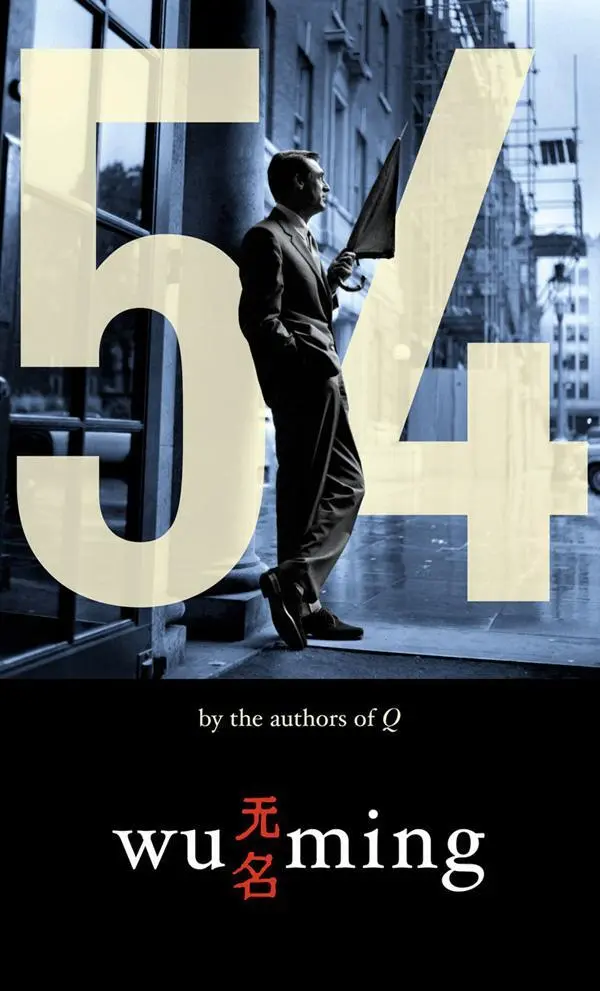
Wu Ming - 54
Здесь есть возможность читать онлайн «Wu Ming - 54» весь текст электронной книги совершенно бесплатно (целиком полную версию без сокращений). В некоторых случаях можно слушать аудио, скачать через торрент в формате fb2 и присутствует краткое содержание. Год выпуска: 2006, Издательство: Houghton Mifflin Harcourt, Жанр: Историческая проза, на английском языке. Описание произведения, (предисловие) а так же отзывы посетителей доступны на портале библиотеки ЛибКат.
- Название:54
- Автор:
- Издательство:Houghton Mifflin Harcourt
- Жанр:
- Год:2006
- ISBN:нет данных
- Рейтинг книги:5 / 5. Голосов: 1
-
Избранное:Добавить в избранное
- Отзывы:
-
Ваша оценка:
54: краткое содержание, описание и аннотация
Предлагаем к чтению аннотацию, описание, краткое содержание или предисловие (зависит от того, что написал сам автор книги «54»). Если вы не нашли необходимую информацию о книге — напишите в комментариях, мы постараемся отыскать её.
Set during the height of the Cold War-with the world divided into East and West-54 features Italian partisans, KGB agents, Parisian lowlifes, and cameos by David Niven, Marshal Tito, and Grace Kelly. Wu Ming brings us a cinematic romp that is by turns edgy social satire and modern comic send up.
54 — читать онлайн бесплатно полную книгу (весь текст) целиком
Ниже представлен текст книги, разбитый по страницам. Система сохранения места последней прочитанной страницы, позволяет с удобством читать онлайн бесплатно книгу «54», без необходимости каждый раз заново искать на чём Вы остановились. Поставьте закладку, и сможете в любой момент перейти на страницу, на которой закончили чтение.
Интервал:
Закладка:
He had said goodbye to everything he loved. Angela had told him not to go. ‘You’re crazy, Pierre, if they put you in prison there, you’ll never get out.’ She had reminded him about Odoacre’s conference, a fortnight all to themselves, at the end of April. ‘Now of all times you had to decide to leave!’ But she hadn’t been able to give him a real reason to stay. She couldn’t, when she was so stuck in her own life: her husband on the one side, her brother on the other. And Pierre in the middle. ‘I love you, Pierre. I will always love you. Even when you decided to stop seeing me.’ To stop seeing her. He was in love with Angela. Every time he had thought of putting an end to the relationship, his stomach had tightened and he hadn’t been able to do anything.
‘You men deceive yourselves, and for your self-deceptions you destroy everything. I can’t leave my husband, you know. Love is a luxury for the rich. And you and I aren’t rich, Pierre.’ But perhaps everything would change now. After his journey, he would be a different person. Stronger. Perhaps he would also find the strength to say goodbye to Angela. As he tossed and turned on the filthy camp bed, Pierre thought that this journey would give him the strength to clear the situation.
It wasn’t flight. It was like the Odyssey that his father had told him as a child, on those long evenings by the fire. His father was Ulysses, he had left all those years before to fight a war that wasn’t his, and had never come back. And Pierre was Telemachus. That was how the story began: a son setting off in search of the father he had never known.
Someone shook him and he started awake.
‘It’s time to go.’
Robinson had two guns on shoulder belts: the rifle and a Thompson submachine-gun, like the one that Nicola had in the cellar.
Pierre leapt out of bed and picked up his case.
Robinson picked up one of the two cans. ‘You take the other one.’
It was heavy, but he pretended it wasn’t. He followed the man out of the shack.
They walked in the dense darkness, along a path that ran through the pine forest.
When Robinson stopped, Pierre nearly crashed into him with all his weight. He kept his balance, and managed to glimpse a little inlet in the canal, where it widened to reach the sea.
The boat was smaller than he had expected. He was frightened, and about to confess that he couldn’t swim. He held his tongue. It wasn’t the moment to show that he was afraid. They climbed aboard. As Robinson started the engine, Pierre looked towards the sea. The night showed him nothing.
Chapter 36
Adriatic Sea, 16 April
Nothing.
Spasms shook his stomach and his throat, but by now there was nothing left to come out.
Robinson, sitting solidly at the stern, by the engine, didn’t react; the spray licked at him as he bobbed with the rhythm of the waves, but he kept hold of the rudder. Every now and again he consulted the compass, then went back to staring straight ahead once more, as though he could see the route ahead of them.
Pierre wiped his mouth with the sleeve of his coat and thought that if he could get through this crossing, everything else would be a stroll in the park. He gritted his teeth and anchored himself more firmly in his seat.
He would have liked to speak, not to think about his nausea, but the boatman wasn’t the right person.
He decided to try anyway, shouting over the noise of the wind. ‘Why do they call you Robinson?’
Silence.
He thought he hadn’t heard him, but when he was about to raise his voice, the reply arrived from stern: ‘Because I look after myself, like Robinson Crusoe.’
The tone was less dry than usual. Perhaps the boredom of the journey was getting to Robinson as well.
Pierre decided to try again. ‘Ettore told me you were a partisan. Were you in the 28th?’
‘No. But I lent Bulow a hand.’
‘Were you in the Battle of the Valleys?’
The reply came back sharply: ‘I took them into the valleys.’
‘Seriously? Did you get a medal?’
The wind carried away his reply.
‘What?’
Robinson raised his voice. ‘What would I want with a medal?’
Pierre didn’t know what to add. He said, ‘My brother was a partisan as well. Up by Imola, in the 36th. He got a silver medal.’ Silence. ‘Did you kill any Germans?’
Robinson raised his hand with four fingers raised. Talking made Pierre feel better, his nausea had subsided.
‘And how was it?’
Silence again. For a moment Pierre thought he had asked the wrong question.
But the other man said, ‘They killed my brother.’
‘And did you shoot them with that?’ He pointed to the Thompson gun wrapped in the tarpaulin on the bottom of the boat.
Robinson shook his head. He rummaged under his jacket, then something flashed between them, landing on the seat, just beside Pierre.
‘With that,’ Robinson said, running his thumb along his throat.
Pierre shivered and pulled the knife from the wood, feigning indifference: his stomach was tight, but not with nausea. One of the knives they use for gutting and cutting up fish.
Killing a man in cold blood. Once, as a child, he had seen a pig being slaughtered. It squealed like a human being, and it took five people to hold it still. The most impressive spectacle he had ever witnessed. Perhaps death was what distinguished him from men the age of Robinson and his brother: having had to kill, and seeing people die.
He wrapped himself tighter in his coat, and did his best to banish the image of those four Germans squealing like pigs while Robinson butchered them one after the other. He decided to concentrate on his own stomach.
‘Do you see those lights?’
‘Yes. Is it a village?’
Robinson nodded.
It was pitch-dark. Pierre thought that if there were rocks, the boat would shatter.
Eventually he glimpsed something. It was the coastline, less than a hundred metres away.
Robinson switched off the engine and started to row.
When the lights of the village were far enough away, he switched the engine back on and guided the boat in a southerly direction.
The engine was turned off again. Pierre glimpsed a brighter strip along the coast, perhaps a beach. A light was shining from the shore, it flashed twice.
Robinson replied with the electric torch, after which he fixed the oars in the rowlocks and started rowing with all his strength, until the keel scraped on to the sand.
It was a little beach trapped among the rocks. The mountain wall descended steeply to the sea. Pierre felt absolutely tiny.
He put on the rubber boots that Robinson handed him, and jumped out, drenched to the marrow.
Three men joined him to carry the boat on to dry land.
When they were all on terra firma, Robinson swapped a few jokes with the smugglers. Pierre couldn’t understand a word. Then he saw that they were opening a case and illuminating the contents with their torches: cigarettes. Sticks of every brand.
As they loaded the cases on to the boat, Robinson whispered, ‘Give them a hand.’
Pierre picked up one of the boxes, helped by one of the Slavs, and loaded it on board.
When he had finished, Robinson threw Pierre’s bag on to the dry sand. He passed an envelope to the Slavs, then took the lid off the can of petrol and refilled the tank.
One of the men offered Pierre a cigarette, and he accepted it. A very strong flavour of black tobacco.
Robinson’s voice forced him to turn around. ‘These men will take you up to the top, to the village. They’ll understand if you talk to them in Italian. I’ll be back in exactly a month. If you don’t see me coming, find a spot around here, and come to this beach for three nights. If I haven’t come by the third night, then go away and come back the following month on the same date.’
Читать дальшеИнтервал:
Закладка:
Похожие книги на «54»
Представляем Вашему вниманию похожие книги на «54» списком для выбора. Мы отобрали схожую по названию и смыслу литературу в надежде предоставить читателям больше вариантов отыскать новые, интересные, ещё непрочитанные произведения.






Обсуждение, отзывы о книге «54» и просто собственные мнения читателей. Оставьте ваши комментарии, напишите, что Вы думаете о произведении, его смысле или главных героях. Укажите что конкретно понравилось, а что нет, и почему Вы так считаете.