Wu Ming - 54
Здесь есть возможность читать онлайн «Wu Ming - 54» весь текст электронной книги совершенно бесплатно (целиком полную версию без сокращений). В некоторых случаях можно слушать аудио, скачать через торрент в формате fb2 и присутствует краткое содержание. Год выпуска: 2006, Издательство: Houghton Mifflin Harcourt, Жанр: Историческая проза, на английском языке. Описание произведения, (предисловие) а так же отзывы посетителей доступны на портале библиотеки ЛибКат.
- Название:54
- Автор:
- Издательство:Houghton Mifflin Harcourt
- Жанр:
- Год:2006
- ISBN:нет данных
- Рейтинг книги:5 / 5. Голосов: 1
-
Избранное:Добавить в избранное
- Отзывы:
-
Ваша оценка:
54: краткое содержание, описание и аннотация
Предлагаем к чтению аннотацию, описание, краткое содержание или предисловие (зависит от того, что написал сам автор книги «54»). Если вы не нашли необходимую информацию о книге — напишите в комментариях, мы постараемся отыскать её.
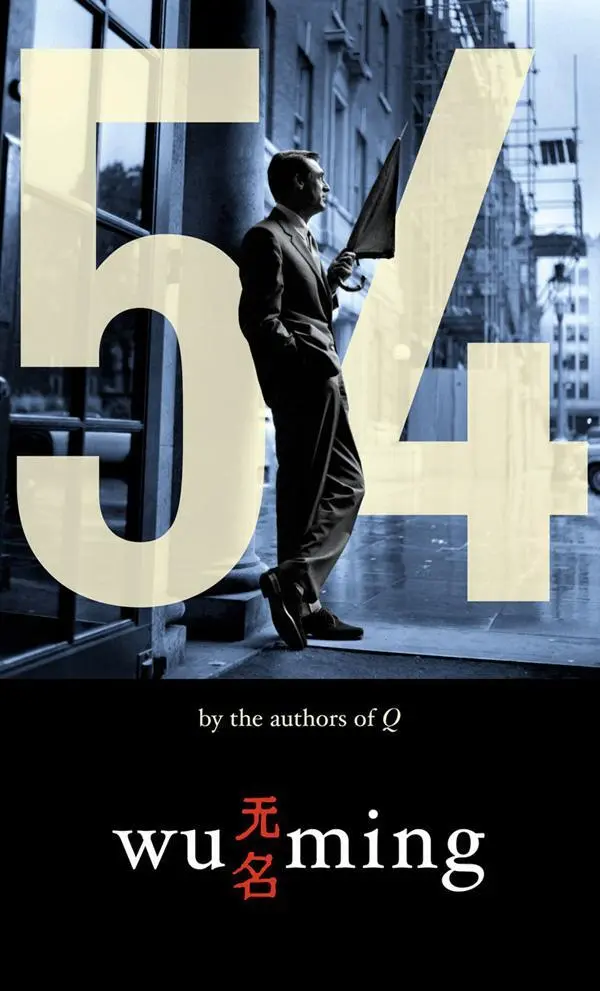
Set during the height of the Cold War-with the world divided into East and West-54 features Italian partisans, KGB agents, Parisian lowlifes, and cameos by David Niven, Marshal Tito, and Grace Kelly. Wu Ming brings us a cinematic romp that is by turns edgy social satire and modern comic send up.
54 — читать онлайн бесплатно полную книгу (весь текст) целиком
Ниже представлен текст книги, разбитый по страницам. Система сохранения места последней прочитанной страницы, позволяет с удобством читать онлайн бесплатно книгу «54», без необходимости каждый раз заново искать на чём Вы остановились. Поставьте закладку, и сможете в любой момент перейти на страницу, на которой закончили чтение.
Интервал:
Закладка:
Winter was over, he no longer had to break the layer of ice to give the pigeons something to drink. The professor lifted the birds out of their little rooms and into the cage, opened the shutter, liberated the flock and started waving his banner around to send them into the sky, like a conductor performing an andante maestoso .
What a sight! As they wheel, each pigeon displays first its back, then its belly, a completely different colour. Multiply the effect by several dozen, and you end up with a shifting wave, the light breaking on it and fragments shooting off in a thousand different directions.
In the flock there were pure and piebald plumages, black, dun, powder-blue, almond, bronze.
Fanti was a pigeon-fancier, one of 3,000 in Emilia Romagna. He had fifty individuals, from triganini modenesi to pedigree doves (chosen by Manifardi and Corradini) and homing pigeons. Every day he fed them a kilo of vetch mixed with corn, maize and millet.
He had been a pigeon-fancier since he was a boy. When he moved to England, he had not given up his hobby, and had in fact become an important member of the International Federation of Homing Pigeon Fanciers, founded in 1881.
He had gone mad at the last fair and market held in Bologna, spending 300,000 lire on a slender female, with a bright-grey back tending to indigo, sgurafosso . Very elegant. Her name was Eloisa, and she had made the journey from Indochina to Italy in two months. Two hundred kilometres a day, ‘a remarkable accomplishment’. That had happened on 6 February — the purchase, not the flight, which had occurred some months before. Fanti was in correspondence via homing pigeon with various friends in England, France and Ireland, but he had not yet put Eloisa to the test.
When he was in his pigeon loft, Fanti fell into a sort of trance. Standing beside him, on the roof, was Robespierre Capponi. A promising, restless pupil. He was saying something to him. Zara . bicycle . To Zara on a bicycle? No, can’t be that. the watch . 10,000. Fanti nodded, said ‘mhm’ from time to time, but his mind was elsewhere: his eyes narrowing slightly, he stared at a tiny black dot to the north-west, in the middle of a patch of sky not occupied by the flock. A small object with a globular outline, then, as it got closer, bigger and arch-shaped. Lend me . The approaching object was Bertram, one his homing pigeons. Pierre broke off. Fanti stretched out his hands, and the bird allowed itself to be caught.
How do pigeons find their way home? Many people think they somehow take their bearings from the sun in some way, but they make their way home without any difficulties on foggy or cloudy days. According to some people, pigeons are sensitive to geomagnetic fields, taking their bearings from those when the sky is overcast. An interesting hypothesis. It was probably a combination of magnetism, the position of the sun and familiar landscapes. ‘Pretty impressive for such a small bird, don’t you think?’
A message from his friend McCullock, who was inviting him to spend the summer at his home in Arklow on St George’s Channel.
Pierre started talking again, a couple of phrases, then silence once more. Fanti became aware that Pierre had hooked a question mark into the Celtic fantasies in which he was about to lose himself.
‘I’m sorry?’
‘I said, since you agree, and since you’re even encouraging me to leave, will you lend me the 30,000 lire? I’ll pay you back little by little, but I will pay you back.’
‘I’ve encouraged you to do what?’ Fanti thought he must have been speaking out loud, and perhaps Pierre had misunderstood his stream of consciousness, imagining that it was somehow connected to what he was saying himself.
‘What do you mean, do what, professore ? Set off for Yugoslavia in search of my father! You were just saying it was important to take risks, to go, to free yourself, break through the mist to reach your destination. I’ve sold my bicycle and my watch, I have 10,000 lire set aside. All I need is 30,000 to get across the Adriatic. But have you heard a word I’ve said to you?’
Fanti sighed, took off his bowler and smoothed his hair. Having called back the pigeons and lowered the shutter of the cage, he turned towards Pierre, with his hands in his pockets and a thoughtful expression on his face. ‘Be patient, my boy. You’ll have to tell me everything all over again. Let’s go down to the house. Fancy a cup of tea?’
Chapter 33
Moscow, General Headquarters of the First Central Directorate of the KGB, 3 April
Information always reached the Ministry first hand. The Committee had inherited the entire network.
A few years previously the moles working inside the British secret service had been discovered. According to rumours circulating in the corridors some of them had ‘gone back’ to Moscow, and the ones who had remained ‘outside’ had taken precautions, scaling down their own activity. Be that as it may, there were people around who had worked behind enemy lines, renouncing the love of their homeland to serve the cause of socialism. No one apart from the big bosses knew who they were, but Zhulianov felt great admiration for them. Now he too had his part to play in the intricate machinery.
The material he had in his hand came from London. Ten typed pages containing the information he needed.
It wasn’t a question of kidnapping an enemy agent, a scientist who wanted to change flags or an agent who had to come back. Nothing of the kind.
The subject of the kidnapping was one of the most famous actors in America, actually a naturalised Englishman. Zhulianov remembered all the films he had been shown to perfect his accent: dozens, hundreds of films in which the American bourgeoisie displayed its own decadence and moral corruption for all to see without the slightest concern for modesty. Family dramas, betrayals, comedies of error, ostentatious luxury. And the dreary war films in which the Russians never even made an appearance. As though they hadn’t been the first to stop Hitler, while the Anglo-Americans were playing at naval battles. The first to enter Berlin, when the Allies were still wading through the Rhineland bogs.
But it wasn’t the fault of the actors. Parts in the big American propaganda machine, luxury employees who had bartered their dignity for wealth and glory. In the Soviet Union, the cinema was at the service of the people. In the capitalist countries the people were at the service of the cinema. Millions of workers, wits so dulled by Hollywood comedies that they forget their exploited status and rush to spend their money at the box office.
‘Cary Grant’ was on top of the documents, along with his physical description and distinguishing features. The directives were clear: Zhulianov would be in command of a four-man squad of well-trained and well-motivated soldiers. His task was to identify the target, intercept him and transfer him on to a Bulgarian merchant vessel en route for Malta. The hostage was then to remain on board the ship for seventy-two hours. After that, he would be released outside the headquarters of Military Intelligence in La Valletta.
Andrei Zhulianov thought of his old mother, in Kiev. She would be proud of him.
Moscow, the Lubyanka
The general looked out of the big window. Cars drove across the square in front of the building, under a fine rain.
This mission was a new step forward in his career. Khrushchev’s trust was well placed. He was beginning to understand how the squat Ukrainian’s mind worked: many things were changing, and Soviet foreign policy would never be the same again. They needed practical, trusted people. People like him. He allowed himself a faint smile as he watched the headlights shining in the Moscow evening.
Читать дальшеИнтервал:
Закладка:
Похожие книги на «54»
Представляем Вашему вниманию похожие книги на «54» списком для выбора. Мы отобрали схожую по названию и смыслу литературу в надежде предоставить читателям больше вариантов отыскать новые, интересные, ещё непрочитанные произведения.










Обсуждение, отзывы о книге «54» и просто собственные мнения читателей. Оставьте ваши комментарии, напишите, что Вы думаете о произведении, его смысле или главных героях. Укажите что конкретно понравилось, а что нет, и почему Вы так считаете.