Wu Ming - 54
Здесь есть возможность читать онлайн «Wu Ming - 54» весь текст электронной книги совершенно бесплатно (целиком полную версию без сокращений). В некоторых случаях можно слушать аудио, скачать через торрент в формате fb2 и присутствует краткое содержание. Год выпуска: 2006, Издательство: Houghton Mifflin Harcourt, Жанр: Историческая проза, на английском языке. Описание произведения, (предисловие) а так же отзывы посетителей доступны на портале библиотеки ЛибКат.
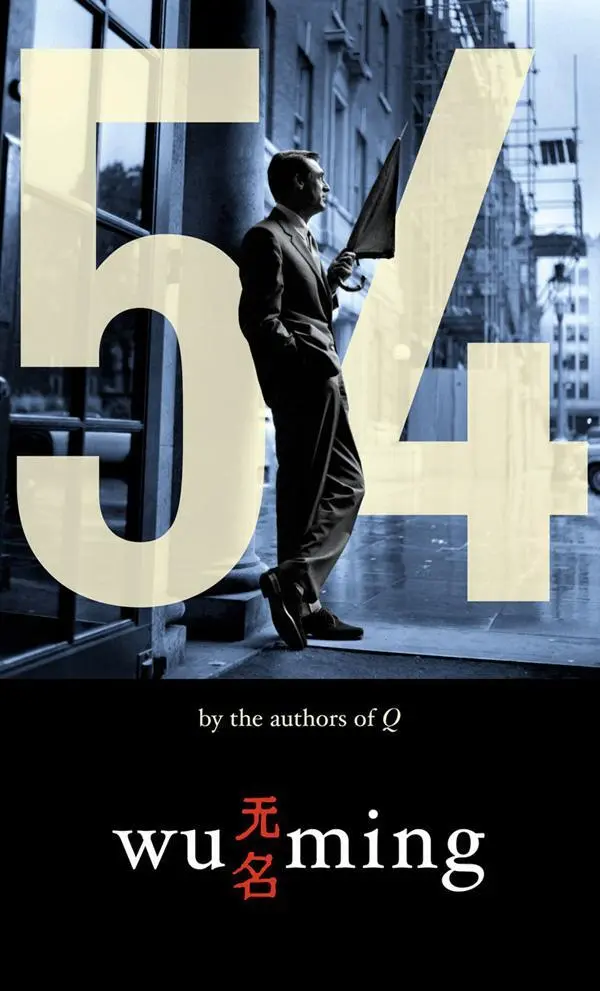
- Название:54
- Автор:
- Издательство:Houghton Mifflin Harcourt
- Жанр:
- Год:2006
- ISBN:нет данных
- Рейтинг книги:5 / 5. Голосов: 1
-
Избранное:Добавить в избранное
- Отзывы:
-
Ваша оценка:
54: краткое содержание, описание и аннотация
Предлагаем к чтению аннотацию, описание, краткое содержание или предисловие (зависит от того, что написал сам автор книги «54»). Если вы не нашли необходимую информацию о книге — напишите в комментариях, мы постараемся отыскать её.
Set during the height of the Cold War-with the world divided into East and West-54 features Italian partisans, KGB agents, Parisian lowlifes, and cameos by David Niven, Marshal Tito, and Grace Kelly. Wu Ming brings us a cinematic romp that is by turns edgy social satire and modern comic send up.
54 — читать онлайн бесплатно полную книгу (весь текст) целиком
Ниже представлен текст книги, разбитый по страницам. Система сохранения места последней прочитанной страницы, позволяет с удобством читать онлайн бесплатно книгу «54», без необходимости каждый раз заново искать на чём Вы остановились. Поставьте закладку, и сможете в любой момент перейти на страницу, на которой закончили чтение.
Интервал:
Закладка:
Chapter 31
Moscow, the Lubyanka, 1 April
General Ivan Alexandrovich Serov tried out the sofa in the big office. The afternoon light came faintly through the window, the Moscow spring trying to defeat the frost: it had been a hard winter.
He still didn’t feel at ease. In particular, he couldn’t see why a single person needed such a capacious office. Elegant surroundings. Too much so, he thought. He would get rid of some of the fripperies. The heavy curtains could be used to warm up the army rather than gathering dust by the window. And the ornaments would go first, he’d always hated them, pointless, cumbersome objects. With all that iron you could forge weapons to defend the revolution, and the wood could be burned in the soldiers’ bivouacs. And the porcelain vases? A better use could be found for the porcelain, too.
Basically that was why he had been put there. To restore order and clean up. He would start with the small things. Ornaments and knick-knacks.
The ‘economic’ vision of things was the strong point of his career and his political training. A sound practical sense at the service of the greatest ideal. If the ideal was the dynamite, the practical sense was the fuse. During his years at the Ministry he had never got used to working behind the scenes.
Having grown up on the battlefields, he knew the cold of Belorussia and Poland, and the lead of the Nazi bullets. He didn’t need frills and furbelows to direct the deportations from the Caucasus, to put down the pockets of White Russian resistance in Poland, coordinate Ministry activities in East Germany.
He studied the paintings on the walls. Lenin stared at a vague point on the horizon. His determined gaze inspired a profound trust in human destinies. He had seen the Little Father only once, when he had marched through Red Square with his regiment at the age of eighteen.
May the 1st 1922: he turned his head towards the stage, along with all his comrades, and he saw him, small, fur hat protecting his bald head, flanked by the traitor Trotsky and Comrade Stalin.
Now Stalin looked down at him from the wall opposite, with an ‘amused’ expression. His moustache hid his mouth, it was impossible to tell whether or not he was smiling, but it seemed to him that he was: the wise, angelic smile of someone who has understood everything. He remembered the day of the funeral, the yelling masses, the women tearing their clothes and striking themselves on the head.
He wept too. The first time in years. He hadn’t even shed a tear in Berlin, in the spring of 1945, at the sight of the red flag hoisted over the Reichstag. And yet he had been moved. The victory crowned years of hard work, hunger and death. He would carry that moment with him, the big flag flapping in the wind, until the end of his days. And Stalin’s funeral. An infinite sense of loss, a vague sense of panic: the Leader was no longer there. That day the question rose up from the back of his mind, the same question being asked by the members of Central Committee: ‘What now?’
‘Now.’ General Serov immediately knew what would happen. Only the strongest survive. And the patient. A lesson he had learned while fighting Hitler: a good general must always know when to retreat, to allow the enemy to advance, to tire themselves out, and then to strike them mercilessly until they are destroyed. That day, as he stared at Stalin’s coffin, he banished his tears and started thinking.
Only a year had passed since then, enough to make some calculations and decide who would be promoted and who would stay where they were.
The struggle for succession had been resolved in a few months. ‘Stalin’s dauphin’, Malenkov, versus ‘Stalin’s best friend’, Beria. He himself had known how to wait and choose his moment. Anyone who had set out to rout his adversaries and win hands down had been dragged into the mud. Same mistake as Hitler: Blitzkrieg . A strategy that doesn’t pay off in the long term. Any self-respecting Russian should know that.
As Minister of the Interior, Beria planned to change everything, trampling over Stalin’s corpse while it was still warm. Bloody lunatic. From the first moment, when he was called in to receive his new instructions (‘No more purges of Jews from the Party, no more trials, we’ve got to start everything over from the beginning’), the general understood that this fool would not get far. He stepped aside, to watch the wolves tear him to pieces. At the head of the pack he found his man, the cleverest one, who would destroy all the rest of them: the future Party Secretary, Nikita Khrushchev. The general didn’t think twice before joining the conspiracy to eliminate Beria and the ‘Caucasian’ clan. It was a matter of survival.
It was easy to imagine Beria’s deputy in the Ministry of the Interior, Sergei Kruglov, being bought for a couple of roubles, just to take the place of his boss. But the general didn’t trust him to stay in the saddle. What was certain was that before going into action, Khrushchev would make sure he had the support of the army. So he sent an explicit signal to Marshal Zhukov, Deputy Defence Minister and an old associate from his Berlin days. So he went in search of conspirators.
In June, Khrushchev won the support of Malenkov. The end of the ‘Caucasians’ was not far off.
When Khrushchev gave the order to arrest Lavrenti Pavlovich Beria, on charges of ‘moral decadence’ and ‘espionage in the service of foreign powers’, the Moscow police rose up in his defence. Marshal Zhukov sent armoured cars into the city to restore order. That day civil war broke out. The general stayed in his office at the Ministry, waiting for events to run their course.
The traitor Beria was sentenced, and it was clear to the general that within a few months Khrushchev would make a clean sweep. The day after Beria’s elimination, Khrushchev handed the Ministry to Kruglov: a reward for doing over the boss.
Kruglov was an arriviste bureaucrat, put there to keep the Services quiet while the cards were being dealt again. The general could tell that this was his big opportunity. At the age of only forty-nine he would be able to make it to the top. Take it or leave it. He had to take a gamble.
Discrediting Kruglov was the riskiest manoeuvre of his career.
As a man in a position of trust, the general had access to information about the spy network abroad. He needed only to spread the news of a coming purge of the agents in the ‘hot’ countries. The Yankees, diligent as ever, would do the rest.
In January, the Tokyo resident defected; in February, so did the one in Vienna; in the same month, the agent in charge of an important mission in West Germany went over to the CIA the moment he crossed the border from the Eastern Zone.
Kruglov found himself being pensioned off without even knowing what had happened.
The rest followed of its own accord. Recent history.
In early March, after the commemorations for the first anniversary of Stalin’s death, Malenkov had severed the Services from the Minister of the Interior, to reconstitute them as an autonomous organ directly dependent on the Council of Ministers: The Committee for State Security. The man in charge would be the loyal and incorruptible General Serov.
He had reached the top.
Sitting at his desk, in absolute solitude, he was willing to bet that sooner or later that fat muzhik Khrushchev would oust Malenkov too.
Better to concentrate on the task at hand. He opened his folder: the headed paper on which the documents were written was fresh off the press. The coat of arms stood out clearly: the shield, to defend the revolution, and the sword, to strike the enemies of the country. The three letters at the top of the page, solid, crisp capitals, in perfect harmony with his vision of things.
Читать дальшеИнтервал:
Закладка:
Похожие книги на «54»
Представляем Вашему вниманию похожие книги на «54» списком для выбора. Мы отобрали схожую по названию и смыслу литературу в надежде предоставить читателям больше вариантов отыскать новые, интересные, ещё непрочитанные произведения.









Обсуждение, отзывы о книге «54» и просто собственные мнения читателей. Оставьте ваши комментарии, напишите, что Вы думаете о произведении, его смысле или главных героях. Укажите что конкретно понравилось, а что нет, и почему Вы так считаете.