Wu Ming - 54
Здесь есть возможность читать онлайн «Wu Ming - 54» весь текст электронной книги совершенно бесплатно (целиком полную версию без сокращений). В некоторых случаях можно слушать аудио, скачать через торрент в формате fb2 и присутствует краткое содержание. Год выпуска: 2006, Издательство: Houghton Mifflin Harcourt, Жанр: Историческая проза, на английском языке. Описание произведения, (предисловие) а так же отзывы посетителей доступны на портале библиотеки ЛибКат.
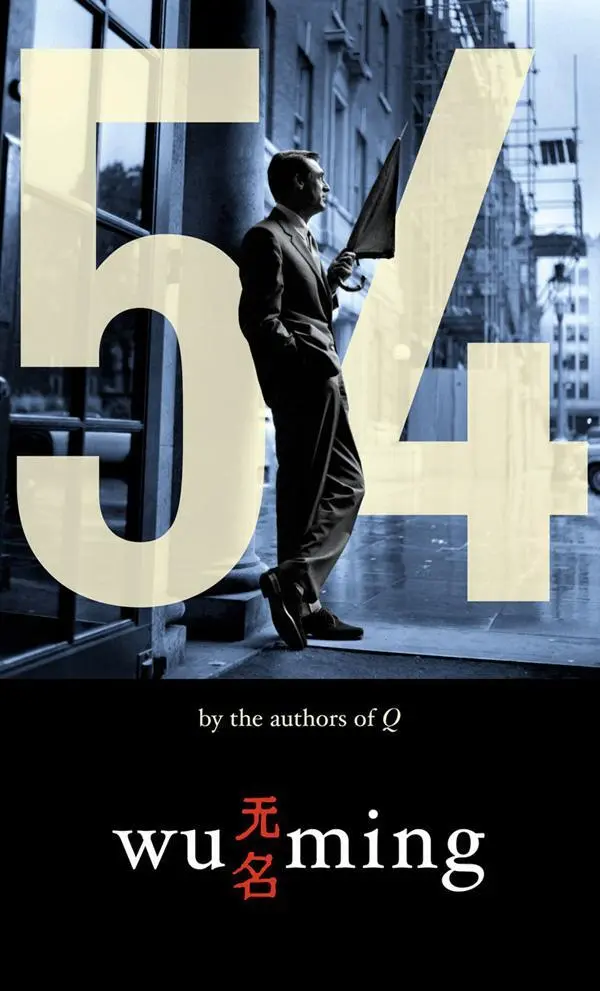
- Название:54
- Автор:
- Издательство:Houghton Mifflin Harcourt
- Жанр:
- Год:2006
- ISBN:нет данных
- Рейтинг книги:5 / 5. Голосов: 1
-
Избранное:Добавить в избранное
- Отзывы:
-
Ваша оценка:
54: краткое содержание, описание и аннотация
Предлагаем к чтению аннотацию, описание, краткое содержание или предисловие (зависит от того, что написал сам автор книги «54»). Если вы не нашли необходимую информацию о книге — напишите в комментариях, мы постараемся отыскать её.
Set during the height of the Cold War-with the world divided into East and West-54 features Italian partisans, KGB agents, Parisian lowlifes, and cameos by David Niven, Marshal Tito, and Grace Kelly. Wu Ming brings us a cinematic romp that is by turns edgy social satire and modern comic send up.
54 — читать онлайн бесплатно полную книгу (весь текст) целиком
Ниже представлен текст книги, разбитый по страницам. Система сохранения места последней прочитанной страницы, позволяет с удобством читать онлайн бесплатно книгу «54», без необходимости каждый раз заново искать на чём Вы остановились. Поставьте закладку, и сможете в любой момент перейти на страницу, на которой закончили чтение.
Интервал:
Закладка:
KGB.
The photograph showed a young man, almost bald, pointed chin and strong jaw. The general read the data carefully.
Andrei Vassilyevich Zhulianov; born in Kiev in 1924, into a family of shopkeepers; marked out at secondary school as a student with a particular gift for languages and sent to the Foreign Languages Faculty in Kiev; military service in the Second Desanniki division from 1942 to 1945; reached the rank of sergeant-major; medal of honour for merit on the field; joined the Soviet Communist Party in 1945; active in the Military Information Service with the rank of captain from 1945 to 1948; special praise for three undercover operations in West Berlin between 1946 and 1948; admitted to the Higher Political School of the Ministry of the Interior in 1948; perfect knowledge of English, German, French and Serbo-Croat; partial knowledge of Italian; joined the Ministry for State Security in 1953. Personal characteristics: higher than average intelligence; exceptional dedication to the party; good general knowledge; excellent knowledge of the classics of scientific socialism; unmarried; judo, wrestling and pistol-shooting.
An interesting candidate, without a doubt.
Andrei Vassilyevich Zhulianov looked at himself in the bathroom mirror, to check every detail. Six foot one, fourteen stone, square shoulders, broad chest. He checked that his nails were clean. He was wearing a woollen jacket and matching tie. He had been told that the general was a scrupulous observer, he had to be neat and tidy, and there must be nothing superfluous. The only detail allowed him was the Party badge on the lapel of his jacket. He polished the gilded hammer and sickle with his sleeve, gave a long sigh and went out into the corridor.
Being called in by the head of the newly born KGB was not something that happened every day. There had been a few changes at the top levels over the past few weeks, and the wind of change was in the air for everyone. Some people had already disappeared, to end up shuffling paper in obscure and marginal offices. Others had been given the opportunity to put long years of study to the test. The few women working in the Ministry had been excluded from operational duties. It had been the first order from the head of the Committee. The women’s action in the field would be limited to the role of ‘bait’, to extort information and unmask infiltrators or double agents. But no network would place any trust in agents of the female sex. The general’s mistrust of women was well known. Jews received similar treatment.
As he climbed the stairs of the building, banal phrases came to his mind, to be dismissed immediately: ‘If my mother could see me now. ’
Everyone in the Ministry knew that a personal summons from the President of the Committee meant a big job was a possibility. The department’s director had given him to understand promotion was in the air.
After the end of the war, opportunities to shine had been few and far between. He had exploited them to the best of his ability. In Berlin, when the fame of General Serov instilled reverential fear in him, he had won the praise of his colonel. Military counterespionage was satisfied with the way he had behaved on several occasions at least. But his gifts for learning languages had removed him from active service and transferred him to the Ministry’s Higher Political School. Six years had passed, during which he had devoted himself chiefly to study, perfected his knowledge of languages and improved his memory.
His memory. As he had been able to understand since he had been transferred there, the bulk of the Ministry’s activity was devoted to the accumulation of information. Hundreds of thousands of files, cards, profiles, personal data. On everyone and everything. Obtaining and storing information, that was the real power of the Ministry, now the KGB.
The secretary admitted him without a smile, checked his card and told him to wait in the antechamber, after which she slipped behind a door and left him on his own.
He waited five minutes before the secretary appeared and told him to go in.
A wide, rather gloomy room. Heavy curtains kept the light out. At first he could discern only a black outline behind the black mahogany desk. A table lamp lit a man’s hands.
General Serov said, ‘Step forward, comrade.’
Zhulianov walked over to the desk, clicked his heels and gave the military salute in homage to their old times in Berlin.
The general did not reciprocate. ‘Sit down.’
From close up he was frightening. A young-looking fifty, skinny physique, slightly grizzled air, hard features, as though sculpted from rock. But the most striking thing about him was his eyes. Grey and impassive, they stared into his own. He remembered the advice of the head of department, and he did not look down.
The two men said nothing for several long seconds. Zhulianov was motionless, not making a single gesture, not even swallowing. The test had begun.
Then the general said, ‘Comrade Zhulianov, from this moment you are transferred to the First Central Directorate, Subdirectorate S.’
The ‘illegals’, thought Zhulianov, containing his emotion.
‘You’ve been chosen for a level-4 mission. On the basis of your curriculum vitae I think you are the most suited to the kind of work required. It is an extremely high-risk job, and one of very great importance. You are not obliged to accept, but your dedication to the Party and the country lead me to suppose that you will not let us down.’
Zhulianov absorbed the information while trying to remain calm. This was his big opportunity.
The general continued without taking his eyes off his face, his every reaction would be recorded: ‘Level 4 provides for the possibility of losing your freedom and your life. The same risks that you have already run while fighting against the German invaders, and infiltrating yourself into West Berlin after the war. The mission’s success will contribute to the preservation of peace and the defence of the Soviet Union against its enemies.’ A pause. ‘I don’t think you need any further information in order to make a decision.’
Silence again. Zhulianov waited. The general’s expression did not change. He added, ‘You have twenty-four hours to make your mind up.’
Zhulianov understood what he had to say.
‘That will not be necessary, Comrade General. I accept without reservation the task that you wish to assign to me, in the interest of the Soviet Union.’
‘Very good. The details of the job are contained in the folder that will be handed to you at the end of this meeting. You will have to learn them by heart. Meanwhile bear in mind that you will have to travel to a hostile country to kidnap a subject against his will. The subject’s safety will have to be guaranteed at the risk of your own life. If conditions appear too risky for the safety of the subject, you will have to consider the mission suspended. But the Committee will do its best to ensure that this does not occur.’
Silence again. Zhulianov felt pride swelling his chest, but made an effort to give no sign of it.
The head of the KGB handed him a blue folder.
‘We will meet again next Tuesday. By then you will have to have memorised the contents of this dossier.’ No gesture of farewell. ‘The Committee places its trust in you, Comrade Zhulianov. You may go.’
Chapter 32
Bologna, 2 April
The grey Crombie came to just below his knees, and distinguished him from all the Bolognese who were out walking in long overcoats or wrapped up in double-breasted mackintoshes with very tight belts. There were also old men in black cloaks, but they didn’t count.
Fanti wore black leather gloves and a characteristic, very English bowler hat. Grey corduroy trousers and a pair of low-sided boots. No one else in the city dressed like the professor, although that in itself did not make him look like an eccentric, at least not in the eyes of people unfamiliar with his way of life. You would have mistaken him for a distinguished foreigner passing through, perhaps an Allied officer in civilian clothes. But when he went up to the pigeon-house dressed like that, and you saw him on the roof, from the street or from the building opposite, going into the cage in his English coat, exposing his expensive hat to the birdshit, and plunging his hand into the grain box wearing those gloves that must have cost at least 5,000 lire, well, you’d have thought, this really is an odd geezer, a very peculiar character indeed.
Читать дальшеИнтервал:
Закладка:
Похожие книги на «54»
Представляем Вашему вниманию похожие книги на «54» списком для выбора. Мы отобрали схожую по названию и смыслу литературу в надежде предоставить читателям больше вариантов отыскать новые, интересные, ещё непрочитанные произведения.










Обсуждение, отзывы о книге «54» и просто собственные мнения читателей. Оставьте ваши комментарии, напишите, что Вы думаете о произведении, его смысле или главных героях. Укажите что конкретно понравилось, а что нет, и почему Вы так считаете.