Wu Ming - 54
Здесь есть возможность читать онлайн «Wu Ming - 54» весь текст электронной книги совершенно бесплатно (целиком полную версию без сокращений). В некоторых случаях можно слушать аудио, скачать через торрент в формате fb2 и присутствует краткое содержание. Год выпуска: 2006, Издательство: Houghton Mifflin Harcourt, Жанр: Историческая проза, на английском языке. Описание произведения, (предисловие) а так же отзывы посетителей доступны на портале библиотеки ЛибКат.
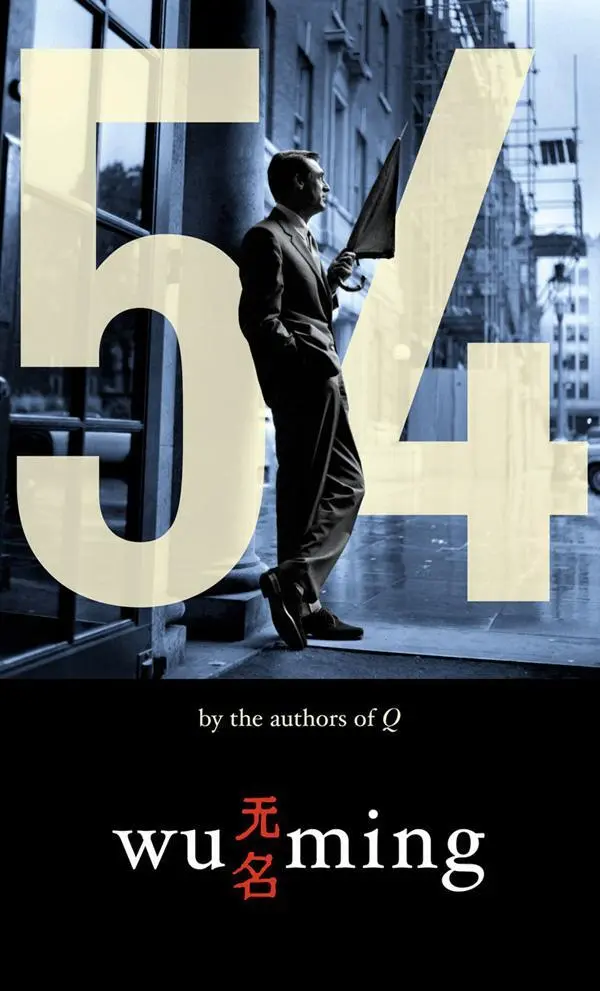
- Название:54
- Автор:
- Издательство:Houghton Mifflin Harcourt
- Жанр:
- Год:2006
- ISBN:нет данных
- Рейтинг книги:5 / 5. Голосов: 1
-
Избранное:Добавить в избранное
- Отзывы:
-
Ваша оценка:
54: краткое содержание, описание и аннотация
Предлагаем к чтению аннотацию, описание, краткое содержание или предисловие (зависит от того, что написал сам автор книги «54»). Если вы не нашли необходимую информацию о книге — напишите в комментариях, мы постараемся отыскать её.
Set during the height of the Cold War-with the world divided into East and West-54 features Italian partisans, KGB agents, Parisian lowlifes, and cameos by David Niven, Marshal Tito, and Grace Kelly. Wu Ming brings us a cinematic romp that is by turns edgy social satire and modern comic send up.
54 — читать онлайн бесплатно полную книгу (весь текст) целиком
Ниже представлен текст книги, разбитый по страницам. Система сохранения места последней прочитанной страницы, позволяет с удобством читать онлайн бесплатно книгу «54», без необходимости каждый раз заново искать на чём Вы остановились. Поставьте закладку, и сможете в любой момент перейти на страницу, на которой закончили чтение.
Интервал:
Закладка:
He leaned his back against the wall, his knees between his arms. After a few minutes his chin bounced on to his chest a few times, his eyes closed and his brain switched off.
He hadn’t eaten since the previous evening. The Slav smugglers had changed him a little money, but Pierre had only been able to think about the quickest way of getting there, walking, then a few kilometres by coach, then walking again. He still had some money, about 2000 or 3000 lire, and his stomach was protesting, no longer distracted by vomit, nausea and tension. They were bound to sell something edible at the café, but he preferred to stay put now that he was there, outside his father’s house. He would rather wait.
Before long he would see him appearing at the crossroads riding his bicycle.
An hour passed, perhaps more. A sunset dense with clouds and mist. The shadow at the top of the alley might be someone. No bicycle, but that was a negligible detail. Pierre leapt to his feet, more because he couldn’t stop himself than in order to attract attention. The man had a big knapsack over his shoulder, and was holding a bunch of keys. He glanced fleetingly at the stranger, walked past him and stopped at the next door along.
‘Excuse me.’ Pierre took a couple of steps towards him. ‘Excuse me. Do you speak Italian? I’m looking for Vittorio Capponi, he lives here, do you know him?’
‘Caponi? No, I don’t know, sorry,’ the man replied, strangely embarrassed. ‘I not here long, not know much.’
Pierre pointed to the house with both hands. ‘Here, his house, Vittorio Capponi.’
‘No, sorry, don’t know.’ The man with the knapsack pushed open the door and slipped inside. Pierre didn’t get his foot in the door quickly enough, and it closed. He knocked two or three times. ‘Excuse me, just one moment.’
In the faint light of the only street lamp, three faces appeared at various windows. One of them withdrew the moment Pierre glanced up. The others stayed there.
‘Excuse me, do you know where Vittorio Capponi is? Where is Vittorio Capponi? Does he live here?’
The heads swayed in unison, like puppets in an animated clock. Then the second face disappeared as well. Pierre turned to the only one remaining, a woman.
‘Vittorio —’
He didn’t get to finish before the woman shook her head again.
Pierre felt rage welling up inside him. He turned around all of a sudden and banged a fist against the door. He cursed. He went and sat down disconsolately once again, but he couldn’t sit still, he started pacing back and forth like an animal in a cage. His knuckles were bleeding. Every minute weighed an absolute ton.
Darkness fell, along with cold and another shadow. This one too just glanced at him and kept on towards the end of the street.
Pierre caught up with the shadow and touched it on the shoulder. The woman turned around in alarm.
‘Excuse me, miss, I’m looking for Vittorio Capponi, does he live her?’
‘Not here,’ replied the woman. ‘He gone.’
‘Gone? Where to?’
The woman started walking again at a brisk pace. ‘Where I don’t know. He gone.’
‘When? When did he leave?’ Pierre noticed that he was holding her by one arm and relaxed his grip.
‘Two or three months.’
‘Why, what happened?’
The woman stopped and crossed her hands over her chest. ‘I’m sorry, I don’t know that.’ Then she started walking again, and Pierre gave up following her.
He went back towards the house, while a deluge of thoughts swept through his mind.
Gone.
Pierre tried to put his ideas in order, to organise his information, think about what was to be done. He crouched down again to calm himself, but it didn’t work for long. Then he was on his feet again, pacing back and forth in front of the door, his bones frozen and his head in flames. A letter marked ‘return to sender’, his departure from the village, the eloquent silence of his neighbours. Two months’ absence. January: the expulsion of Djilas from the League of Yugoslavian communists. It all added up. But there had been no sign of Vittorio Capponi since long before that, since March, and even then there had been just two lines on the death of Milena, and then nothing. What had happened? Only one way to find out: stay in Gramovac, keep on asking, pick up a scrap here and there, assemble the mosaic, find a gap in the wall of silence by continuing to ask, plead, even threaten. He could try to get into the house, force the door or a window, try to find something that would help him understand, a scribbled address, any kind of clue. But he had to be on his guard. If his father had problems with the police, he would have to be very careful. He couldn’t overdo it, make an awful scene, sit down outside the door for too long or frighten anyone. An Italian with a false passport and a counterfeit border stamp didn’t want to go attracting attention to himself.
He had done enough of that already that evening. Trying to get into the house straight away wasn’t the best idea in the world. Too many eyes watching him from the windows. He thought he could feel them. He decided to make himself comfortable there and try to sleep. The last time he had slept had been thirty-six hours ago, and his exhaustion didn’t help. He sat down, stretched his legs out on the pavement, his case between his back and the wall. He tried to breathe more and more deeply.
‘What is it?’
Eyes suddenly wide open, mouth too, as he was woken by a hand tugging his jacket.
‘I am friend of Vittorio Capponi. Who are you?’ whispered the white-haired shadow.
Pierre ran his hands over his face a few times, as though washing it with imaginary water. ‘I’m his son,’ he said finally.
‘His son? Really? Are you Nicola?’
‘No, I’m Robespierre.
‘Ah, Robespierre, of course. Fine, Robespierre. It big pleasure to meet you. Come, come.’
Sheltering Pierre under his coat, he all but dragged him towards the shaft of light that crossed the cobblestones a few metres away.
‘Come in, quick. This my house. Come in.’ He pointed him to a chair and made him sit down. A faint light fell on the table. The room was small, in semi-darkness: a chest of drawers, a washbasin, a gas cylinder, a bed.
‘Here. Take it.’ The man put a glass on the table and slid it towards Pierre. ‘Drink, is good, against the cold.’
It was a strong and rather bitter grappa. Pierre downed it in one and the glass was refilled. The man was older than his father, he must have been over sixty. When he turned to pour himself some grappa, Pierre saw that half of his face was disfigured by a burn.
‘Souvenir of the war,’ he said, brushing his scars with his fingers. ‘Bad memory. I’m Darko, I know your father very well, we great friends, look.’
He opened a box behind him, and after rummaging about in it for a moment, he took out a photograph. The man without a scar, standing in front of the carcass of a deer with his arm around Darko, was his father.
‘Can you tell me where he is, why he left?’ asked Pierre, to choke down the lump in his throat.
‘He had to go away. Problems with political idea, you know?’
‘Yes, yes, I understand, but where is he now? How would I find him?’
‘Calm now, Robespierre, I’ll explain everything. He now in
Sipan, near Dubrovnik, 200 kilometres from here.’
‘And how do I get there? Is there a coach, a ferry?’
Darko poured the third glass, then he turned back and a piece of cheese, half a loaf of bread and some black olives appeared on the table.
‘ Uzmi jedi, moj sine . Eat!’
Pierre didn’t need to be asked twice. He stretched his hands out to the bread and repeated the question. ‘How can I get to Sipan?’
Читать дальшеИнтервал:
Закладка:
Похожие книги на «54»
Представляем Вашему вниманию похожие книги на «54» списком для выбора. Мы отобрали схожую по названию и смыслу литературу в надежде предоставить читателям больше вариантов отыскать новые, интересные, ещё непрочитанные произведения.






Обсуждение, отзывы о книге «54» и просто собственные мнения читателей. Оставьте ваши комментарии, напишите, что Вы думаете о произведении, его смысле или главных героях. Укажите что конкретно понравилось, а что нет, и почему Вы так считаете.