Wu Ming - 54
Здесь есть возможность читать онлайн «Wu Ming - 54» весь текст электронной книги совершенно бесплатно (целиком полную версию без сокращений). В некоторых случаях можно слушать аудио, скачать через торрент в формате fb2 и присутствует краткое содержание. Год выпуска: 2006, Издательство: Houghton Mifflin Harcourt, Жанр: Историческая проза, на английском языке. Описание произведения, (предисловие) а так же отзывы посетителей доступны на портале библиотеки ЛибКат.
- Название:54
- Автор:
- Издательство:Houghton Mifflin Harcourt
- Жанр:
- Год:2006
- ISBN:нет данных
- Рейтинг книги:5 / 5. Голосов: 1
-
Избранное:Добавить в избранное
- Отзывы:
-
Ваша оценка:
54: краткое содержание, описание и аннотация
Предлагаем к чтению аннотацию, описание, краткое содержание или предисловие (зависит от того, что написал сам автор книги «54»). Если вы не нашли необходимую информацию о книге — напишите в комментариях, мы постараемся отыскать её.
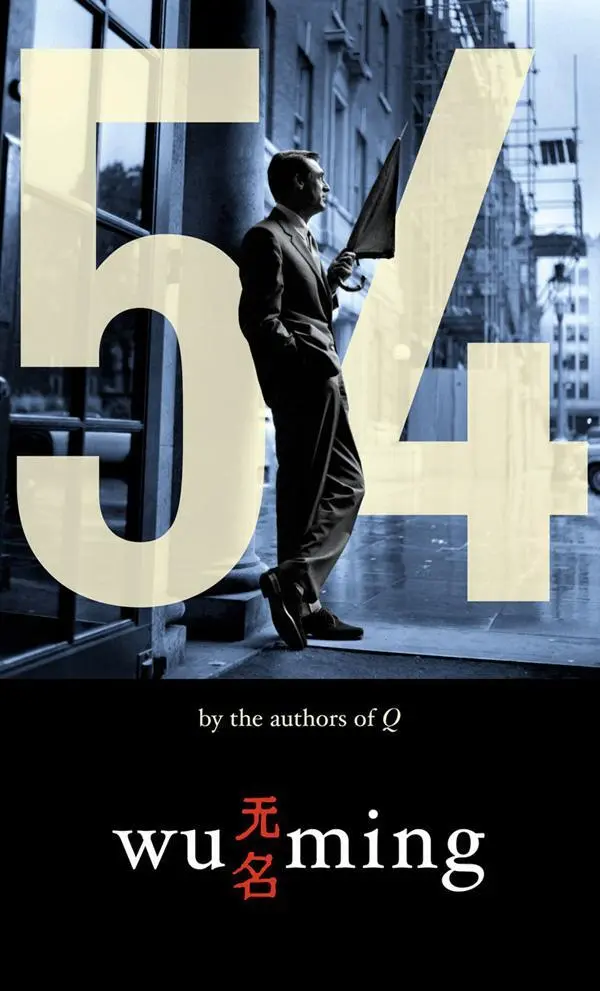
Set during the height of the Cold War-with the world divided into East and West-54 features Italian partisans, KGB agents, Parisian lowlifes, and cameos by David Niven, Marshal Tito, and Grace Kelly. Wu Ming brings us a cinematic romp that is by turns edgy social satire and modern comic send up.
54 — читать онлайн бесплатно полную книгу (весь текст) целиком
Ниже представлен текст книги, разбитый по страницам. Система сохранения места последней прочитанной страницы, позволяет с удобством читать онлайн бесплатно книгу «54», без необходимости каждый раз заново искать на чём Вы остановились. Поставьте закладку, и сможете в любой момент перейти на страницу, на которой закончили чтение.
Интервал:
Закладка:
The stink of shit was still the same. But he was happy to smell it. The stables of Agnano were his home. He heard the voices of the stable boys greeting him, ‘Kociss, you’re back!’ ‘Where’ve you been?’ ‘What you been up to?’ But he didn’t really hear them. He waved a greeting, but his head and his legs were heading straight to the back of the stables, to the storeroom where the harnesses were kept. One thought in his head: compensation. He walked through the building and came out by a little door at the back, finding himself in a service passage. The shed was covered by climbing plants, and the door could hardly be seen. He found it closed with a steel padlock, and his heart started thumping. He appealed to a few saints for assistance. Before there had just been a rusty chain. The thought of someone cheating him of his compensation put him in a cold sweat. He started walking around the construction in search of a way in: who the fuck had been able to get in there? There was nothing inside but junk and cobwebs!
Nothing, not even a little window. There was nothing for it but to crack open the padlock. He went back to the store, took a pickaxe and a hammer and went and positioned himself by the shed door. A glance around: no one. Off we go. Four dry, precise blows. It fell to the ground with a thud.
He went in, letting in enough light to make out the things inside.
He saw the pile of old saddles, still intact. He felt as though he had been reborn. He dismantled the mountain of leather. Someone had moved the tarpaulin. But underneath, thanks be to the Madonna, the television was still there. Right where he had left it.
He just had to clean it up a bit and it would be as good as new.
He would make money with this. Real money. Bollocks to Cinquegrana and the American army.
Transporting it was a bit of an enterprise. Who knows what had happened to the bike. A rusty old boneshaker, which had transported tons of shit in the past, was the only means of transport at his disposal. He leaned against the tarpaulin and gripped the television. It was one hell of a weight! It seemed to weigh twice as much as it had when he had taken it. Jail had softened him, what a pain in the arse. He had had it up to there already. But his compensation had arrived. Now he faced the final torture: the miles he would be taking the great brute of a thing, all the way to Gigino on the Vico Vasto.
Chapter 40
Slano, Dalmatia, 18 April
In the early afternoon mist, Pierre spotted a dark line on the horizon. He pointed and said, ‘Sipan?’ The man looked up from the tangle of his fishing net and nodded.
That morning, Darko had woken him while it was still dark. A cup of milk and honey sat steaming on the table. Pierre had washed away his sleep in the cold water of the basin and hurried to get dressed.
The cargo was already on board, covered with an old military cloth. Cheese, to judge by the smell.
The motion of the truck had rocked Pierre to sleep. Once they reached Split, Darko had woken him again.
The journey had taken less than an hour.
Pierre narrowed his eyes and looked again. The reflection of the sun on the water was dazzling. He was sorry he had never learned to swim, because the island looked so close. But perhaps that was just an illusion.
He leaned towards the fisherman and touched his shoulder. ‘Do you speak Italian?’
The man’s head rocked to left and right. He pushed out his chest and pointed to someone sitting on the wharf a little way off.
The lorry driver’s name was Stjepan, and he was going to Mostar with a cargo of fish. The turn-off for Mostar was on the coast road, ninety kilometres north of Dubrovnik.
Darko had suggested the alternative: ‘You wait till tomorrow and go with Milos, no problem for him, he has to get to Albania, or else set off now with Stjepan, then find someone else.’
Pierre didn’t want to wait: he had hugged Darko and climbed aboard the lorry.
Over the next half-hour he had not taken his eyes away from the window. The road ran parallel to the coast, through an imposing chain of mountains high above the sea, and the barely discernible line of an island. He had never seen anything like it.
‘You come from Italy?’ Stjepan’s voice had broken the silence. He spoke Italian more or less as Darko did. ‘Learned in war,’ he had added.
There had been twelve Italian deserters fighting in his partisan battalion.
‘Vittorio Capponi?’ A pause to ransack his memory. ‘No, I don’t remember.’
The second fisherman was fiddling with a net as well.
‘Do you speak Italian?’ Pierre asked again.
The reply was more than affirmative.
‘I am Italian, from Rovigno.’
Pierre smiled. ‘Oh, good. I’m from Bologna, my name’s Robespierre. I’m looking for a passage to the island of Sipan.’
‘Are you a tourist?’ His expression was diffident.
‘No, I’ve got to meet a relative I haven’t seen for years.’
He didn’t want to be too explicit about his father, but a generic ‘distant relative’ tended to put people at their ease.
The fisherman studied him for a moment, then struggled to his feet, putting one hand on the ground. ‘Come on. I’ll take you to someone who lives there.’
The place was like the valleys of Comacchio, but wilder and dense with trees. A maze of water and land. Lakes, canals, hidden inlets. A stagnant bog and a river.
They always had the sea ahead of them, and yet another island breaking up the horizon.
‘ Neretva rijeka , the Neretva river,’ Stjepan had said in reply to Pierre’s unspoken question. ‘I was born nearby, in the village of Bacina. You know, during the war, here, there were fascists. They want to put my family in the Lager . An Italian save us.’
Pierre hadn’t had to ask twice, and soon he was hearing stories about the man they called ‘Diavolo’ — the Devil — the army in Abyssinia, Albania, Greece and finally Bacina, the Italian army base.
‘He helped everyone. He spied for our partisans. He warned you when they come to put you in the Lager . He carried bombs and guns.’
In the long run, he had been discovered and imprisoned. Then Stjepan and some others had got the guards drunk, and he had escaped barefoot, his wrists tied together, joining the rebels the following morning.
‘ Smrt fasismu. Sloboda narodu! ’ the lorry driver had concluded, pulling up to the right. The road branched. The signposts said Dubrovnik 94, Mostar 57, Sarajevo 193. The journey had taken a few hours.
The two men muttered something to each other. The Istrian said, ‘Frane’s leaving at eight for
Sipanska Luka. He can take you. You have money?’ Pierre rummaged in his bag. ‘Not much,’ he replied, and took out
the roll of notes, still intact from the day before.
‘Half of that will be fine,’ commented the Istrian.
‘About 1,000 lire?’
‘Fine.’
An hour passed. Pierre had started walking.
The lorries were in a hurry, they showed no sign of wanting to stop, and three out of five were taking the road for Mostar. Only two cars had passed, one a police car, and fortunately Pierre had noticed in time, had lowered his arms and sat on the roadside looking uninterested. No sign of a motorcycle. Bicycles passed by, laden like donkeys, full shopping baskets hanging from the handlebars, and often with a passenger sitting sideways on the crossbar. Some people travelled on foot.
Walking, Pierre covered five or six kilometres an hour. He had calculated his speed years previously, when walking along the Via Emilia between Bologna and Imola. A bet that he had lost with the musketeers, and those thirty kilometres to pay as a forfeit. The rest of them drove along behind him in a friend’s car, laughing their heads off at the new Zatopek.
Читать дальшеИнтервал:
Закладка:
Похожие книги на «54»
Представляем Вашему вниманию похожие книги на «54» списком для выбора. Мы отобрали схожую по названию и смыслу литературу в надежде предоставить читателям больше вариантов отыскать новые, интересные, ещё непрочитанные произведения.






Обсуждение, отзывы о книге «54» и просто собственные мнения читателей. Оставьте ваши комментарии, напишите, что Вы думаете о произведении, его смысле или главных героях. Укажите что конкретно понравилось, а что нет, и почему Вы так считаете.