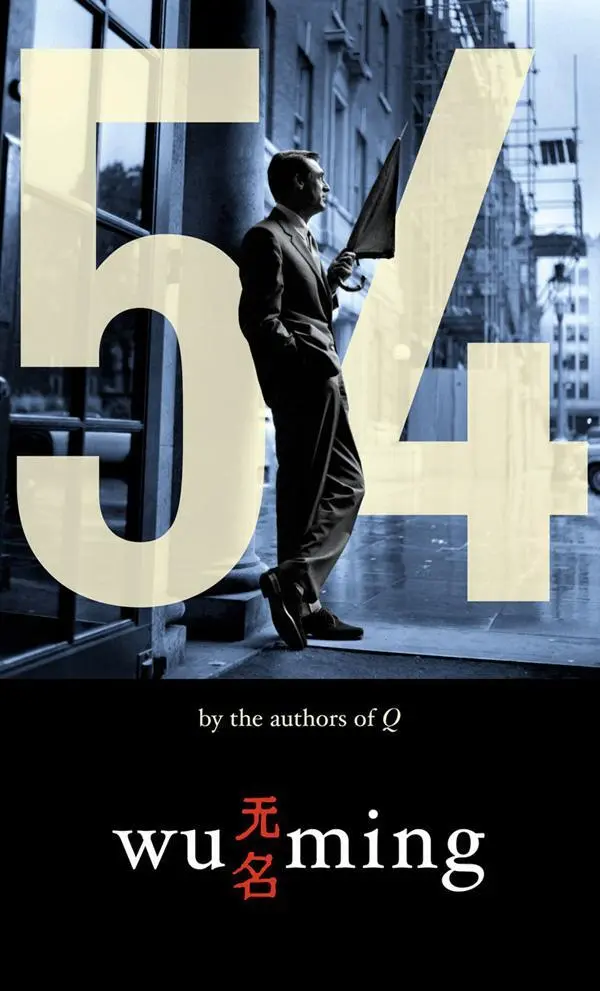
Wu Ming - 54
Здесь есть возможность читать онлайн «Wu Ming - 54» весь текст электронной книги совершенно бесплатно (целиком полную версию без сокращений). В некоторых случаях можно слушать аудио, скачать через торрент в формате fb2 и присутствует краткое содержание. Год выпуска: 2006, Издательство: Houghton Mifflin Harcourt, Жанр: Историческая проза, на английском языке. Описание произведения, (предисловие) а так же отзывы посетителей доступны на портале библиотеки ЛибКат.
- Название:54
- Автор:
- Издательство:Houghton Mifflin Harcourt
- Жанр:
- Год:2006
- ISBN:нет данных
- Рейтинг книги:5 / 5. Голосов: 1
-
Избранное:Добавить в избранное
- Отзывы:
-
Ваша оценка:
54: краткое содержание, описание и аннотация
Предлагаем к чтению аннотацию, описание, краткое содержание или предисловие (зависит от того, что написал сам автор книги «54»). Если вы не нашли необходимую информацию о книге — напишите в комментариях, мы постараемся отыскать её.
Set during the height of the Cold War-with the world divided into East and West-54 features Italian partisans, KGB agents, Parisian lowlifes, and cameos by David Niven, Marshal Tito, and Grace Kelly. Wu Ming brings us a cinematic romp that is by turns edgy social satire and modern comic send up.
54 — читать онлайн бесплатно полную книгу (весь текст) целиком
Ниже представлен текст книги, разбитый по страницам. Система сохранения места последней прочитанной страницы, позволяет с удобством читать онлайн бесплатно книгу «54», без необходимости каждый раз заново искать на чём Вы остановились. Поставьте закладку, и сможете в любой момент перейти на страницу, на которой закончили чтение.
Интервал:
Закладка:
In a few days, he might get as far as Dubrovnik. It would take at least two. The sun, having just emerged from the mountains, began to grow warm.
Pierre returned to the wharf at a quarter to eight. He had eaten and slept, lying in the meadow just outside the village.
Frane saw him and waved. He sorted out the last few tangles and hoisted the anchor. The blue-green fishing boat was ready to set sail.
Another two hours had passed, three lorries, two tractors and a cart driven by some bastard who wouldn’t stop. Pierre’s gestures were growing more disheartened and less enthusiastic.
But the third car of the morning had stopped anyway.
‘ Grüss Gott, ’ the woman had said by way of greeting. ‘ Wohin gehst du denn?’
Pierre didn’t know a word of German, but giving the reply ‘Dubrovnik’ had struck him as fair enough.
The woman had said something and nodded to him to get in.
‘ Wartest du hier schon lange?’ her husband had asked with a big smile. To which Pierre had felt obliged to explain, in English, ‘Sorry, I don’t speak German.’
But the Austrians spoke English.
Tourists on their honeymoon. From Vienna to Greece. A nice, rather eccentric couple.
Pierre had told them the story of his distant relative, adding a few details, and the newlyweds were delighted. Not least because Pierre, in the confusion of the moment, had used the English word ‘parents’ when he meant relations.
When they reached the village of Slano, the woman had spread out a map and shown Pierre that the island of
Sipan was a stone’s throw away, much closer than Dubrovnik. If he was after a crossing he would be better off searching there rather than elsewhere.
Pierre had been persuaded, although Darko had talked about Dubrovnik. He had asked them to wait for him, and headed straight for an old fisherman who was sorting out his nets.
Some church bells had been striking one.
The journey had taken half an hour.
*
Pierre heard the engine starting. He looked after the wake of the boat, as far as the coast, which was gently getting further away.
Halfway across he felt as though several hours had passed. They had been on the sea for fifteen minutes.
That sensation was reversed immediately afterwards. A faint gleam of houses emerged from the darkness of sea and sky. For a moment he forgot everything, Gramovac, Darko, Stjepan and the two Austrians. He forgot the visions of water and land that had accompanied him so far. He forgot Frane.
Telemachus was going to meet Ulysses.
Chapter 41
Sipanska Luka, Sipan, 19 April
The cheesemonger had smiled. Behind him, the man at the fish stall had confirmed the idea, slicing the air with the side of his hand: ‘Ah, talijanski drug!’ The woman selling vegetables had tapped her finger to her temple with a strange expression on her face. Finally a customer had nodded, paid quickly and dashed off to point towards a paved alleyway leading up towards the church and the hill overlooking the bay. He had waved his hand up and down a number of times, as though stroking the top of the mountain. Pierre deduced that the ‘Italian’ lived on the other side. With a similar gesture, fingers climbing over an obstacle, he made it clear that he had understood. The guy nodded and repeated his gesture from the start.
After the first bend, the alley turned into a path. It climbed steeply between the last bright houses, passed the drystone walls of the tiny gardens and plunged into the dark green of the gorse bushes.
Pierre started sweating. His suitcase wasn’t the easiest kind of luggage to drag all the way up there. He kept switching hands, and wiped his forehead with his shirt cuff. The night spent on the wharf had left a sticky deposit all over his body. He had slept enough to set off at a marching pace the moment he arrived, but the fact that the village was deserted had made him postpone his departure.
His mind was blank. His eyes looked at the sea, but didn’t enjoy the view. They looked for a house in the middle of the wild-west cacti and the mastic bushes. He couldn’t distinguish individual sounds, there was just a single droning noise in his ears, a dissonant chord of birds, cicadas and the wind. He changed hands again. He took a deep breath. He couldn’t smell anything. Just the weight of the suitcase on his fingers, sweat trickling behind his ears and the pain of his feet, crushed by shoe leather.
The path reached the top. Pierre saw the green scrub descending uninterruptedly to the sea. He saw the ruins of a building that had once been a church. He saw bare patches of land dotted with white sheep. He saw a brighter plot of land in the midst of the shrubs and the holm oaks, and a stone house on the edge of the plot.
He changed hands again and braced himself for the descent.
He didn’t hear someone shouting, ‘Stoj!’
All he heard was a sudden bang, like a gunshot. A cloud of dust rose up in front of him.
‘Stoj!’
Pierre looked towards the ruin, at the goats, at the house. He couldn’t see anyone. For a moment he didn’t move. Then he put down the suitcase, took a few steps forward, waved his arms above his head and shouted, ‘Don’t shoot, don’t shoot!’
The dust rose a few inches to the right of his leg, and fragments of bark spattered from a shrub.
‘I’m called Robespierre Capponi, I’m the son of Vittorio Capponi, don’t shoot! I’m looking for Vittorio Capponi!’
He picked up the suitcase and resumed his descent. No one fired.
A minute later he heard the voice, and saw the barrel of the Mauser that had greeted his arrival.
‘Hands up. Don’t turn around.’
Pierre did so, without breathing.
A hand took his suitcase from him. He heard a hinge opening. The barrel of the Mauser was still fixed on him.
‘What are you doing here?’ the voice said again.
‘I’m looking for Vittorio Capponi,’ Pierre said clearly. ‘I’m his son.’
‘Don’t try to be clever, my son is in Italy, tell me what you’re doing here.’ The barrel of the gun against his back stressed the importance of the answer.
This was not how Pierre had imagined it, the meeting between Telemachus and Ulysses.
‘It’s me, dad,’ he said finally in a desperate voice. ‘I’m Robespierre, it’s true.’ He tried to turn round but the Mauser replied that this wasn’t quite the moment. ‘I’ve come looking for you, I didn’t know where you’d got to, I was worried about you, really, if you don’t believe me, ask me some questions, something that only you and I could know, anything you like.’
‘I don’t feel like playing games. You could have learned all kinds of things about me. Aren’t I right?’
‘No, go on, dad, please. Listen —’
‘Fine,’ said Vittorio, interrupting him, ‘our song. The one I sang to put you to sleep.’
Pierre was completely taken aback. Fanti said he had no ear for music, but it was just a question of training. Angela always stuck her fingers in her ears when he sang.
He began. Simple, childlike music, the words in dialect.
After the first two verses, he realised that he could turn round.
Vittorio Capponi was holding the submachine-gun with both hands. He looked hard into Pierre’s eyes, and didn’t move. His grey beard contrasted with his tanned face. He had long hair down to his shoulders. His face was hard, his eyes bright. He looked like a hermit, the shepherd king of some remote Balkan tribe.
Pierre stopped singing.
It wasn’t how he’d imagined it, Ulysses and Telemachus.
He opened his arms, ran forward and threw his arms around his father in a nine-year hug.
Vittorio Capponi took his hand off the barrel of the Mauser, lifted the gun upwards, and stood there, unsure what to do with the weapon.
Читать дальшеИнтервал:
Закладка:
Похожие книги на «54»
Представляем Вашему вниманию похожие книги на «54» списком для выбора. Мы отобрали схожую по названию и смыслу литературу в надежде предоставить читателям больше вариантов отыскать новые, интересные, ещё непрочитанные произведения.







Обсуждение, отзывы о книге «54» и просто собственные мнения читателей. Оставьте ваши комментарии, напишите, что Вы думаете о произведении, его смысле или главных героях. Укажите что конкретно понравилось, а что нет, и почему Вы так считаете.