Wu Ming - 54
Здесь есть возможность читать онлайн «Wu Ming - 54» весь текст электронной книги совершенно бесплатно (целиком полную версию без сокращений). В некоторых случаях можно слушать аудио, скачать через торрент в формате fb2 и присутствует краткое содержание. Год выпуска: 2006, Издательство: Houghton Mifflin Harcourt, Жанр: Историческая проза, на английском языке. Описание произведения, (предисловие) а так же отзывы посетителей доступны на портале библиотеки ЛибКат.
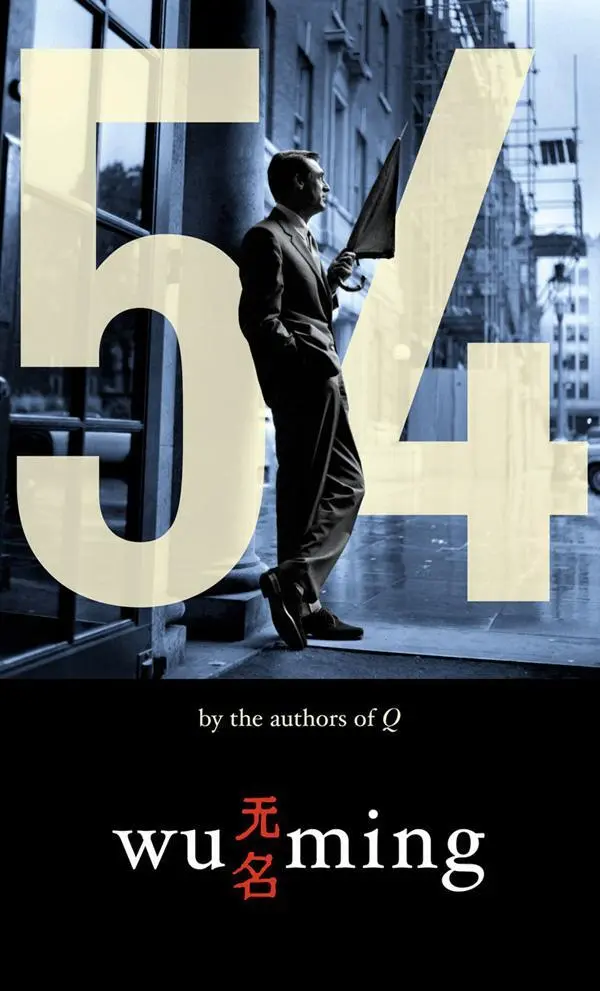
- Название:54
- Автор:
- Издательство:Houghton Mifflin Harcourt
- Жанр:
- Год:2006
- ISBN:нет данных
- Рейтинг книги:5 / 5. Голосов: 1
-
Избранное:Добавить в избранное
- Отзывы:
-
Ваша оценка:
54: краткое содержание, описание и аннотация
Предлагаем к чтению аннотацию, описание, краткое содержание или предисловие (зависит от того, что написал сам автор книги «54»). Если вы не нашли необходимую информацию о книге — напишите в комментариях, мы постараемся отыскать её.
Set during the height of the Cold War-with the world divided into East and West-54 features Italian partisans, KGB agents, Parisian lowlifes, and cameos by David Niven, Marshal Tito, and Grace Kelly. Wu Ming brings us a cinematic romp that is by turns edgy social satire and modern comic send up.
54 — читать онлайн бесплатно полную книгу (весь текст) целиком
Ниже представлен текст книги, разбитый по страницам. Система сохранения места последней прочитанной страницы, позволяет с удобством читать онлайн бесплатно книгу «54», без необходимости каждый раз заново искать на чём Вы остановились. Поставьте закладку, и сможете в любой момент перейти на страницу, на которой закончили чтение.
Интервал:
Закладка:
‘Abogado, qué tal? Deje que le presente a mis amigos.’
He wore an elegant black suit, his hair was short and curly, slicked back with brilliantine, a jovial, slightly chubby face, with a thin moustache. He couldn’t have been more than thirty.
León Mantovani pointed to his guests: ‘ Le presento a dos compañeros italianos. Piense que el padre luchó junto al comandante Tito contra la dominación nazifascista. Estuvo en las montañas con la guerrilla. ’
The man shook hands with the old partisan.
‘Muy honrado. abogado Castro Ruz.’
Then he did the same to the boy, and it was as though he had transmitted a strange sensation to him.
One that suggested that life, like history, would never be short of surprises.
End Titles

home
These are really the thoughts of all men in all ages and lands, they are not original with me, If they are not yours as much as mine they are nothing, or next to nothing, If they are not the riddle and the untying of the riddle they are nothing, If they are not just as close as they are distant they are nothing.
This is the grass that grows wherever the land is and the water is, This the common air that bathes the globe.
Walt Whitman, ‘Song of Myself’, 17
On Cary Grant (1904–86)
Cary and Betsy separated in 1958 and divorced four years later. Cary married twice more. He retired from the cinema in 1966, after about seventy-two films. He became a director of the cosmetics multinational Fabergé. He died in 1986 and was cremated, and his ashes were scattered to the wind.
‘I used LSD about a hundred times before it became illegal.’ (C.G.) A subculture of Cary Grant fans lives and thrives on the web. The most complete site is: www.carygrant.net . You can also sign up to Warbrides, the email fan club: www.carygrant.net/warbrides.html Among the many biographies and critical works, we would be happy to recommend: McCann, G., Cary Grant: A Class Apart , Columbia University Press, 1997.
Imagine that Cary amused himself by putting hidden references to his Yugoslavian adventure into his subsequent films. Have fun spotting them!
On Frances Farmer (1914–70)
Hollywood tried to salve its guilty conscience by dedicating a film to her. Frances (1982) is sustained by a mesmeric performance from Jessica Lange, and describes very effectively the progressive slide into misery and the descent to hell, even if it is strained in places. For example, there is no proof that Frances underwent a transorbital lobotomy. The film simply skips the last twenty years of her life and ‘career’: two marriages, odd jobs, moving from Seattle to San Francisco before finally settling in Indianapolis, where she fronted a television show, before dying of cancer, having written an autobiography, Will There Really be a Morning? , published posthumously in 1972.
Frances was buried in Oaklawn Garden Memorial Cemetery in Indianapolis, Indiana.
Nirvana dedicated a song to her, ‘Frances Farmer Will Have Her Revenge on Seattle’, on the album In Utero , 1993.
The daughter of Kurt Cobain and Courtney Love is called Frances.
Dedicated sites:
www.geocities.com/the mistyone/index2.html
www.people.virginia.edu/pm9k/libsci/FF/francesF.html
On Lucky Luciano (1897–1962)
In spite of the efforts of Charles Siragusa and his involvement in various investigations, Salvatore Lucania was never interned. He died of a heart attack at Naples airport on 26 January 1962. He is buried in St John’s Cemetery, Queens, New York.
‘Never have been a jerk and never will be a jerk.’ (L.L.)
On Wilma Montesi (1932–53)
No concrete evidence has ever emerged that Wilma Montesi attended a party at the Capocotta estate, in Tor Vaianica. The geographical proximity of the estate and the stretch of beach on which her body was found was the only very feeble link with Montagna and his friend Piero Piccioni.
In fact, the sole foundation of the hypothetical accusation was based on Montagna’s past as a fascist spy, confidence trickster and (especially) procurer, and on the fact that Piccioni was the son of the Foreign Minister, Attilio. The case was stuffed full of false testimonies and clockwork ‘confessions’. Anna Maria Moneta Caglio launched the fashion for ‘super-witnesses’, who are, even today, indispensable figures in any judicial frame-up.
The case was exploited by the ‘left-wing’ of the Christian Democrats led by Amintore Fanfani (and keeping the Italian Communist Party and its press as ‘useful idiots’) to assume control of the party (recently bereft of its leader, Alcide De Gasperi), ousting the tendency of Piccioni, whose career was severely compromised by the scandal.
On 27 May 1957 the Venice court acquitted all the accused. The sentence described Anna Maria Caglio as an unreliable witness and a compulsive liar.
In the sixties and seventies, Piero Piccioni became one of the most important composers of Italian film soundtracks. In the nineties, to everyone’s great surprise, he became one of the household names of so-called ‘lounge music’ and Exotica and the Sixties Revival subculture.
Update 2004: Piero Piccioni died on 23 July 2004 at the age of eighty-two.
The case has never been solved. Who killed Wilma Montesi?
On Joe McCarthy (1908–57)
In its session of 2 December 1954, the United States Senate officially condemned McCarthy’s work, with a majority of seventy-seven to twenty-two. That put an end to his career as a witch-hunter. The senator succumbed to rancour and alcoholism. He died of hepatitis in 1957. He is buried in the Roman Catholic cemetery of Appleton, Wisconsin.
On certain inexplicable mediumistic phenomena
Steve Cement is clearly recognisable in the film Lucky Luciano by Francesco Rosi (Titanus, 1973, soundtrack by Piero Piccioni).
Salvatore Pagano, aka Kociss, appears in the film To Catch a Thief by Alfred Hitchcock (Paramount, 1955).
The film on the Fifth Offensive was made in 1973: Sutjeska , with Richard Burton (in the role of Tito), Irene Papas, Milena Dravic, Ljuba Tadic and Bata Zivojinovic. Colour, 87 minutes, the most expensive production by the Yugoslavian cinematic industry.
Thanks to
Wu Ming 5 (Riccardo Pedrini), for his help, brainstorming sessions, and documentation on filuzzi and boxing.
Cinzia for the cover of the Italian edition.
Andrea Olivieri for his advice and translations into the Triestine dialect. Marco De Seriis for other linguistic advice.
Fabrizio Giuliani for information on the KGB. Giuliani has translated from the Russian the book by Yevgeny Primakov, Storia del Kgb (3 vols.), Hobby & Work, Milan 1999‒2000.
Annamaria Cattaneo for the material on pigeons.
Istituto regionale ‘Ferruccio Parri’ per la storia del Movimento di liberazione, via Castiglione 25, Bologna.
Biblioteca comunale dell’ Archiginnasio, piazza Galvani 1, Bologna.
The partisan fighters Mirco Zappi (36th Garibaldi Brigade) and Carlo Venturi ‘Ming’ (‘Red Star’ Brigade), for the material they supplied to us.
Vitaliano Ravagli, for the epos and his friendship.
Daniele Vitali, Luigi Lepri, Alberto Menarini and Gaetano Marchetti for their inestimable work in defence of the Bolognese dialect.
Roberto Santachiara, hasta siempre comandante!
Читать дальшеИнтервал:
Закладка:
Похожие книги на «54»
Представляем Вашему вниманию похожие книги на «54» списком для выбора. Мы отобрали схожую по названию и смыслу литературу в надежде предоставить читателям больше вариантов отыскать новые, интересные, ещё непрочитанные произведения.








Обсуждение, отзывы о книге «54» и просто собственные мнения читателей. Оставьте ваши комментарии, напишите, что Вы думаете о произведении, его смысле или главных героях. Укажите что конкретно понравилось, а что нет, и почему Вы так считаете.