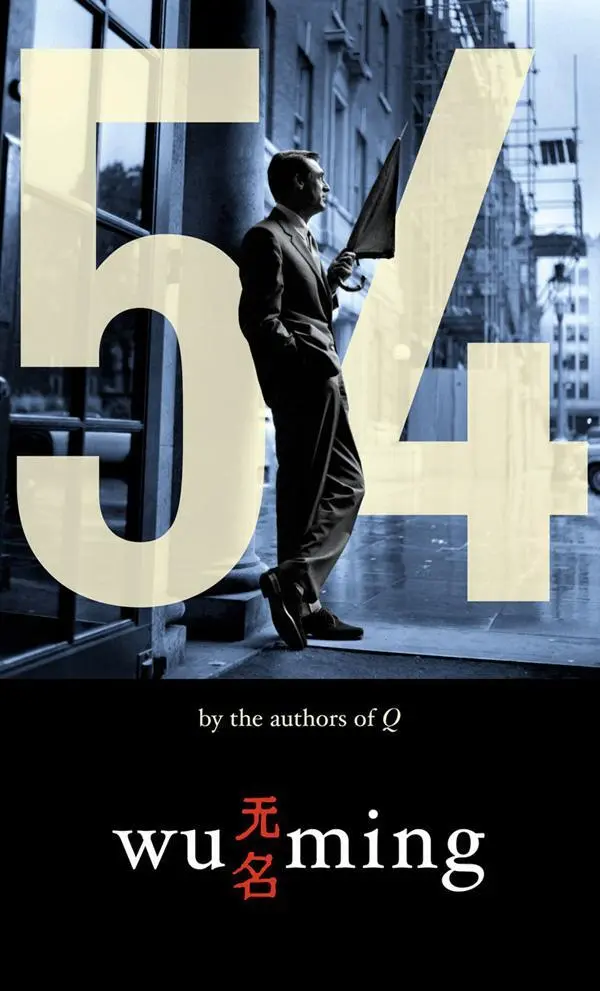
Wu Ming - 54
Здесь есть возможность читать онлайн «Wu Ming - 54» весь текст электронной книги совершенно бесплатно (целиком полную версию без сокращений). В некоторых случаях можно слушать аудио, скачать через торрент в формате fb2 и присутствует краткое содержание. Год выпуска: 2006, Издательство: Houghton Mifflin Harcourt, Жанр: Историческая проза, на английском языке. Описание произведения, (предисловие) а так же отзывы посетителей доступны на портале библиотеки ЛибКат.
- Название:54
- Автор:
- Издательство:Houghton Mifflin Harcourt
- Жанр:
- Год:2006
- ISBN:нет данных
- Рейтинг книги:5 / 5. Голосов: 1
-
Избранное:Добавить в избранное
- Отзывы:
-
Ваша оценка:
54: краткое содержание, описание и аннотация
Предлагаем к чтению аннотацию, описание, краткое содержание или предисловие (зависит от того, что написал сам автор книги «54»). Если вы не нашли необходимую информацию о книге — напишите в комментариях, мы постараемся отыскать её.
Set during the height of the Cold War-with the world divided into East and West-54 features Italian partisans, KGB agents, Parisian lowlifes, and cameos by David Niven, Marshal Tito, and Grace Kelly. Wu Ming brings us a cinematic romp that is by turns edgy social satire and modern comic send up.
54 — читать онлайн бесплатно полную книгу (весь текст) целиком
Ниже представлен текст книги, разбитый по страницам. Система сохранения места последней прочитанной страницы, позволяет с удобством читать онлайн бесплатно книгу «54», без необходимости каждый раз заново искать на чём Вы остановились. Поставьте закладку, и сможете в любой момент перейти на страницу, на которой закончили чтение.
Интервал:
Закладка:
‘The Eroica , by Beethoven.’
‘That’s the one. And they buried Bob with the other fallen of the 36th, in a part of the cemetery that also has Andrea Costa and all the best citizens of Imola.’
Bottone breaks away from the group and shakes his head. ‘It’s almost a good thing that he died so quickly.’
‘What was that you said, Bottone?’
‘Another ten years and who would have remembered Commander Bob?’
‘You’re wrong, Bottone,’ Garibaldi corrects him. ‘It’s easier to be forgotten while you’re alive, when you can still wind people up, than when you’re dead, hoopla, you’re a big hero again, time to get the banners out, sing a bit, and say that the spirit of the Resistance never dies. That’s how it is, mark my words.’
Meanwhile Capponi is already inside and heating up the coffee machine, while Bortolotti hurls himself at the television and turns it on, he’s wild about it now, and loads of us don’t agree, we should all be able to make the decision, and only if there’s something interesting on, not like that, not just for the sake of it. But what do you expect, it’s a taste for novelty, and Bortolotti says there’s no point having something if you don’t use it. In fact, since they’ve had the table football he’s almost stopped playing billiards, and he spends all his time fiddling with those little men. The coffee machine, the television, the table football, the gas stove and the new lights: all stuff bought with Pierre’s money.
‘But Brando, do we really know for certain that he won all that money at the casino?’
Brando doesn’t reply, partly because he has to reply to Bortolotti’s hand, but above all because he’s been really down lately, poor guy. Pierre has left, Sticleina’s got married, he’s found a real job as a nurse in Piacenza and gone to live there, Gigi has found another girl who’s a mambo fan and he doesn’t much feel like dancing the filuzzi with his friend the barber.
Capponi walks over to the wall, to where his medal is framed, and beneath it he tacks up two photographs, neatly aligned, with drawing pins.
One is a picture of Commander Bob, in uniform, hair combed back, half his face in light and half in shade. It looks a bit like a holy image, but it’s best not to point that out. The other is more blurred, two guys, isn’t that one Pierre? Hey! That means the other one must be Vittorio. They are hugging and smiling, and above them is written, in marker pen: Greetings from the New World to all our friends in the Bar Aurora .
‘Oh, Capponi, where on earth have they gone? To Venezuela?’
Then, in an undertone: ‘And yet Melega says that Pierre was in no great rush to leave just because of his father. It seems there’s something to do with Montroni’s wife, who actually did leave more or less around that time.’
‘Did she go to Venezuela as well?’
‘Who knows?’
‘It’s all bollocks as far as I’m concerned. Do you really reckon Signora Montroni would cuckold her husband with a barman?’
‘But she didn’t marry the barman. ’
‘Ah, women, women. ’ says Stefanelli from the next room.
From the television, right next to the two photographs, comes the voice of the presenter, who is interviewing some characters who are passing through Rome.
‘Why don’t you switch that thing off?’
Garibaldi’s request is the only sign of anyone paying attention to the television since Bortolotti switched it on. And you can bet that that will still be the case until closing time, because here in the Bar Aurora we haven’t the slightest interest in some famous actor who happens to have arrived in Rome today, or some politician, and if it weren’t for the football and the cycling we wouldn’t have bought the television in the first place. We’ve got Bottone, with his atom bombs, and La Gaggia, who knows the Montesi case like the back of his hand. We have to work out whether Garibaldi is narrowing his eyes because he wants a certain card or because the smoke’s annoying him. Benfenati takes care of any political doubts we might have, and any doubts about the pools, like the Carrarese — Parma game, are dealt with by Melega and Bortolotti. Everything else is just opinion: Montroni’s wife, Pierre’s money, how cold it’s getting. And Gas, who knows where he ended up, because he still owes us the money for the old TV.
That’s why that presenter is never going to be a great success in the Bar Aurora. And if it was up to us, we’d kick his arse all the way back to America.
VIII Trieste, Italy, 5 November
The poet and architect Carlo Alberto Rizzi got up early and made himself a good breakfast. At his desk, he leafed through his notebook. That evening, at the club, he intended to declaim a poem about the 4th of November, about the commemoration of the martyrs, about the gold medal awarded to the city. He had jotted down some impressions, and was preparing to turn them into verse.
So clear a morning distance is erased.
An interesting note. He could exploit it to talk about the Italian people, distant yet close, on the opposite shore of the Adriatic. As though even the atmosphere had grown keener, on that 4th of November, to bring the irredentist lands closer to Trieste, cut off from the motherland by wicked and biased interests.
The merest breath of the bora sets the banners flapping, on every balcony, on every building, specially two, huge, at the entrance to the square: the Tricolour and the Halberd of Trieste.
Celebrations on land and sea, in the Piazza dell’Unità and on the ships moored opposite, in the San Giusto dock: the cruiser Duke of Abruzzi, three white destroyers and an old-fashioned sailing ship, all shrouds and pennants, the training ship Amerigo Vespucci from the Naval Academy in Livorno.
Soldiers and sailors standing in ranks. The crowd moving anxiously from one railway station to another. Waiting for President Einaudi and Scelba.
The wind and the banners gave the poet a shiver of inspiration. He picked up a white sheet of paper and smoothed it in front of him, as though to purify it with his hand. His biro scratched and nothing came out. He breathed on the tip and started again:
The bora stirred, and from the ship-filled sea Rose scents and memories that touched the heart. Trieste, our beloved city fair, Trieste — pride of all thy sons thou art!
Fine, so that’s the wind taken care of. And the banners? Mustn’t forget them.
The buildings huddled on thy crowded flanks Bunting-clad and draped with banners bold Proudly salute the living and the dead; Thy blessings fall upon both young and old.
He buttered a slice of bread, spread it with marmalade and after the first bite stared once again at the crumb-scattered notebook.
Twenty-one cannon shots raise flocks of doves on land and gulls on sea. The presidential procession arrives: ten cars, preceded by the horses of the curassiers.
The President musters the soldiers. Women and children push their way to the front to touch, greet, stroke the uniforms. People in the trees on the lamp-posts: ‘Italy! Italy!’ At least 150,000 people.
The authorities climb to the city hall and at 11.35 they appear on the balcony. The mayor reminds them of their sister people on the eastern coast of the Adriatic. Scelba explains why the government has signed an agreement that does not satisfy the expectations of the Italian people: Trieste had been waiting for too long, it had to resolve its situation at all costs. He reassures the Slovenes who have stayed on Italian territory of respect for pacts and the will to bury the past and ensure cooperation. If pacts are respected, minorities will become a reason for friendship between the two countries.
Читать дальшеИнтервал:
Закладка:
Похожие книги на «54»
Представляем Вашему вниманию похожие книги на «54» списком для выбора. Мы отобрали схожую по названию и смыслу литературу в надежде предоставить читателям больше вариантов отыскать новые, интересные, ещё непрочитанные произведения.






Обсуждение, отзывы о книге «54» и просто собственные мнения читателей. Оставьте ваши комментарии, напишите, что Вы думаете о произведении, его смысле или главных героях. Укажите что конкретно понравилось, а что нет, и почему Вы так считаете.