Wu Ming - 54
Здесь есть возможность читать онлайн «Wu Ming - 54» весь текст электронной книги совершенно бесплатно (целиком полную версию без сокращений). В некоторых случаях можно слушать аудио, скачать через торрент в формате fb2 и присутствует краткое содержание. Год выпуска: 2006, Издательство: Houghton Mifflin Harcourt, Жанр: Историческая проза, на английском языке. Описание произведения, (предисловие) а так же отзывы посетителей доступны на портале библиотеки ЛибКат.
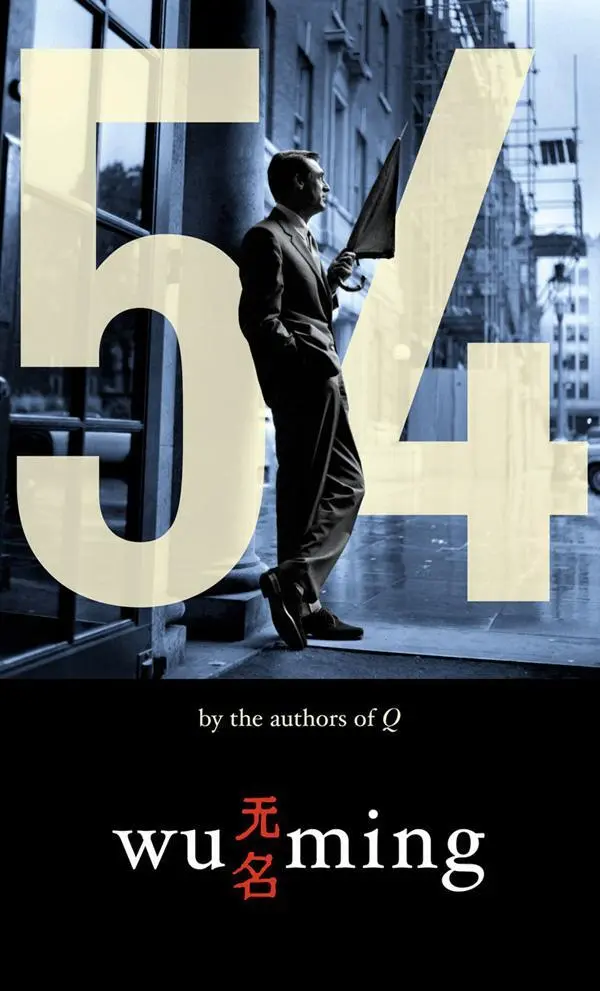
- Название:54
- Автор:
- Издательство:Houghton Mifflin Harcourt
- Жанр:
- Год:2006
- ISBN:нет данных
- Рейтинг книги:5 / 5. Голосов: 1
-
Избранное:Добавить в избранное
- Отзывы:
-
Ваша оценка:
54: краткое содержание, описание и аннотация
Предлагаем к чтению аннотацию, описание, краткое содержание или предисловие (зависит от того, что написал сам автор книги «54»). Если вы не нашли необходимую информацию о книге — напишите в комментариях, мы постараемся отыскать её.
Set during the height of the Cold War-with the world divided into East and West-54 features Italian partisans, KGB agents, Parisian lowlifes, and cameos by David Niven, Marshal Tito, and Grace Kelly. Wu Ming brings us a cinematic romp that is by turns edgy social satire and modern comic send up.
54 — читать онлайн бесплатно полную книгу (весь текст) целиком
Ниже представлен текст книги, разбитый по страницам. Система сохранения места последней прочитанной страницы, позволяет с удобством читать онлайн бесплатно книгу «54», без необходимости каждый раз заново искать на чём Вы остановились. Поставьте закладку, и сможете в любой момент перейти на страницу, на которой закончили чтение.
Интервал:
Закладка:
The mouse called ‘Jerry’ lived behind the wainscoting of a spacious and well-furnished living room. Inside, a bed made from a matchbox, and various bits of furniture recycled from the rubbish. There was a housekeeper, but all you ever saw of her was her feet, and her fat calves.
She was trying to hit the cat with a broom. The cat had turned the living room into a complete mess. The cat’s name was ‘Tom’. He spent his days chasing ‘Jerry’.
Mice and cats scampered around McGuffin, at the top of a mound of rubbish. Often a cat would doze off inside McGuffin. She didn’t look like ‘Tom’.
The mice had long fur and long tails, and they didn’t look much like ‘Jerry’.
At dawn, McGuffin’s broken screen reflected the rising sun.
At sunset, the broken mirror in front of it reflected the red of the sinking sun.
At night, squeaking crickets, distant barking, insistent miaowing, the noise of shoes or bottles thrown at cats to shut them up.
A smashed chair. Radio dials. Irreparable gadgets.
McGuffin couldn’t have known, but the smell was terrible.
McGuffin imagined it.
Never again would he capture electromagnetic waves to turn them into dreams or nightmares.
Never again would anyone stare at him with eyes as dead as the cigarette stubs that surrounded him now.
At least McGuffin had a purpose. The cat was pregnant. She would give birth before Christmas.
He had passed from home to home. Now he was a home. Someone really needed him, at last.
If he had had a mouth, a face, McGuffin would have smiled.
III Montreal, Quebec, 11 September
The moment of glory. The whole of Montreal seeing him evening after evening. Friends and relations, even the ones in the Ville de Québec.
Arsenic et vieilles dentelles . A rustproof pochade , the story of two adorable old ladies, a crazy nephew who thinks he is Teddy Roosevelt, a criminal on the run and a secret that must not be confessed. He played the role of Mortimer, the sane nephew, a newly-wed husband preparing to set off on his honeymoon.
Laughter, smiles, even requests for autographs. Jean-Jacques Bondurant ran, rolled his eyes, raised his eyebrow. Exaggeratedly, like Cary in the film version. He was perfect, the monozygotic twin of the most elegant man in the world. Apart from the fact that he delivered his lines in québecois French.
The audience adored him. Twenty performances at the Théâtre du Rideau Vert, and the bookings were still coming in.
Not bad for a benefit show, with most of the parts taken by amateurs.
He remembered the opening night. Charlotte in the front row, happy, proud of him.
In the photographs published in magazines, Charlotte and Jean-Jacques had eyes full of sapphires and emeralds. Cary Grant’s double and his wife. They smiled towards the future. Alive. Strong.
The curtain was about to rise. The noise quickened his blood. His Quintino suit was a second skin.
He guarded a secret in his heart. Wherever he went, he took a note with him. The note consisted of a few lines and a two-word farewell. They bounced around his cranium, from one side to the other.
Au revoir.
The smile spread across Jean-Jacques’ face until it filled his cheeks.
Merci beaucoup, monsieur Grant.
IV Los Angeles, 11 September
Betsy had advised Cary to go and see Dr Clapas. All her friends had good things to say about him. The events of the past few months had banished depression, returning Cary Grant to the world that was clamouring for his return. Now they had to try to understand the reasons for his depression, to make sure that it didn’t come back. Never again was the sun to darken, nor the hand that moved the razor to tremble.
Clapas was French. A pointed white beard, silver-rimmed glasses. He had moved to California with his wife in 1949, at the age of fifty.
If the truth be told, it appeared that he had fled , after a rather unpleasant experience culminating in a nervous collapse. A dangerous criminal had taken him hostage in his own home. The man was a patient and had turned up for his session, but the police, who had been on his trail for some time, had surrounded the building. Holding him at gunpoint, the criminal (a multiple robber and murderer with anarchist and subversive tendencies) had told Clapas of all the atrocities he had committed. Clapas’s anamnesis had been so mercilessly accurate that the criminal had gone mad and, having managed to free himself, committed suicide in the most grotesque fashion: bursting into a police station, guns in hand, and opening fire on the officers. The press had reported his last words: ‘Shoot at my genitals!’ adding that some policemen had followed his advice. Dr Clapas had become frightened and, fearing an underworld vendetta, had fled the country.
In Hollywood he had modified his rigid Freudian approach so as to be more à la page and to attract showbiz people. Apart from concepts drawn from the oriental philosophies and religion, such as karma, chakra and mantra , he experimented with psychoactive drugs, which he believed induced local regression, as happens in dreams. In exceptional circumstances, he gave his patients a very new compound, lysergic acid diethylamide, better known as LSD, a substance capable of ‘unlocking the casket of the id’.
Cary had told him about Archie Leach, about the invention of ‘Cary Grant’, about a father who had died a drunk and a loser, about a mother who had died and come back to life, about two failed marriages. Cary couldn’t talk about Nazi spies, missions on behalf of MI6 or encounters with the socialist satraps of a far-off eastern country, but what he had talked about was more than enough. Clapas, sincerely struck, had decided to give him LSD, without telling him of its effects lest he provoke defence reactions.
‘Same time tomorrow.’
Clapas hung on the actor’s every word. Clapas sweated and clutched his linen trousers around his knees. Cary Grant was completely transformed, he spoke in a very heavy English accent, using idiomatic expressions from turn-of-the-century Bristol, and generally talked and talked and talked. Cary Grant was Archie Leach.
Cary watched his own past like a 35 mm film shown on TV, apart from the bright colours, crikey, bright as a fire in which your mother dies, a fire lit by your father. Widescreen, a more distant rectangle than usual, between two black strips. Events follow hot on one another’s heels. Marriage to Barbara Hutton, friend to the friends of Mussolini, interminable parties and bombing raids on London (the latter probably the consequence of the former), Errol Flynn bombing London, Errol Flynn fucking a little girl up the arse in the cockpit of his Luftwaffe plane, MI6 catching him in flagrante and locking him up in a madhouse, every night Errol climbs over the wall dividing the male wing from the female one, managing to fuck Frances Farmer or Elsie Leach, here Cary bursts into tears, Clifford Odets’s hand writes ‘Here Cary bursts into tears’ and brings the scene to an end, Senator McCarthy sends anyone who knows how to read and write to the pyre, the Gestapo tries to arrest Charlot, who defends himself and knocks them flying with his walking stick, MI6 free Elsie in exchange for his cooperation, Cary refuses and says, ‘I’m not James Bond!’ (‘Who the hell is James Bond?’ wonders Dr Clapas), then accepts because Elsie is stuffing him with hallucinogenic wheatgerm, so Cary has to go off on a long journey, he opens the clothes cupboard and inside is a naked Quebecois with a regimental tie around his neck, the Quebecois is Cary’s double, and he is chatting with Josip Broz known as Tito (‘Where the hell does Tito come into it? Clapas wonders), they go together to the Hotel Lux in Moscow, in the corridor papered with portraits of Stalin they are involved in a shooting match, policemen turn up in Louis XVI costumes, Robespierre shows up, grabs the wigs from their heads and tells them, ‘Change, or I’ll send you to the guillotine!’ then introduces himself to Cary, who is now, who knows why? wearing nothing but a pair of swimming trunks. The bathing attendant appears and says to him, ‘Monsieur Bond, au téléphone!’ Cary repeats, ‘I am not James Bond!’ Sir Alfred Hitchcock says, ‘Cut!’ Guillotines are set in motion, heads fall into a single large basket. Cary rummages in the bucket and pulls out a head: it is Joe McCarthy’s. Cary swims, Frances Farmer swimming beside him, then Frances Stevens (Clapas notes: ‘Ask who that is’).
Читать дальшеИнтервал:
Закладка:
Похожие книги на «54»
Представляем Вашему вниманию похожие книги на «54» списком для выбора. Мы отобрали схожую по названию и смыслу литературу в надежде предоставить читателям больше вариантов отыскать новые, интересные, ещё непрочитанные произведения.












Обсуждение, отзывы о книге «54» и просто собственные мнения читателей. Оставьте ваши комментарии, напишите, что Вы думаете о произведении, его смысле или главных героях. Укажите что конкретно понравилось, а что нет, и почему Вы так считаете.