Wu Ming - 54
Здесь есть возможность читать онлайн «Wu Ming - 54» весь текст электронной книги совершенно бесплатно (целиком полную версию без сокращений). В некоторых случаях можно слушать аудио, скачать через торрент в формате fb2 и присутствует краткое содержание. Год выпуска: 2006, Издательство: Houghton Mifflin Harcourt, Жанр: Историческая проза, на английском языке. Описание произведения, (предисловие) а так же отзывы посетителей доступны на портале библиотеки ЛибКат.
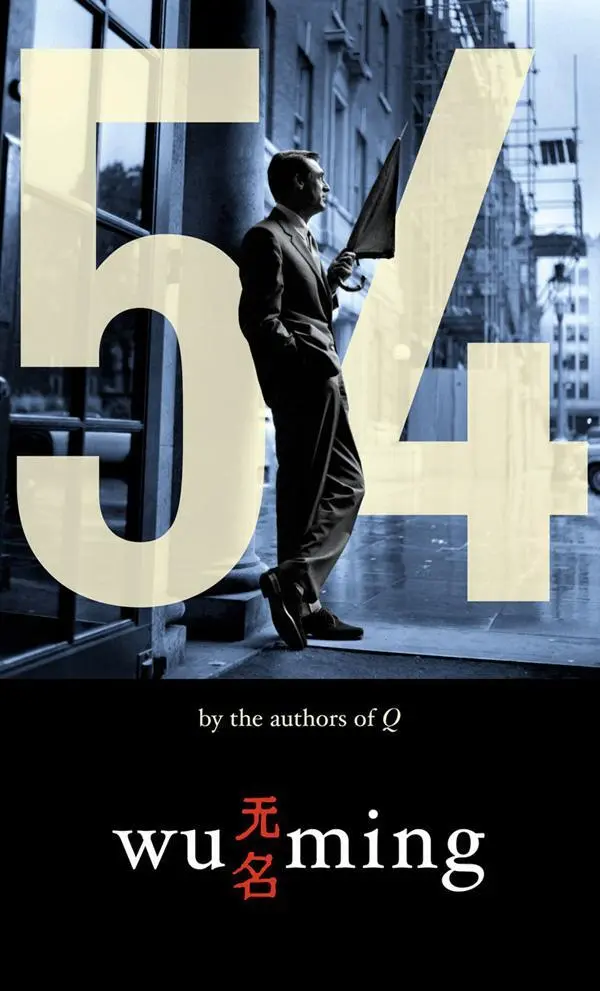
- Название:54
- Автор:
- Издательство:Houghton Mifflin Harcourt
- Жанр:
- Год:2006
- ISBN:нет данных
- Рейтинг книги:5 / 5. Голосов: 1
-
Избранное:Добавить в избранное
- Отзывы:
-
Ваша оценка:
54: краткое содержание, описание и аннотация
Предлагаем к чтению аннотацию, описание, краткое содержание или предисловие (зависит от того, что написал сам автор книги «54»). Если вы не нашли необходимую информацию о книге — напишите в комментариях, мы постараемся отыскать её.
Set during the height of the Cold War-with the world divided into East and West-54 features Italian partisans, KGB agents, Parisian lowlifes, and cameos by David Niven, Marshal Tito, and Grace Kelly. Wu Ming brings us a cinematic romp that is by turns edgy social satire and modern comic send up.
54 — читать онлайн бесплатно полную книгу (весь текст) целиком
Ниже представлен текст книги, разбитый по страницам. Система сохранения места последней прочитанной страницы, позволяет с удобством читать онлайн бесплатно книгу «54», без необходимости каждый раз заново искать на чём Вы остановились. Поставьте закладку, и сможете в любой момент перейти на страницу, на которой закончили чтение.
Интервал:
Закладка:
We will be the same, but we will be new.
Really, thanks for everything,
Robespierre
Fanti hid his emotion behind a half-smile. He chose the right record and put it on. He picked up his pipe and filled it with the tobacco he smoked on major occasions. As he took the first few puffs he watched the scented smoke rising in blue whirls, mixing with the notes of Stan Kenton, flying over the books, the English ornaments and the jazz records, 23 Degrees North and 82 Degrees West . The coordinates of the future. Havana. The tropics.
He murmured, ‘Good luck, Pierre. Good luck.’
VII Bologna, 4 October, St Petronius’ Day
‘You don’t think Capponi’s gone as well?’
On the lowered shutter, no sign, no ‘Back soon’, nothing, some people are driven to suppositions.
‘Gone? Do you think he’d go away like that, without saying anything to us?’
‘Why, what did his father do? He packed up everything, lock, stock and barrel, and went to South America.’
‘What’s that got to do with the price of fish, excuse me? Pierre had to get his father out of the country, he won all that money in Monte Carlo and he didn’t think twice. And Capponi isn’t a tramp like his brother.’
La Gaggia hears the voices slipping under the door and pokes out his head to see what’s happening.
‘Tell us, Gaggia, you don’t know where on earth everyone’s gone? Did the patron saint tell them to shut up shop?’
‘St Petronius? Benassi has never closed for him. And remember that Capponi isn’t from Bologna to boot, and I haven’t seen him this morning, but even Garibaldi and Bottone don’t know where everyone’s got to.’
‘I bet someone’s died!’
‘Hasn’t Bottone been having troubles with his liver lately? I know he was persuaded to take “Chinese mushrooms”.’
‘That’s enough bollocks about dead people and Chinese fungus, come on, let’s be serious now, what could have happened? You don’t think the cops came back?’
This allusion to the constabulary immediately prompts a change of subject. Because in early summer, in our place, but also in the streets, the shops and the other bars, any excuse is enough to talk about the Scelba government, whether it will survive, or whether it’ll be packing its bags, whether it’s going to be the turn of another Christian Democrat, or whether we’ll be voting again, but in the spring, because there’s no point even thinking about having elections in Italy between June and April. Someone’s convinced that there is a reason, an anti-communist strategy put together by the CIA, but no one is able to explain it. Others merely say you can’t have them in the summer because people want to think about enjoying themselves, and not in autumn and winter because people are too pissed off. With the bad weather, the cold, work, nobody’s in the mood to think about politics, ending up in a rotten mood, digesting the usual pap, listening to the stuff the big shots come out with. But in spring, ah, that’s something completely different, it’s a bit warmer, the days are nicer, you start thinking about your holidays and work is less of a burden. And according to Bottone there’s the question of luck: in 1948 the priests won because it was spring and now they’re fixated on that date, no getting out of it, if you move it to some other time of year the harvest will be postponed.
La Gaggia has already forgotten all about work, all the urgent stuff, because it’s soon going to start raining seriously and we all have to get our shoes on. And anyway, as we know, Scelba has two problems: first of all there’s Trieste, because right now they’re signing the treaty in London. They say it’s going to be provisional, but they won’t get us to swallow that: Tito has acted the lion and we Italians have been the lambs, because that was how it suited America. And the other issue is the one about Wilma Montesi, a terrible scandal, Minister Piccioni had to resign, his son went to jail along with that man Montagna, the police are passing the buck, the chief of police in Rome nearly ended up in the slammer as well. These days La Gaggia is the most sought-after expert in the whole bar, apart from Melega and Bortolotti, the match has only just begun, and on the Montesi issue our cobbler is the only one who knows everything inside out, because he has been following the story from the beginning, and he always told us that a few things would come out sooner or later.
‘They don’t know which way to turn, poor things! They dug up the girl’s uncle less than a week ago: headline, Giuseppe Montesi accused of murder and now, pff, there’s that bubble burst and they’ve got to blow another even bigger one.’
‘Lucky the move on that poor uncle didn’t work, eh, Gaggia? I’ve a feeling he was a comrade as well, that one.’
His voice becomes heated. ‘It’s because they’ve really cocked up, so they’re trying to salvage anything they can. Because forgive me, let’s say poor Wilma did get fucked by her uncle, or someone else, someone who wanted to fuck her, let’s say it had nothing to do with Piccioni and Montagna. What difference does it make? Montagna’s a criminal anyway, he had friends in high places, the various chiefs of police have bent over backwards to shelve the investigations. Piccioni, ok, he wouldn’t come up smelling of roses, but Piccioni isn’t the problem!’
At the end of the street, under the lime trees that were shedding their leaves, a bicycle appears.
‘Walterún! Walterún!’
He stops. He looks annoyed.
‘D’you know what’s happened to Capponi?’
‘Capponi? Isn’t he in Imola? With Garibaldi, Bortolotti, Melega. There was the funeral of that really famous partisan, what was his name?’
‘Bob! That’s right! Luigi Tinti, known as Bob. Walterún, you must know him, he fought in Milan!’
In a flash, Bob ousts Scelba, Wilma Montesi, Trieste. The people who knew him well, like Capponi, are all in Imola, but even those who were too old, or too young, know at least an anecdote, and drag it out, asking whether he was really the protagonist or whether it might have been someone else. Almost all of them are stories that we have already told each other a day or two ago, when the terrible news arrived and Capponi wanted to send us all home, then he decided to stay, to drink to the Commander’s health and remember his exploits. In the end we left after midnight, and the bar was fuller than it had been at six. Even the men from the Section arrived, and people we’d never seen here before, and for the first time since we’d known him Benfenati didn’t say a word, he sat there in silence, listening to the stories, then he hugged Capponi and went home.
Today the speeches are more or less the same, but no one is complaining, because it’s better to repeat some things one extra time than to forget them.
But no sooner has Walterún said goodbye than Capponi and the rest of the gang turn up, Garibaldi, Melega, Bortolotti and Bottone.
Someone complains about the surprise closure, without even a note, a sign. Capponi replies that since Benassi sold him half of it, he too has the power to decide whether the bar should stay shut. And today, never mind the bar, he had to go to Imola so don’t make a fuss.
‘Garibaldi, you’re good at this kind of thing, how many people would have been there?’
‘At least 15,000.’
‘And a few more. All the mayors of all the villages in the mountains were there, Bulow was there, and Teo and Piccolo carrying the coffin, there were partisan sections from the whole of Italy. Bergonzini was there, he gave the public oration along with the mayor, there were so many people there that they couldn’t all get into the Piratello cemetery, there was a band, what did they play again?’
Читать дальшеИнтервал:
Закладка:
Похожие книги на «54»
Представляем Вашему вниманию похожие книги на «54» списком для выбора. Мы отобрали схожую по названию и смыслу литературу в надежде предоставить читателям больше вариантов отыскать новые, интересные, ещё непрочитанные произведения.










Обсуждение, отзывы о книге «54» и просто собственные мнения читателей. Оставьте ваши комментарии, напишите, что Вы думаете о произведении, его смысле или главных героях. Укажите что конкретно понравилось, а что нет, и почему Вы так считаете.