Wu Ming - 54
Здесь есть возможность читать онлайн «Wu Ming - 54» весь текст электронной книги совершенно бесплатно (целиком полную версию без сокращений). В некоторых случаях можно слушать аудио, скачать через торрент в формате fb2 и присутствует краткое содержание. Год выпуска: 2006, Издательство: Houghton Mifflin Harcourt, Жанр: Историческая проза, на английском языке. Описание произведения, (предисловие) а так же отзывы посетителей доступны на портале библиотеки ЛибКат.
- Название:54
- Автор:
- Издательство:Houghton Mifflin Harcourt
- Жанр:
- Год:2006
- ISBN:нет данных
- Рейтинг книги:5 / 5. Голосов: 1
-
Избранное:Добавить в избранное
- Отзывы:
-
Ваша оценка:
54: краткое содержание, описание и аннотация
Предлагаем к чтению аннотацию, описание, краткое содержание или предисловие (зависит от того, что написал сам автор книги «54»). Если вы не нашли необходимую информацию о книге — напишите в комментариях, мы постараемся отыскать её.
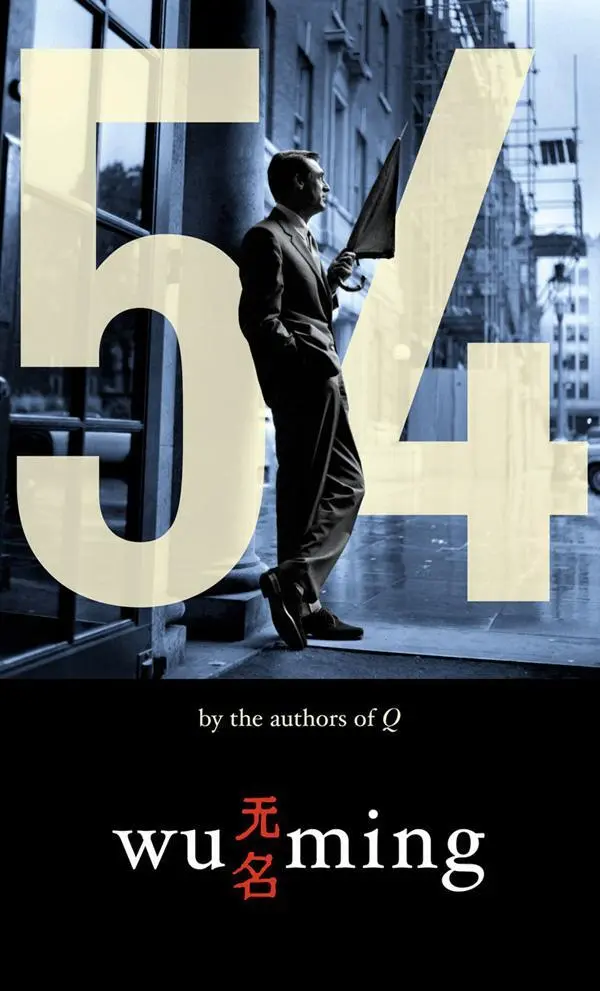
Set during the height of the Cold War-with the world divided into East and West-54 features Italian partisans, KGB agents, Parisian lowlifes, and cameos by David Niven, Marshal Tito, and Grace Kelly. Wu Ming brings us a cinematic romp that is by turns edgy social satire and modern comic send up.
54 — читать онлайн бесплатно полную книгу (весь текст) целиком
Ниже представлен текст книги, разбитый по страницам. Система сохранения места последней прочитанной страницы, позволяет с удобством читать онлайн бесплатно книгу «54», без необходимости каждый раз заново искать на чём Вы остановились. Поставьте закладку, и сможете в любой момент перейти на страницу, на которой закончили чтение.
Интервал:
Закладка:
‘To facilitate useful exchange between the two countries’, ‘Italy and Yugoslavia must collaborate for the defence of peace and the prosperity of the two nations’.
Rizzi remembers the whistles that had risen up from the square when the Prime Minister had uttered those phrases, too obliging to Tito and to a pact that flattered Yugoslavia just to keep it away from Moscow. The rights of the people were being trampled by the politicians: worse than in Korea and Vietnam, because at least there everyone spoke the same language, in the North and the South. Their regimes might have been different but their culture, their traditions, their spirit were not. If it had been up to the British, Trieste would have become another Berlin, divided into sectors, dismembered. And in Vietnam there had been talk of a referendum, of unification: why did no one think of asking the opinion of the people in Zone B? In the face of Wilson and the principle of self-determination.
But those gloomy thoughts, the image of Scelba’s bald pate on the city hall balcony, were distracting him from his verses. So what was missing? The irredentist lands, close by in the distance. The hubbub and the sadness. His pen glided across the paper:
Trieste! Italy! — yet our joy subsides;
We think of others not so far away
But cruelly severed from their fatherland
Who should be celebrating here today.
Excellent. Nearly done. Just a few more lines in the notebook:
Einaudi pins the gold medal to the gigantic banner that Rome donated to the city. The loudspeakers articulate the reasons for the honour:
‘Outstretched for centuries, pointing in Italy’s name to ways of unifying peoples of different clans, proudly it participated with our country’s finest in the independence and unity of the Fatherland, during the long vigil it confirmed with the sacrifice of the martyrs the will to be Italian. That will sealed with blood and with the heroism of the volunteers of the 1914 ‒ 18 war. In particularly difficult conditions, under Nazi artillery fire, in the partisan war it demonstrated how great its yearning was for justice and for freedom, which it won by using its vital force to rout the oppressor. In recent dramatic events and in the humiliation of Italy, against the treaties seeking to part it from the motherland, with tenacity and passion equal to its hope, it confirmed to the world its unshakeable right to be Italian. An example of inestimable patriotic faith, of constancy against all adversity, and heroism.’
The day had come to an end in San Giusto’s. The Basilica was packed; so was the square, despite the bora that was just starting up. After the Te Deum of thanks, the bishop had recalled the dismembered diocese, the Istrian parishes transferred to the control of Lubljana and Parenzo. On the tower, the banner with the medal had greeted the crowd, along with the chimes of the big bell.
Rizzi thought about how chilly it had grown. He glanced out of the window: the wind wouldn’t stop blowing, it was freezing. He would have to buy a new coat. A coat that was as warm as his old grey duffel-coat. The GMA agents had taken it from him without so much as a by-your-leave. An exchange of clothes, it seemed. In one of the cafés in the centre of the city. But then why hadn’t they given it back to him? Given it back to him? They’d kicked his arse and sent him home.
His leg still hurt.
And his arse wasn’t what it had been, either.
IX Moscow, the Lubyanka, 21 November
General Serov lays out the documentation on the desk, the pages perfectly aligned.
The latest information from Saigon, the capital of South Vietnam.
A report on Bao Dai, the pantomime ‘emperor’. A moronic grin and a stolid expression on banknotes and stamps. He was outside history, if he had ever been in it.
Report on the new Prime Minister Ngo Dihn Dien, a pious man with an unhealthy attraction for crucifixes, in power in a Buddhist country. His brother: an opium addict with foolish pseudointellectual aspirations, and a passionate conspirator. His sister-inlaw: a slut, consumed with hatred for the communists. A corrupt regime supported by America.
The latest information from Hanoi, the capital of North Vietnam. Russia’s ‘friends’, with China up to its eyeballs in a quagmire of blood and shit.
An unstable equilibrium. ‘Peace’ wouldn’t last long.
The latest information on Tito, on the Italians who were abandoning Istria and Dalmatia, on that scandal, the ‘Montesi case’.
Information on Guatemala, once again the exclusive property of the United Fruit Company after the coup in which the CIA had toppled an ‘inconvenient’ government.
Latin America, the Americans’ backyard, a thin stratum of land over seething magma. That was the new front, Serov would bet on it.
Dispatches from France and Switzerland.
Report on ‘Vladimir’ and ‘Estragon’. Based in Paris, the Latin Quarter. They socialised with artists, pseudo-revolutionaries, compulsive liars, self-styled ‘prophets’ of even more self-styled movements. A Romanian by the name of Isidore Isou. Utter nonsense. Azzoni and Mariani were wallowing in it all. There wasn’t a single telephoto image that didn’t show Mariani laughing, teeth on full view, cheekbones and eyebrows practically touching. Azzoni looked into the lens.
They would continue to use them. Clowns understand other clowns, and the world was now one great big circus parade.
Latest information on everybody and everything.
What a frenetic year. A year that had changed the face of the world.
The birth of the KGB. The Berlin Conference. The rearmament of Germany and its membership of NATO. The defeat of the French in Indochina and the division of Vietnam. Tito. The ruin of McCarthy. Tito and Cary Grant. Nuclear experiments in the deserts and the middle of the oceans. The end of the ‘postwar period’.
The birth of monsters throughout the Soviet Union: two-headed lambs, calves without legs, a goat with only one eye. Inauspicious events loomed.
Just for a change.
General Serov rose to his feet, cracked the joints of his neck and shoulders, and walked the short distance that separated him from the window. He looked through the pane and once more, as he did every day, he felt part of a big clockwork machine.
Part of history.
X Mexico City, some time later
‘You really don’t know the story of that bastard Rasputin? Ok, if you’ve never been to Moscow I can see you might not know it, compadres . You’ve got to know that when the conspirators went to get him, in the depths of the night, at his house, Rasputin, who was a pretty big bloke, tall and fuerte , managed to escape by throwing himself into the river from a window. But it was invierno and the water was freezing, so the fucker died of exposure after a few strokes. His corpse was recovered and carried to the shore, as stiff as a stockfish. Everyone was amazed that his dick was todavía hard. The maid, who had served him for many years and who had also been his lover, had a real veneration for his cock. You know what Russian peasants are like, simple and superstitious. And she thought she could save the symbol of his manly vigour and his potency. So she cut off his knob. And apparently it was enormous, más que treinta centimetros! And she ran off with it. De aquel moment no one knows lo que pasò , what happened to the member. There are legends, certainly, strange stories, about the relic, but it seems that it passed from hand to hand, that it was sold for a fortune, that the White Russians were looking high and low for it, to turn it into a banner for the counter-revolution. And the Bolsheviks were after it as well, to burn it, and scatter the ashes to the viento . Moral of the story, now we know donde está Rasputin’s cock. In the Museum of Natural History in Moscow. If you look in the case of the stuffed monk seal, down at the bottom, you’ll see the seal pups, with their characteristic hood. Except that one of them isn’t a seal pup.’
Читать дальшеИнтервал:
Закладка:
Похожие книги на «54»
Представляем Вашему вниманию похожие книги на «54» списком для выбора. Мы отобрали схожую по названию и смыслу литературу в надежде предоставить читателям больше вариантов отыскать новые, интересные, ещё непрочитанные произведения.






Обсуждение, отзывы о книге «54» и просто собственные мнения читателей. Оставьте ваши комментарии, напишите, что Вы думаете о произведении, его смысле или главных героях. Укажите что конкретно понравилось, а что нет, и почему Вы так считаете.