Wu Ming - Altai
Здесь есть возможность читать онлайн «Wu Ming - Altai» весь текст электронной книги совершенно бесплатно (целиком полную версию без сокращений). В некоторых случаях можно слушать аудио, скачать через торрент в формате fb2 и присутствует краткое содержание. Год выпуска: 2013, Издательство: Verso, Жанр: Историческая проза, на английском языке. Описание произведения, (предисловие) а так же отзывы посетителей доступны на портале библиотеки ЛибКат.
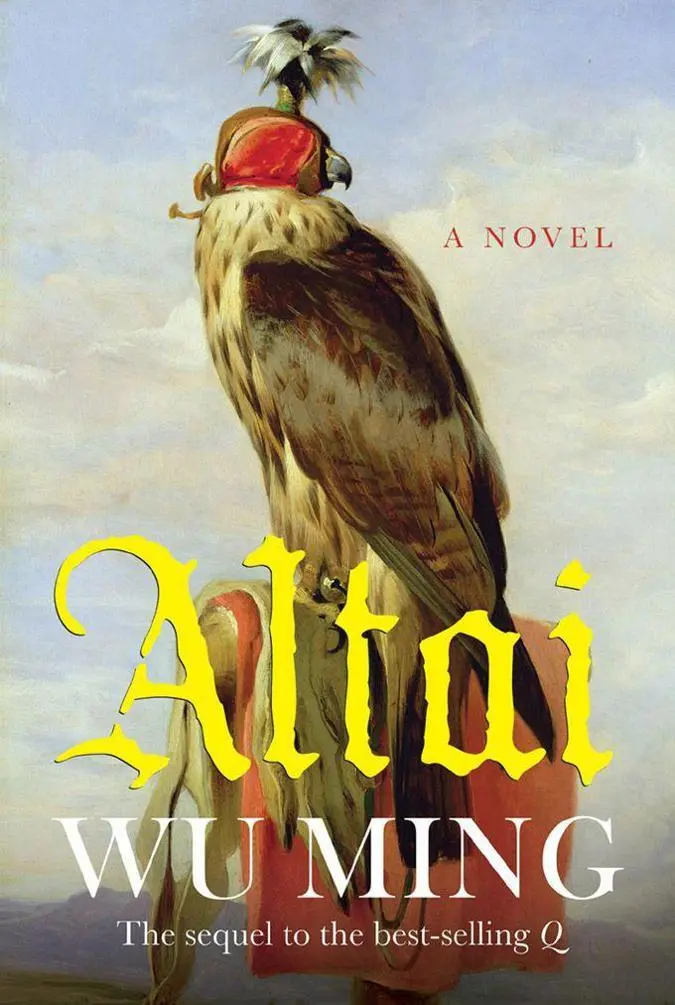
- Название:Altai
- Автор:
- Издательство:Verso
- Жанр:
- Год:2013
- ISBN:нет данных
- Рейтинг книги:3 / 5. Голосов: 1
-
Избранное:Добавить в избранное
- Отзывы:
-
Ваша оценка:
Altai: краткое содержание, описание и аннотация
Предлагаем к чтению аннотацию, описание, краткое содержание или предисловие (зависит от того, что написал сам автор книги «Altai»). Если вы не нашли необходимую информацию о книге — напишите в комментариях, мы постараемся отыскать её.
Through a series of deadly political games leading all the way to the Sultan’s palace in Constantinople, De Zante and his companions spiral headfirst toward a conflict in which the great empires of the Republic of Venice and the Ottomans threaten the very foundations of civilization.
Altai — читать онлайн бесплатно полную книгу (весь текст) целиком
Ниже представлен текст книги, разбитый по страницам. Система сохранения места последней прочитанной страницы, позволяет с удобством читать онлайн бесплатно книгу «Altai», без необходимости каждый раз заново искать на чём Вы остановились. Поставьте закладку, и сможете в любой момент перейти на страницу, на которой закончили чтение.
Интервал:
Закладка:
Solomon Ashkenazi was studying the revenue of Cyprus, the income from vines and olives, for the future king of the island. Nasi seemed to live in his carriage, between the Palazzo Belvedere and the Seraglio. There had been no sign, on the other hand, from Ismail, since he returned from Bandirma. Nasi told me the old man was writing his memoirs.
Because of my somber mood, the doubts that the German had instilled in me were about to spill out with great violence. They dampened the enthusiasm that I needed to cauterize my self-inflicted wound. That weird old man from a far-off place had placed a little wedge in Nasi’s great edifice, enough to open it up a crack. The story of Joseph began to torment me again. Showered with honors by the pharaoh, he had made the Jews prosper in Egypt, but when that pharaoh died, his successor had enslaved the people of Israel.
What would happen if Selim were suddenly to die? What guarantees did we have that the new sultan would go on protecting us? We didn’t have a Jewish army; we had no weapons. How could we defend the new Zion?
When I set out my doubts, Nasi heard in them my cry for help. I wanted him to startle me again, to take me up a mountain and let me see even further. And my mentor did exactly that.
The place he took me to was the laboratory of the greatest inventor on earth. Taqi al-Din Muhammad ibn Ma’ruf al-Shami al-Asadi, whom the Turks called more simply Takiyuddin. He was a Syrian who had grown up in Egypt, a man of faith and science, a judge and mathematician, an engineer and astronomer. He had come to the city on the invitation of the Sultan. Selim intended to finance his studies and his inventions, and there was already talk of a huge astronomical observatory, even bigger than the one in Samarkand.
The gray beard and the wrinkles beside his laughing eyes revealed that Takiyuddin was even older than Nasi. I noticed how similar the two men were, though very different in feature. The affinity was intellectual: two geniuses confronting one another.
The precise order that reigned in Takiyuddin’s laboratory did not seem dictated only by practical considerations. Mathematics and geometry also desire to enchant the eye, as happens in the most successful architecture. The desks, the equipment and the machines formed an arabesque that filled the vast room, made of wheels and pulleys, hoists and ladders. Forming a colored backdrop were shelves filled with jars, boxes, powders and liquids. Takiyuddin welcomed us, and with his arms spread wide he introduced us to his creations.
“Just look, my friends. These machines speak for themselves.”
Immediately twelve chimes confirmed his assertion. They came from a clock to my right, the size of a double-doored cabinet, like the one I had seen in the library at Palazzo Belvedere. Judging by the inscriptions, this one was capable of recording not only the hour and the calendar date, but also the time of day, the phases of the moon, and the positions of signs of the zodiac.
It reminded me, though much smaller in form, of the clock that dominates Saint Mark’s Square, with the two Moors striking the bell.
Takiyuddin came up beside me, holding a glass ball the size of an orange. A thin gold chain held it around his neck like a pendant. He looked first at it and then at the clock, and at last he nodded with satisfaction. Within the sphere I glimpsed a numbered dial. I had heard of clocks so small that you could wear them on your person, but I had assumed they were legends. Now, on the other hand, I was seeing one close up, and I couldn’t work out how weights and counterweights could be contained, going up and down, in such a tiny space. Neither could I understand what use such an object might be. Perhaps to a country squire, because in a city like Venice or Constantinople, church bells or muezzins were more than enough to help mark out the day, the same for everyone.
Takiyuddin opened a door below the wall clock and took out a peg the size of a finger. Then he slipped it into one of many holes that ran around the main dial and said only that in a quarter of an hour, at the sound of the alarm bell, he would have to say good-bye, having been summoned to the Sultan’s palace.
Spellbound, I stared at the numbers and pointers. I imagined that the metal arrow that told the hour would continue its course around the dial until it struck the peg inserted by Takiyuddin, setting off the alarm mechanism. I would have stayed there watching for the whole quarter hour, to see whether my hypothesis was correct, but a strong smell of roasted meat drew my attention toward the fireplace, where a spit laden with chickens was turning over the embers, without anyone there to move it.
Suspended just behind the birds, where the flames were high, was a big copper teakettle with a narrow spout. Above that was the chimney flue, and if you lowered your head a little, you could see a paddle wheel right in the opening. The kettle, with an impetuous puff, shot steam from its spout, and the hot, powerful exhalation struck the paddles. They turned, and a system of arms, serrated wheels and pulleys communicated that circular motion to the spit. “Would you ever have thought that a teakettle could roast chickens?” remarked Don Yossef. The sight of such ingenious machines had a cheering effect, and I certainly needed that, but I was beginning to wonder why Nasi had brought me there.
Before I could ask him, he put in my hands a metal tube with a lens fixed in each end. He told me to put it to one eye and look through it, out of the window, toward a faraway object. I chose a minaret on the Mosque of Suleyman.
The effect took my breath away. I could see the little window from which the muezzin summoned the faithful to prayer as if it were only a few feet away from us. I instinctively thought of how useful and at the same time how dangerous such a tool would be if it were made accessible to everyone. Spies would be able to look into people’s houses from a comfortable distance. Governments would be able to control the activities of their subjects. An invention of this kind would change the practice of my trade completely.
I was about to convince myself that this was the reason for our visit, when the bell of the clock started striking over and over again, making a diabolical racket.
Takiyuddin apologized, saying that he couldn’t keep the Sultan waiting. And besides, he knew that we, too, had another appointment.
It was only then that I became aware of the presence of a person in the darkest corner of the big laboratory. I recognized the amused expression of Master Fitch. That day he was wearing his usual leather jacket and dark breeches, but he had allowed himself the affectation of a white feather in his hat.
Coming forward and bowing, the young Englishman invited us to approach an object covered by a gray cloth. I couldn’t imagine what new contraption it might be.
“This is the proof you wanted,” he said in his comical accent. He lithely slipped the cover off to reveal an ordinary piece of artillery mounted on a wooden gun carriage.
38
“The scale is reduced,” Fitch said, “but the proportions are correct. The iron was smelted in Takiyuddin’s foundry, as you requested. He himself can guarantee the success of the propulsion and the resilience of the weapon.”
“Good,” murmured Nasi, stroking the gun carriage. He slipped his hand and the whole of his forearm inside the mouth of the weapon, exploring its inner surfaces. “Very good,” he repeated. Then he turned to me.
“This, my friend, is the answer to the doubts that are gnawing at your soul.” I was about to say something, but he raised a hand and stopped me. “A kingdom cannot say it is free until it is capable of defending its own freedom. That is an incontrovertible truth. But where the strength of an army cannot reach, ingenuity can.”
Читать дальшеИнтервал:
Закладка:
Похожие книги на «Altai»
Представляем Вашему вниманию похожие книги на «Altai» списком для выбора. Мы отобрали схожую по названию и смыслу литературу в надежде предоставить читателям больше вариантов отыскать новые, интересные, ещё непрочитанные произведения.









Обсуждение, отзывы о книге «Altai» и просто собственные мнения читателей. Оставьте ваши комментарии, напишите, что Вы думаете о произведении, его смысле или главных героях. Укажите что конкретно понравилось, а что нет, и почему Вы так считаете.