Peter Marren - Nature Conservation
Здесь есть возможность читать онлайн «Peter Marren - Nature Conservation» — ознакомительный отрывок электронной книги совершенно бесплатно, а после прочтения отрывка купить полную версию. В некоторых случаях можно слушать аудио, скачать через торрент в формате fb2 и присутствует краткое содержание. Жанр: unrecognised, на английском языке. Описание произведения, (предисловие) а так же отзывы посетителей доступны на портале библиотеки ЛибКат.
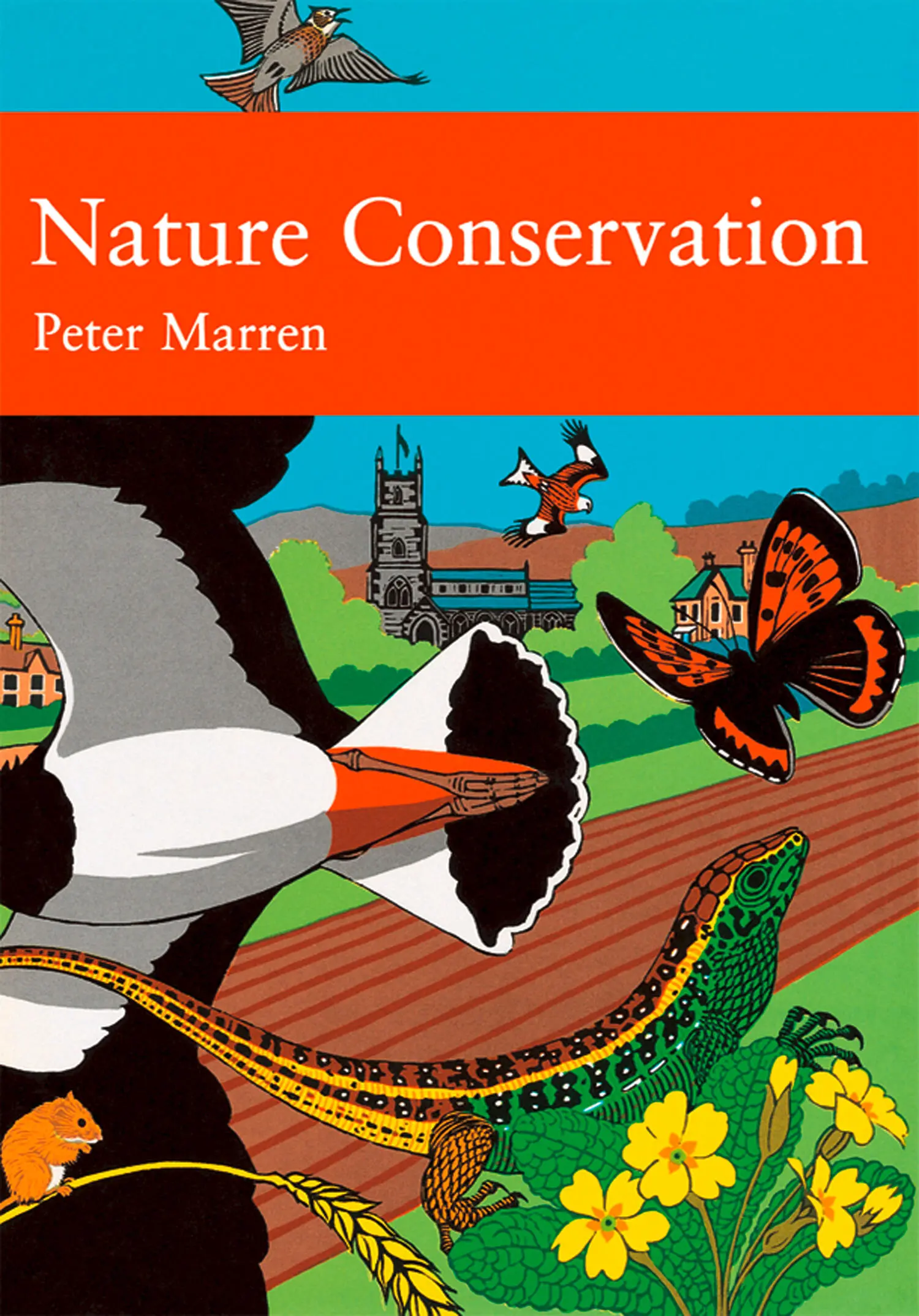
- Название:Nature Conservation
- Автор:
- Жанр:
- Год:неизвестен
- ISBN:нет данных
- Рейтинг книги:3 / 5. Голосов: 1
-
Избранное:Добавить в избранное
- Отзывы:
-
Ваша оценка:
Nature Conservation: краткое содержание, описание и аннотация
Предлагаем к чтению аннотацию, описание, краткое содержание или предисловие (зависит от того, что написал сам автор книги «Nature Conservation»). Если вы не нашли необходимую информацию о книге — напишите в комментариях, мы постараемся отыскать её.
Nature Conservation — читать онлайн ознакомительный отрывок
Ниже представлен текст книги, разбитый по страницам. Система сохранения места последней прочитанной страницы, позволяет с удобством читать онлайн бесплатно книгу «Nature Conservation», без необходимости каждый раз заново искать на чём Вы остановились. Поставьте закладку, и сможете в любой момент перейти на страницу, на которой закончили чтение.
Интервал:
Закладка:
In 1992, Malcolm Rifkind, Secretary of State for Scotland, told his newly established natural heritage body that if it was not ‘a thorn in his flesh from time to time’ then it would not be doing its job properly. It was expected, however, to ‘work with Scotland’s people’ more successfully than its predecessor, which meant not running too far ahead of public opinion. Scottish Natural Heritage was set up by Act of Parliament in 1992. It combined the functions of the old NCC in Scotland and the Countryside Commission for Scotland, a disproportionately small body compared with England’s Countryside Commission (for Scotland had no National Parks), responsible for footpaths and non-statutory ‘National Scenic Areas’. ‘SNH’ was given a generous first-year budget of £34.6 million and inherited a combined staff of about 530. Its chairman, the television personality Magnus Magnusson, was an unashamed populist and ‘aggressive moderate’, professing to dislike ‘the harsh voice of single-minded pressure groups’ quite as much as ‘the honeyed tones of the developer’. The new chief executive, Roger Crofts, came fresh from the Scottish Office, as did two of his senior directors.
Although the nature conservation responsibilities of SNH were similar to its predecessor – new legislation had not changed the statutory instruments in Scotland, which were still SSSIs – the ground rules were different. SNH’s founding statute emphasised the magic word ‘sustainable’ for the first time in British law, although exactly what was meant by the duty of ‘having regard to the desirability of securing that anything done, whether by SNH or any other person ( sic ) in relation to the natural heritage of Scotland, is undertaken in a manner which is sustainable’ – is open to interpretation! It was plainly ridiculous to make sustainability a duty of a minor government agency but not of the Government itself (‘like giving a wee boy a man’s job’). SNH put on record its view that sustainable development in Scotland required serious changes in government policy and the way public money was spent. But it, like English Nature, also espoused a corporate ethos that sought consensus and partnership, which inevitably means doing things more slowly. Confrontation was the policy of the bad old days.
Des Thompson, SNH’s senior ornithologist, surveying Flow Country patterned bogs by the Thurso River in Caithness. (Derek Ratcliffe)
The second ground rule was accountability. To give at least the semblance of bringing SNH ‘closer to its constituents’, it was organised into four local boards, each with its own budget, work programme, and salaried board members, and responsible for three or more area ‘teams’. Predictably enough, the regional boards proved expensive to run, sowed wasteful bureaucracy and duplication of effort, and set one local ‘power base’ against another. They were abandoned in 1997, and replaced by a new structure with 11 ‘areas’ overseen by three ‘Area Boards’. This was SNH’s third administrative upheaval in five years.
Another significant change was what the former NCC’s Scottish director Morton Boyd called ‘the fall of science’. The minister in charge of environmental affairs at the Scottish Office was Sir Hector Monro (now Lord Monro of Langholm). He had served on the NCC’s Council ‘and had grown to dislike scientists’ (Boyd 1999). The role of science must be advisory, he insisted, and should not be used as the basis of policy. Hence SNH’s top scientist, Michael B. Usher, was not the ‘Chief Scientist’, as before, but the ‘Chief Scientific Adviser’, and he was eventually excluded from SNH’s main management team. Nor were SNH’s local boards particularly rich in scientific experience. The scientists sat on a separate research board under Professor George Dunnet, later named the Scientific Advisory Committee. It was rich in IQs but poor in influence, and, fed up with being repeatedly ignored, Dunnet resigned in 1995. As Boyd commented, the standing of scientists is not what it once was. Not only were they held responsible for the disputes that had made the NCC unpopular in Scotland, scientists were also seen as an unacceptable ‘élite’. The new approach had to be ‘people-led’.
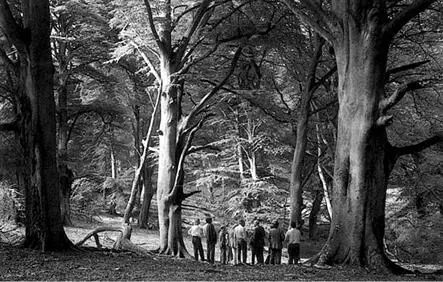
Humility? The NCC’s scientific advisory committee dwarfed by the great beeches of the New Forest. (Derek Ratcliffe)
With the Scottish Office breathing down its neck, landowners asserting themselves and voluntary bodies inclined to be publicly critical, SNH was obliged to tiptoe over eggshells. Crofts kept in close touch with his minister and senior civil servants, and some saw SNH’s new relationship with Government as one of servant and master. Rifkind’s words, it seemed, were more to be honoured in the breach than the observance. When SNH tried to introduce notions of sustainability into transport policy, for instance, it was firmly put in its place by his successor, Ian Lang. The only thorns he would be prepared to tolerate, it seemed, were rubber ones.
All the same, SNH’s reports give the impression of substantial progress in uncontroversial matters, with various initiatives carefully ticked off against Scottish Office targets. It has, for example, played a useful role in helping walkers and landowners to find common ground through an Access Forum. This has worked because landowners saw voluntary agreements on access as a way of staving off legislation, while the ramblers saw it as a means of ‘trapping them into compromise on a matter of rights’ (Smout 2000). The result was a grandly named ‘Concordat on Access to Scotland’s hills and mountains’. Though legislation is coming anyway, the talks have at least defused the situation by liberalising entrenched attitudes, and access is not now the contentious issue in Scotland that it became in England.
In terms of wildlife protection, SNH has kept a lower profile than the NCC, although it has experienced much the same problems. SNH’s approach has been more tactful, and it has tried as far as possible to build bridges with bodies like the Crofter’s Association, and with local communities. Local accountability was impressed upon it even more strongly by the new Scottish Parliament. In the early days, SNH inherited several outrageous claims for compensation by the owners of large SSSIs. It also had to cope with a statutory appeals system for SSSIs imposed on SNH by a group of landowners in the House of Lords led by Lord Pearson of Rannoch. Although in practice the appeals board was given little work to do, its existence tended to make the SNH cautious about notifying new SSSIs, and conservative about recommending Euro-sites. National Nature Reserves were also reviewed; those with weak agreements and no immediate prospect of stronger ones were struck off, or ‘de-declared’ (see Chapter 5). SNH was similarly cautious about acquiring land or helping others to acquire it. For example, SNH smiled benignly at the new owners of Glen Feshie, part of the Cairngorms National Nature Reserve, despite knowing nothing about them, and was not allowed to contribute so much as a penny towards the purchase price of Mar Lodge (only to its subsequent management). Like English Nature, it has stepped back from direct management into a more advisory role.
SNH are probably right that the future of Scotland’s wildlife will benefit more from changing attitudes and shifting subsidies than from putting up barricades around special sites. While about 10 per cent of Scotland (and Wales) is SSSI, compared with 7 per cent in England, nearly three-quarters of the land is subject to the Common Agricultural Policy, while the equally profligate Common Fisheries Policy presides over Scottish inshore waters. Hence the Scottish Office’s 1998 White Paper People and Nature , while voicing doubts about basing conservation policy on SSSIs, does at least contain a ray of hope by underlining the legitimate claims of ‘the wider community’ on the way land is managed; on what Smout has called ‘the public nature of private property’. The forthcoming National Park at Loch Lomondside and The Trossachs may come to symbolise a new ‘covenant’ between land and people. SNH has also won plaudits for determinedly tackling wildlife crime, and for its leadership in trying to resolve the age-old conflict of raptors and game management. The Scottish Executive recently showed its appreciation of SNH, and the challenging nature of its work, by increasing its budget. It is difficult for outsiders to know to what extent SNH has helped to change hearts and minds in Scotland, but it can surely be given some of the credit.
Читать дальшеИнтервал:
Закладка:
Похожие книги на «Nature Conservation»
Представляем Вашему вниманию похожие книги на «Nature Conservation» списком для выбора. Мы отобрали схожую по названию и смыслу литературу в надежде предоставить читателям больше вариантов отыскать новые, интересные, ещё непрочитанные произведения.




![Various - Birds and Nature, Vol. 12 No. 5 [December 1902]](/books/745517/various-birds-and-nature-vol-12-no-5-december-thumb.webp)
![Various - Birds and Nature Vol. 11 No. 2 [February 1902]](/books/745533/various-birds-and-nature-vol-11-no-2-february-1-thumb.webp)
Обсуждение, отзывы о книге «Nature Conservation» и просто собственные мнения читателей. Оставьте ваши комментарии, напишите, что Вы думаете о произведении, его смысле или главных героях. Укажите что конкретно понравилось, а что нет, и почему Вы так считаете.