Iain Finlayson - Browning
Здесь есть возможность читать онлайн «Iain Finlayson - Browning» — ознакомительный отрывок электронной книги совершенно бесплатно, а после прочтения отрывка купить полную версию. В некоторых случаях можно слушать аудио, скачать через торрент в формате fb2 и присутствует краткое содержание. Жанр: unrecognised, на английском языке. Описание произведения, (предисловие) а так же отзывы посетителей доступны на портале библиотеки ЛибКат.
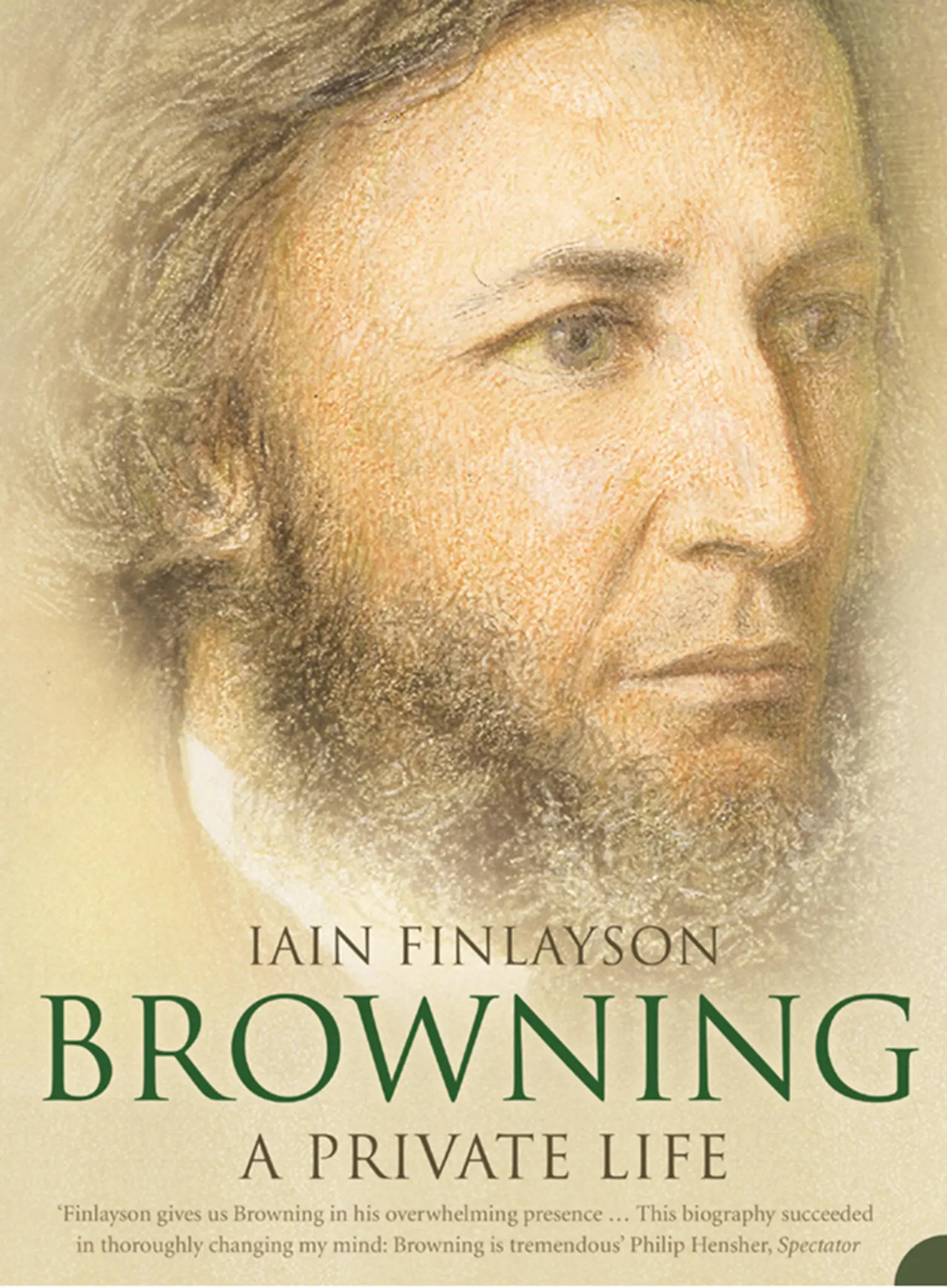
- Название:Browning
- Автор:
- Жанр:
- Год:неизвестен
- ISBN:нет данных
- Рейтинг книги:5 / 5. Голосов: 1
-
Избранное:Добавить в избранное
- Отзывы:
-
Ваша оценка:
Browning: краткое содержание, описание и аннотация
Предлагаем к чтению аннотацию, описание, краткое содержание или предисловие (зависит от того, что написал сам автор книги «Browning»). Если вы не нашли необходимую информацию о книге — напишите в комментариях, мы постараемся отыскать её.
Browning — читать онлайн ознакомительный отрывок
Ниже представлен текст книги, разбитый по страницам. Система сохранения места последней прочитанной страницы, позволяет с удобством читать онлайн бесплатно книгу «Browning», без необходимости каждый раз заново искать на чём Вы остановились. Поставьте закладку, и сможете в любой момент перейти на страницу, на которой закончили чтение.
Интервал:
Закладка:
The letter goes on, very affectingly, very emotionally, and in important respects quite misleadingly, to summarize her life, to draw comparisons between Robert’s full, heady experience of an active, happy life—‘You are Paracelsus’—and the life that Elizabeth has lived ‘only inwardly; or with sorrow , for a strong emotion. Before this seclusion of my illness, I was secluded still, and there are few of the youngest women in the world who have not seen more, heard more, known more, of society, than I, who am scarcely to be called young now. I grew up in the country—had no social opportunities, had my heart in books and poetry and my experience in reveries. My sympathies drooped towards the ground like an untrained honeysuckle—and but for one , in my own house—but of this I cannot speak.’ Here Elizabeth drew a veil over the memory of Bro.
It was a lonely life, growing green like the grass around it. Books and dreams were what I lived in—and domestic life only seemed to buzz gently around, like the bees about the grass. And so time passed and passed—and afterwards, when my illness came and I seemed to stand at the edge of the world with all done, and no prospect (as it appeared at one time) of ever passing the threshold of one room again; why then, I turned to thinking with some bitterness (after the greatest sorrow of my life had given me room and time to breathe) that I had stood blind in this temple I was about to leave—that I had seen no Human nature, that my brothers and sisters of the earth were names to me, that I had beheld no great mountain or river, nothing in fact. I was as a man dying who had not read Shakespeare, and it was too late! do you understand? And do you also know what a disadvantage this is to my art? Why, if I live on and yet do not escape from this seclusion, do you not perceive that I labour under signal disadvantages—that I am, in a manner, as a blind poet ? Certainly, there is a compensation to a degree. I have had much of the inner life, and from the habit of self-consciousness and self-analysis, I make great guesses at Human nature in the main. But how willingly I would as a poet exchange some of this lumbering, ponderous, helpless knowledge of books, for some experience of life and man, for some …
And here she gives up, helpless and speechless after such a powerful passage of self-confession and self-revelation. She felt, perhaps, she had gone too far and cut it off with a bathetic moral banality—‘But all grumbling is a vile thing’—promptly followed by a pious platitude—‘We should all thank God for our measures of life, and think them enough for each of us.’
We can read all this more objectively than subjectively, Elizabeth wrote it with passion, some element of self-pity and, in the light of what we now know about her early life, some self-delusion and self-dramatization. To take only the most glaringly self-serving example, if she had been lonely it had been through her own choice to avoid company. The impression she gave (by omission rather than direct statement) of being all but a solitary orphan child brought up by the fairies, was hardly fair to her two devoted parents or the eleven younger brothers and sisters who doted upon their demanding older sister. She might have felt solitary from time to time, she might have longed to be less alone sometimes, she might have felt intellectually isolated, but rarely could she have felt lonely in a social sense. At some cost to others, Elizabeth had bought time and space for her reveries, for her inner life, beyond which the Barretts buzzed like bees in the domestic environment, conscientious and generous in their efforts to care for her health, keep her amused, run her errands, and cater to her every comfort.
Nevertheless, there can be little doubt that what she wrote on 20 March 1845 was true to her deepest feelings, to her perceptions of her situation, if not strictly accurate as to domestic reality and psychological truth. The letter also seemed to mark a real and profound desire that she should move towards a more active life, that time was no longer on her side—‘I, who am scarcely to be called young now’. In March 1845, on her thirty-ninth birthday, she entered her fortieth year, though the anniversary merited no mention in her letters to Robert. There is a suggestion, in Elizabeth’s appeals to Robert to make the imaginative effort to understand , to believe her self-assessment, after her observation that he distrusted her, that personal revelations had by now become necessary and that Robert, himself free to move, represented some hope (not yet quantifiable) of her own release to her personal benefit and the benefit of her poetry.
On the contrary, Robert, surfeited with being active in the world, understood that inwardness and seclusion were desirable and essential conditions for creative activity, for the poetic art, and that the products of the cultivated imagination were of more value than mere representations of reality. Elizabeth’s ‘lamentable disadvantage’ was in fact her most priceless advantage. Robert valued very highly the ‘visionary utterances’ in Elizabeth’s poetry and exalted her professed ‘disadvantage’ above what Daniel Karlin characterizes as ‘the process of interaction between the mind and “external influences” out of which his own “dramatic” poetry was made.’ 134 Elizabeth had the measure of Robert and his poetry when she wrote on 17 April, ‘I have a profound conviction that where a poet has been shut from most of the outward aspects of life, he is at a lamentable disadvantage. Can you, speaking for yourself, separate the results in you from the external influences at work around you, that you say so boldly that you get nothing from the world? You do not directly , I know—but you do indirectly & by a rebound. Whatever acts upon you, becomes you —& whatever you love or hate, whatever charms you or is scorned by you, acts on you & becomes you.’ No critic was ever more acutely perceptive about the well-springs of Robert’s work than Elizabeth.
Her estimations of his character were, at this early stage, less sure—though, to be fair, she was working with inadequate information. Elizabeth had read Robert’s poems, but she had not yet fully read the man. The two were not, as he had warned her, to be confused. Robert had provided some personal information about himself and his family, of course, and she had gleaned a little more from John Kenyon and Miss Mitford: the former biased in Robert’s favour, the latter mildly prejudiced against him. The curtain had been rung up on the play, but neither of the principals had yet made their first entrances. They were still exchanging dialogue as offstage voices.
The preliminary scenes had been carefully set, principally by Robert. He had posed himself solitary at his desk with spiders and skull; he had pictured himself amidst a glittering crowd of celebrated men and women—a wealth of writers, an amplitude of artists, a surfeit of society beauties—weary of their dinner tables and ballrooms. Elizabeth had already conjured him, largely through his poetry, as a heroic figure, and Robert himself had impressed upon her his resolve in getting his own way in whatever he set his heart and mind upon gaining. What she did not yet fully understand, but had begun to suspect, was that he had cast her, sight unseen, as his leading lady, the romantic heroine. There were several objections to this, and she managed to play for time whenever Robert pressed for a meeting. Robert at first tended to assume that she deferred a face to face encounter on account of her invalidity, which, not having inquired too closely of Kenyon for particulars, he took to be greater and more debilitating than it was. In Robert’s letter, postmarked 13 May, he wrote to say, ‘I ask you not to see me so long as you are unwell or mistrustful of—No, no that is being too grand! Do see me when you can, and let me not be only writing myself.’
Читать дальшеИнтервал:
Закладка:
Похожие книги на «Browning»
Представляем Вашему вниманию похожие книги на «Browning» списком для выбора. Мы отобрали схожую по названию и смыслу литературу в надежде предоставить читателям больше вариантов отыскать новые, интересные, ещё непрочитанные произведения.




Обсуждение, отзывы о книге «Browning» и просто собственные мнения читателей. Оставьте ваши комментарии, напишите, что Вы думаете о произведении, его смысле или главных героях. Укажите что конкретно понравилось, а что нет, и почему Вы так считаете.