Dr. Pass - Economics
Здесь есть возможность читать онлайн «Dr. Pass - Economics» — ознакомительный отрывок электронной книги совершенно бесплатно, а после прочтения отрывка купить полную версию. В некоторых случаях можно слушать аудио, скачать через торрент в формате fb2 и присутствует краткое содержание. Жанр: unrecognised, на английском языке. Описание произведения, (предисловие) а так же отзывы посетителей доступны на портале библиотеки ЛибКат.
- Название:Economics
- Автор:
- Жанр:
- Год:неизвестен
- ISBN:нет данных
- Рейтинг книги:4 / 5. Голосов: 1
-
Избранное:Добавить в избранное
- Отзывы:
-
Ваша оценка:
Economics: краткое содержание, описание и аннотация
Предлагаем к чтению аннотацию, описание, краткое содержание или предисловие (зависит от того, что написал сам автор книги «Economics»). Если вы не нашли необходимую информацию о книге — напишите в комментариях, мы постараемся отыскать её.
Economics — читать онлайн ознакомительный отрывок
Ниже представлен текст книги, разбитый по страницам. Система сохранения места последней прочитанной страницы, позволяет с удобством читать онлайн бесплатно книгу «Economics», без необходимости каждый раз заново искать на чём Вы остановились. Поставьте закладку, и сможете в любой момент перейти на страницу, на которой закончили чтение.
Интервал:
Закладка:
derivativea financial instrument such as an OPTION or SWAP the value of which is derived from some other financial asset (for example, a STOCK or SHARE) or indices (for example, a price index for a commodity such as cocoa). Derivatives are traded on the FUTURES MARKETS and are used by businesses and dealers to ‘hedge’ against future movements in share, commodity, etc., prices and by speculators seeking to secure windfall profits. See LONDON INTERNATIONAL FINANCIAL FUTURES EXCHANGE (LIFFE), STOCK EXCHANGE.
derived demandthe DEMAND for a particular FACTOR INPUT or PRODUCT that is dependent on there being a demand for some other product. For example, the demand for labour to produce motor cars is dependent on there being a demand for motor cars in the first place; the demand for tea cups is dependent on there being a demand for tea. See MARGINAL REVENUE PRODUCT, FACTOR MARKETS, COMPLEMENTARY PRODUCTS.
deseasonalized datasee TIME SERIES ANALYSIS.
design rightsthe legal ownership by persons or businesses of original designs of the shape or configuration of industrial products. In the UK, the COPYRIGHT, DESIGNS AND PATENTS ACT 1988 gives protection to the creators of industrial designs against unauthorized copying for a period of ten years after the first marketing of the product.
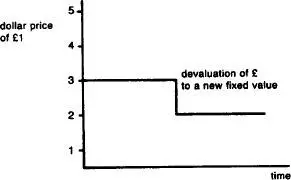
Fig. 44 Devaluation.A devaluation of the pound against the dollar.
devaluationan administered reduction in the EXCHANGE RATE of a currency against other currencies under a FIXED EXCHANGE-RATE SYSTEM; for example, the lowering of the UK pound (£) against the US dollar ($) from one fixed or ‘pegged’ level to a lower level, say from £1 = $3 to £1 = $2, as shown in Fig. 44. Devaluations are resorted to by governments to assist in the removal of a BALANCE OF PAYMENTS DEFICIT. The effect of a devaluation is to make IMPORTS (in the local currency) more expensive, thereby reducing import demand, and EXPORTS (in the local currency) cheaper, thereby acting as a stimulus to export demand. Whether or not a devaluation ‘works’ in achieving balance of payments equilibrium, however, depends on a number of factors, including: the sensitivity of import and export demand to price changes, the availability of resources to expand export volumes and replace imports and, critically over the long term, the control of inflation to ensure that domestic price rises are kept in line with or below other countries’ inflation rates. (See DEPRECIATION 1 for further discussion of these matters.) Devaluations can affect the business climate in a number of ways but in particular provide firms with an opportunity to expand sales and boost profitability. A devaluation increases import prices, making imports less competitive against domestic products, encouraging domestic buyers to switch to locally produced substitutes. Likewise, a fall in export prices is likely to cause overseas customers to increase their demand for the country’s exported products in preference to locally produced items and the exports of other overseas producers. If the pound, as in our example above, is devalued by one-third, then this would allow British exporters to reduce their prices by a similar amount, thus increasing their price competitiveness in the American market. Alternatively, they may choose not to reduce their prices by the full amount of the devaluation in order to increase unit profit margins and provide additional funds for advertising and sales promotion, etc. Compare REVALUATION. See INTERNAL-EXTERNAL BALANCE MODEL.
developed countryan economically advanced country the economy of which is characterized by large industrial and service sectors, high levels of gross national product and INCOME PER HEAD. See Fig. 51. See STRUCTURE OF INDUSTRY, DEVELOPING COUNTRY, ECONOMIC DEVELOPMENT.
developing country or less developed country or underdeveloped country or emerging country or Third World countrya country characterized by low levels of GROSS NATIONAL PRODUCT and INCOME PER HEAD. See Fig. 51. Such countries are typically dominated by a large PRIMARY SECTOR thatproduces a limited range of agricultural and mineral products and in which the majority of the POPULATION exists at or near subsistence levels, producing barely enough for their immediate needs, thus being unable to release the resources required to support a large urbanized industrial population. The term ‘developing’ indicates that, as seen by most such countries, the way to improve their economic fortunes is to diversify the industrial base of the economy by, in particular, establishing new manufacturing industries and by adopting the PRICE SYSTEM. To facilitate an increase in urban population necessary for INDUSTRIALIZATION, a nation may either IMPORT the necessary commodities from abroad with the FOREIGN EXCHANGE earned from the EXPORT of the (predominantly) primary goods, or it can attempt to improve its own agriculture. With appropriate ECONOMIC AID from industrialized countries and the ability and willingness on the part of a developing country, the transition into a NEWLY INDUSTRIALIZED COUNTRY could be made.
Certain problems do exist, however. For instance, increases in real income that are achieved need to be maintained, which means keeping population numbers in check. Illiteracy and social customs for large families tend to work against governmental efforts to increase the STANDARD OF LIVING of its citizens. Also, most of the foreign exchange earned by such countries is by exporting, mainly commodities (see INTERNATIONAL TRADE). See ECONOMIC DEVELOPMENT, STRUCTURE OF INDUSTRY, DEMOGRAPHIC TRANSITION, POPULATION TRAP, INTERNATIONAL COMMODITY AGREEMENTS, UNITED NATIONS CONFERENCE ON TRADE AND DEVELOPMENT, INTERNATIONAL DEBT.
development areaan area of the country formerly designated under UK REGIONAL POLICY (for example, the Northeast and South Wales) as qualifying for financial and other assistance in order to promote industrial regeneration. Development Areas reconfigured (in 2002) as ‘Tier 1 ASSISTED AREAS’ under a joint UK/EUROPEAN UNION regional policy programme. Development/Tier 1 areas are characterized by UNEMPLOYMENT rates that are significantly higher, and levels of INCOME PER HEAD that are significantly lower, than the national average. To remedy this situation, the usual practice is to encourage the establishment of new firms, the expansion of existing firms and the establishment of new industries by offering a variety of investment incentives: investment grants and allowances, tax write-offs, rent- and rate-free (or reduced) factories, etc.
In the UK, firms investing in the assisted areas are offered REGIONAL SELECTIVE ASSISTANCE, which is given on a discretionary basis to cover capital and training costs for projects that meet specified job-creation criteria.
development economicsthe branch of economics that seeks to explain the processes by which a DEVELOPING COUNTRY increases in productive capacity, both agricultural and industrial, in order to achieve sustained ECONOMIC GROWTH.
Much work in development economics has focused on the way in which such growth can be achieved, for instance, the question of whether agriculture ought to be developed in tandem with industry, or whether leading industries should be allowed to move forward independently, so encouraging all other sectors of society. Another controversial question is whether less developed countries are utilizing the most appropriate technology. Many economists argue for intermediate technology as most appropriate rather than very modern plants initially requiring Western technologists and managers to run them. Socio-cultural factors are also influential in attempting to achieve take-off into sustained economic growth. See ECONOMIC DEVELOPMENT, INFANT INDUSTRY.
Читать дальшеИнтервал:
Закладка:
Похожие книги на «Economics»
Представляем Вашему вниманию похожие книги на «Economics» списком для выбора. Мы отобрали схожую по названию и смыслу литературу в надежде предоставить читателям больше вариантов отыскать новые, интересные, ещё непрочитанные произведения.









Обсуждение, отзывы о книге «Economics» и просто собственные мнения читателей. Оставьте ваши комментарии, напишите, что Вы думаете о произведении, его смысле или главных героях. Укажите что конкретно понравилось, а что нет, и почему Вы так считаете.