Dr. Pass - Economics
Здесь есть возможность читать онлайн «Dr. Pass - Economics» — ознакомительный отрывок электронной книги совершенно бесплатно, а после прочтения отрывка купить полную версию. В некоторых случаях можно слушать аудио, скачать через торрент в формате fb2 и присутствует краткое содержание. Жанр: unrecognised, на английском языке. Описание произведения, (предисловие) а так же отзывы посетителей доступны на портале библиотеки ЛибКат.
- Название:Economics
- Автор:
- Жанр:
- Год:неизвестен
- ISBN:нет данных
- Рейтинг книги:4 / 5. Голосов: 1
-
Избранное:Добавить в избранное
- Отзывы:
-
Ваша оценка:
Economics: краткое содержание, описание и аннотация
Предлагаем к чтению аннотацию, описание, краткое содержание или предисловие (зависит от того, что написал сам автор книги «Economics»). Если вы не нашли необходимую информацию о книге — напишите в комментариях, мы постараемся отыскать её.
Economics — читать онлайн ознакомительный отрывок
Ниже представлен текст книги, разбитый по страницам. Система сохранения места последней прочитанной страницы, позволяет с удобством читать онлайн бесплатно книгу «Economics», без необходимости каждый раз заново искать на чём Вы остановились. Поставьте закладку, и сможете в любой момент перейти на страницу, на которой закончили чтение.
Интервал:
Закладка:
deposit account or time account or savings accountan individual’s or company’s account at a COMMERCIAL BANK into which the customer can deposit cash or cheques and from which he or she can draw out money subject to giving notice to the bank. Deposit accounts (unlike CURRENT ACCOUNTS, which are used to finance day-to-day transactions) are mainly held as a form of personal and corporate SAVING and used to finance irregular ‘one-off’ payments. INTEREST is payable on deposit accounts, normally at rates above those paid on current accounts, in order to encourage clients to deposit money for longer periods of time. Unlike with a current account, cheques cannot generally be drawn against deposit accounts. See BANK DEPOSIT.
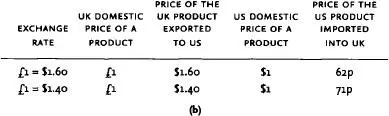
Fig. 43 Depreciation.(a) A depreciation of the pound against the dollar. (b)The effect of depreciation on export and import prices.

depreciation
1 a fall in the value of a CURRENCY against other currencies under a FLOATING EXCHANGE-RATE SYSTEM, as shown in Fig. 43 (a). A depreciation of a currency’s value makes IMPORTS (in the local currency) more expensive and EXPORTS (in the local currency) cheaper, thereby reducing imports and increasing exports, and so assisting in the removal of a BALANCE OF PAYMENTS deficit. For example, as shown in Fig. 43 (b), if the pound-dollar exchange rate depreciates from £1.60 to £1.40, then this would allow British exporters to reduce their prices by a similar amount, thus increasing their price competitiveness in the American market (although they may choose not to reduce their prices by the full amount of the depreciation in order to boost profitability or devote more funds to sales promotion, etc.) By the same token, the depreciation serves to raise the sterling price of American products imported into Britain, thereby making them less price-competitive than British products in the home market.
In order for a currency depreciation to ‘work’, four basic conditions must be satisfied:
(a) how successful the depreciation is depends on the reactions of export and import volumes to the change in relative prices, i.e. the PRICE ELASTICITY OF DEMAND for exports and imports. If these volumes are low, i.e. demand is inelastic, trade volumes will not change much and the depreciation may in fact worsen the situation. On the other hand, if export and import demand is elastic then the change in trade volume will improve the payments position. Balance-of-payments equilibrium will be restored if the sum of export and import elasticities is greater than unity (the MARSHALL-LERNER CONDITION);
(b) on the supply side, resources must be available, and sufficiently mobile, to be switched from other sectors of the economy into industries producing exports and products that will substitute for imports. If the economy is fully employed already, domestic demand will have to be reduced and/or switched by deflationary policies to accommodate the required resource transference;
(c) over the longer term, ‘offsetting’ domestic price, rises must be contained. A depreciation increases the cost of essential imports of raw materials and foodstuffs, which can push up domestic manufacturing costs and the cost of living. This in turn can serve to increase domestic prices and money wages, thereby necessitating further depreciations to maintain price competitiveness;
(d) finally, a crucial requirement in underpinning the ‘success’ of the above factors and in maintaining long-run equilibrium is for there to be a real improvement in the country’s industrial efficiency and international competitiveness. (See ADJUSTMENT MECHANISM entry for further discussion.) See BALANCE-OF-PAYMENTS EQUILIBRIUM, INTERNAL-EXTERNAL BALANCE MODEL, PRICE ELASTICITY OF SUPPLY. Compare APPRECIATION 1.
2the fall in the value of an ASSET during the course of its working life. Also called amortization. The condition of plant and equipment used in production deteriorates over time, and these items will eventually have to be replaced. Accordingly, a firm is required to make financial provision for the depreciation of its assets.
Depreciation is an accounting means of dividing up the historic cost of a FIXED ASSET over a number of accounting periods that correspond with the asset’s estimated life. The depreciation charged against the revenue of successive time periods in the PROFIT-AND-LOSS ACCOUNT serves to spread the original cost of a fixed asset, which yields benefits to the firm over several trading periods. In the period end BALANCE SHEET, such an asset would be included at its cost less depreciation deducted to date. This depreciation charge does not attempt to calculate the reducing market value of fixed assets, so that balance sheets do not show realization values.
Depreciation formulas base the depreciation charge on the HISTORIC COST of fixed assets. During a period of INFLATION, however, it is likely that the REPLACEMENT COST of an asset is likely to be higher than its original cost. Thus, prudent companies need to make provision for higher replacement costs of fixed assets. See INFLATION ACCOUNTING, CAPITAL CONSUMPTION, APPRECIATION 2.

depressed areaan area of a country suffering from industrial decline, resulting in an UNEMPLOYMENT rate that is significantly higher, and a level of INCOME PER HEAD that is significantly lower, than the national average. This situation can be tackled by REGIONAL POLICIES aimed at encouraging new firms and industries to locate in the area by offering them financial and other assistance. See ASSISTED AREA.
depressiona phase of the BUSINESS CYCLE characterized by a severe decline ( slump ) in the level of economic activity (ACTUAL GROSS NATIONAL PRODUCT). Real output and INVESTMENT are at very low levels and there is a high rate of UNEMPLOYMENT. A depression is caused mainly by a fall in AGGREGATE DEMAND and can be reversed provided that the authorities evoke expansionary FISCAL POLICY and MONETARY POLICY. See DEFLATIONARY GAP, DEMAND MANAGEMENT.
deregulationthe removal of controls over economic activity that have been imposed by the government or some other regulatory body (for example, an industry trade association). Deregulation may be initiated either because the controls are no longer seen as necessary (for example, the ending of PRICE CONTROLS to combat inflation) or because they are overly restrictive, preventing companies from taking advantage of business opportunities; for example, the ending of most FOREIGN EXCHANGE CONTROLS by the UK in 1979 was designed to liberalize overseas physical and portfolio investment.
Deregulation has assumed particular significance in the context of recent initiatives by the UK government to stimulate greater competition by, for example, allowing private companies to compete for business in areas (such as local bus and parcel services) hitherto confined to central government or local authority operators. See COMPETITIVE TENDERING.
Conversely, government initiatives can be seen to have promoted regulation insofar as, for example, the PRIVATIZATION of nationalized industries has in some cases led to greater regulation of their activities via the creation of regulatory agencies (such as Ofgas in the case of the gas industry and Oftel in the case of the telecommunications industry) to ensure that the interests of consumers are protected.
Читать дальшеИнтервал:
Закладка:
Похожие книги на «Economics»
Представляем Вашему вниманию похожие книги на «Economics» списком для выбора. Мы отобрали схожую по названию и смыслу литературу в надежде предоставить читателям больше вариантов отыскать новые, интересные, ещё непрочитанные произведения.









Обсуждение, отзывы о книге «Economics» и просто собственные мнения читателей. Оставьте ваши комментарии, напишите, что Вы думаете о произведении, его смысле или главных героях. Укажите что конкретно понравилось, а что нет, и почему Вы так считаете.