Dr. Pass - Economics
Здесь есть возможность читать онлайн «Dr. Pass - Economics» — ознакомительный отрывок электронной книги совершенно бесплатно, а после прочтения отрывка купить полную версию. В некоторых случаях можно слушать аудио, скачать через торрент в формате fb2 и присутствует краткое содержание. Жанр: unrecognised, на английском языке. Описание произведения, (предисловие) а так же отзывы посетителей доступны на портале библиотеки ЛибКат.
- Название:Economics
- Автор:
- Жанр:
- Год:неизвестен
- ISBN:нет данных
- Рейтинг книги:4 / 5. Голосов: 1
-
Избранное:Добавить в избранное
- Отзывы:
-
Ваша оценка:
Economics: краткое содержание, описание и аннотация
Предлагаем к чтению аннотацию, описание, краткое содержание или предисловие (зависит от того, что написал сам автор книги «Economics»). Если вы не нашли необходимую информацию о книге — напишите в комментариях, мы постараемся отыскать её.
Economics — читать онлайн ознакомительный отрывок
Ниже представлен текст книги, разбитый по страницам. Система сохранения места последней прочитанной страницы, позволяет с удобством читать онлайн бесплатно книгу «Economics», без необходимости каждый раз заново искать на чём Вы остановились. Поставьте закладку, и сможете в любой момент перейти на страницу, на которой закончили чтение.
Интервал:
Закладка:
current yieldsee YIELD.
Customs and Excisea government agency for the collection of INDIRECT TAXES levied in accordance with appropriate rates, rules and regulations. In the UK, Her Majesty’s Customs and Excise typically collects revenue from VALUE-ADDED TAX and EXCISE DUTY payable on alcoholic drink, tobacco and betting. The agency also enforces the laws regarding the import and export of certain goods, collects IMPORT DUTIES and seeks to prevent attempts to avoid paying import duties by smuggling. See also INLAND REVENUE.
customs dutya TAX levied on imported products (see IMPORTS). Unlike TARIFFS, customs duties are used primarily as a means of raising revenue for the government rather than as a means of protecting domestic producers from foreign competition. See TAXATION.
customs uniona form of TRADE INTEGRATION between a number of countries in which members eliminate all trade barriers (TARIFFS, etc.) amongst themselves on goods and services, and establish a uniform set of barriers against trade with the rest of the world, in particular a common external tariff. The aim of a customs union is to secure the benefits of international SPECIALIZATION AND INTERNATIONAL TRADE, thereby improving members’ real living standards. See GAINS FROM TRADE, TRADE CREATION, EUROPEAN UNION, MERCOSUR.
cyclical fluctuationthe short-term movements, both upwards and downwards, in some economic variable around a long-term SECULAR TREND line. See Fig. 35. See DEMAND MANAGEMENT.
cyclically adjusted public-sector borrowing requirementsee PUBLIC-SECTOR BORROWING REQUIREMENT.
cyclical unemploymentthe demand-deficient UNEMPLOYMENT that occurs as a result of a fall in the level of AGGREGATE DEMAND and business activity during the RECESSION and DEPRESSION phases of the BUSINESS CYCLE.
cyclical variationsee TIME-SERIES ANALYSIS.
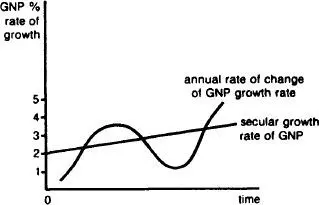
Fig. 35 Cyclical fluctuation.The pronounced short-term swings in output growth rates over the course of the BUSINESS CYCLE, around a rising long-term trend growth line for the country’s GROSS NATIONAL PRODUCT.
d
dawn raida situation in which a potential TAKEOVER bidder for a company buys a substantial shareholding in the target company at current market prices, often through intermediaries (to disguise the identity of the bidder). This shareholding can then be used as a platform for a full takeover bid for all the shares at a stated offer price. See TAKEOVER BID, CITY CODE.
deadweight lossthe reduction in CONSUMERS’ SURPLUS and PRODUCERS’ SURPLUS that results when the output of a product is restricted to less than the optimum efficient level that would prevail under PERFECT COMPETITION. Fig. 36 shows the demand and supply curves for a product, and their interaction establishes the equilibrium market price OP. At this price, consumers’ surplus is shown as the diagonally shaded area ABP and producers’ surplus as the vertically shaded area APO. If output is restricted from OQ to OQ 1, then the price paid by consumers would rise to OP 1and consumers’ surplus would be reduced by the amount ACE, while the price received by producers would fall to OP 2and producers’ surplus would be reduced by the amount ADE.
Deadweight loss is particularly likely to occur in markets dominated by MONOPOLY suppliers who restrict output in order to keep prices high.
dear moneysee TIGHT MONEY.
Fig. 36 Deadweight loss.See entry.
death ratethe number of people in a POPULATION who die per thousand per year. In 2004, for example, the UK death rate was 10 people per 1,000 of the population. The difference between this rate and the BIRTH RATE is used to calculate the rate of growth of the population of a country over time. The death rate tends to decline as a country attains higher levels of economic development. See DEMOGRAPHIC TRANSITION.
debenturesa means of financing companies through fixed-interest LOANS secured against company ASSETS.
In some cases the company may offer a specific asset, such as a particular machine, as security for the loan; in other cases lenders are offered security by means of a general claim against all company assets in the event of default. See LOAN CAPITAL.
debtan amount of money owed by a person, firm or government (the borrower) to a lender. Debts arise when individuals, etc., spend more than their current income or when they deliberately plan to borrow money to purchase specific goods, services or ASSETS (houses, financial securities, etc.). Debt contracts provide for the eventual repayment of the sum borrowed and include INTEREST charges for the duration of the loan. An individual’s debt can include MORTGAGES, INSTALMENT CREDIT, BANK LOANS and OVERDRAFTS; a firm’s debt can include fixed-interest DEBENTURES, LOANS, BILLS OF EXCHANGE and bank loans and overdrafts; a government’s debt can take the form of long-term BONDS and short-term TREASURY BILLS (see NATIONAL DEBT). See PUBLIC SECTOR BORROWING REQUIREMENT. See also INTERNATIONAL DEBT.
debt capitalsee LOAN CAPITAL.
debt financingthe financing of firms’ and governments’ deficits by the issue of FINANCIAL SECURITIES such as short-dated company BILLS OF EXCHANGE and government TREASURY BILLS, and, in the case of government, longer-term BONDS. See PUBLIC SECTOR BORROWING REQUIREMENT.
debtora person or business that owes money to individuals or firms for goods, services or raw materials that they have bought but for which they have not yet paid (trade debtors) or because they have borrowed money. Debtors are also termed ‘accounts receivable’. See CREDITORS, DEBT, CREDIT CONTROL, WORKING CAPITAL, BAD DEBT.
debtor nationa country that has had more invested in it than it has invested abroad. A debtor nation has to pay out more interest and dividends on investments made in the country than it receives, with a consequent deficit in its BALANCE OF PAYMENTS. Many DEVELOPING COUNTRIES are debtor nations. Compare CREDITOR COUNTRY.
debt servicingthe cost of meeting INTEREST payments and regular contractual repayments of principal on a LOAN along with any administration charges borne by the BORROWER.
decentralizationthe diffusion of economic decision-making to many different decision-makers rather than concentrating such decision-making centrally. In an economy this is achieved by the adoption of the PRICE SYSTEM, which devolves decisions to individual consumers and suppliers. In a firm, decentralization involves delegating authority to make decisions ‘down the line’ to particular divisions and departments. See PRIVATE ENTERPRISE ECONOMY, M-FORM ORGANIZATION.
decision treea graphical representation of the decision-making process in relation to a particular economic decision. The decision tree illustrates the possibilities open to the decision-maker in choosing between alternative strategies. It is possible to specify the financial consequence of each ‘branch’ of the decision tree and to gauge the PROBABILITY of particular events occurring that might affect the consequences of the decisions made. See RISK AND UNCERTAINTY.
decreasing returns to scalesee DISECONOMIES OF SCALE.
decreasing returns to the variable-factor inputsee DIMINISHING RETURNS.
deferred compensationpayment schemes that pay lower wages during the early years of employment in an organization and higher wages in subsequent years. With deferred compensation schemes, a worker’s remuneration increases with seniority and experience, which tend to improve the worker’s efficiency within the organization. Such compensation schemes tend to reduce labour turnover and reduce SHIRKING. See PAY.
Читать дальшеИнтервал:
Закладка:
Похожие книги на «Economics»
Представляем Вашему вниманию похожие книги на «Economics» списком для выбора. Мы отобрали схожую по названию и смыслу литературу в надежде предоставить читателям больше вариантов отыскать новые, интересные, ещё непрочитанные произведения.









Обсуждение, отзывы о книге «Economics» и просто собственные мнения читателей. Оставьте ваши комментарии, напишите, что Вы думаете о произведении, его смысле или главных героях. Укажите что конкретно понравилось, а что нет, и почему Вы так считаете.