Charles S. Cockell - Astrobiology
Здесь есть возможность читать онлайн «Charles S. Cockell - Astrobiology» — ознакомительный отрывок электронной книги совершенно бесплатно, а после прочтения отрывка купить полную версию. В некоторых случаях можно слушать аудио, скачать через торрент в формате fb2 и присутствует краткое содержание. Жанр: unrecognised, на английском языке. Описание произведения, (предисловие) а так же отзывы посетителей доступны на портале библиотеки ЛибКат.
- Название:Astrobiology
- Автор:
- Жанр:
- Год:неизвестен
- ISBN:нет данных
- Рейтинг книги:3 / 5. Голосов: 1
-
Избранное:Добавить в избранное
- Отзывы:
-
Ваша оценка:
Astrobiology: краткое содержание, описание и аннотация
Предлагаем к чтению аннотацию, описание, краткое содержание или предисловие (зависит от того, что написал сам автор книги «Astrobiology»). Если вы не нашли необходимую информацию о книге — напишите в комментариях, мы постараемся отыскать её.
offers an introductory text that explores the structure of living things, the formation of the elements required for life in the Universe, the biological and geological history of the Earth, and the habitability of other planets. Written by a noted expert on the topic, the book examines many of the major conceptual foundations in astrobiology, which cover a diversity of traditional fields including chemistry, biology, geosciences, physics, and astronomy.
The book explores many profound questions such as: How did life originate on Earth? How has life persisted on Earth for over three billion years? Is there life elsewhere in the Universe? What is the future of life on Earth?
is centered on investigating the past and future of life on Earth by looking beyond Earth to get the answers. Astrobiology links the diverse scientific fields needed to understand life on our own planet and, potentially, life beyond. This new second edition:
Expands on information about the nature of astrobiology and why it is useful Contains a new chapter “What is Life?” that explores the history of attempts to understand life Contains 20% more material on the astrobiology of Mars, icy moons, the structure of life, and the habitability of planets New ‘Discussion Boxes’ to stimulate debate and thought about key questions in astrobiology New review and reflection questions for each chapter to aid learning New boxes describing the careers of astrobiologists and how they got into the subject Offers revised and updated information throughout to reflect the latest advances in the field Written for students of life sciences, physics, astronomy and related disciplines, the updated edition of
is an essential introductory text that includes recent advances to this dynamic field.
Astrobiology — читать онлайн ознакомительный отрывок
Ниже представлен текст книги, разбитый по страницам. Система сохранения места последней прочитанной страницы, позволяет с удобством читать онлайн бесплатно книгу «Astrobiology», без необходимости каждый раз заново искать на чём Вы остановились. Поставьте закладку, и сможете в любой момент перейти на страницу, на которой закончили чтение.
Интервал:
Закладка:
Source: Reproduced with permission of wikicommons, https://commons.wikimedia.org/wiki/File:Chirality_with_hands.svg.
Given four different side chains or more, molecules too can be assembled into left- and right-handed forms. The reason why glycine is not chiral is that the central (alpha) carbon in the molecule has two identical H atoms attached to it, which does not allow for two distinctive left- and right-handed forms of the molecule. Chiral forms of a molecule are said to be isomers, which are chemical compounds with the same chemical formula but different structures. The conventional way to classify chiral molecules is based on the direction that polarized light, when shone at the molecules, is rotated (Figure 4.7). The different mirror images tend to rotate it one way or the other. If it is rotated to the left, we call it a levorotatory molecule or the “L” form. If it is to the right, or dextrorotatory, we call it the “D” form. When we have an equal mixture of both L and D molecules, we say that the mixture is racemic. Specifically, we use the term enantiomerto refer to one of the two chiral forms of the molecule.
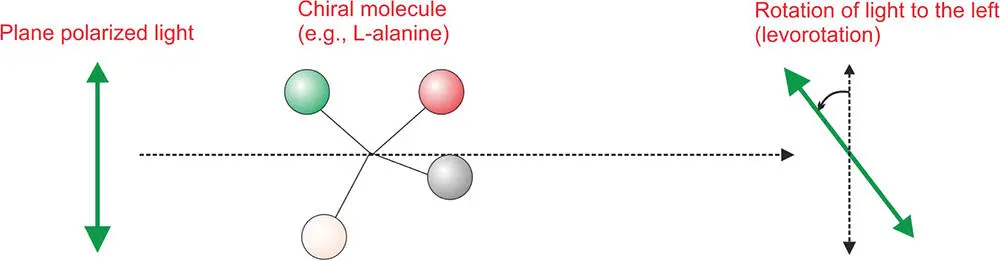
Figure 4.7 Chiral molecules rotate polarized light in particular directions. Schematically, the rotation of light to the left (levorotation) is shown here with the amino acid, L-alanine.
Discussion Point: Life with a Different Chirality
Why are almost all amino acids used in life found in the L form? Is it possible to construct life forms in which D-amino acids are the dominant amino acids in protein-like structures? Or would life elsewhere also be biased toward L-amino acids? We return to this when we discuss astrochemistry ( Chapter 10) and after that chapter you might like to revisit this question. Life on Earth uses D-sugars, but what about a life form that uses L-sugars? What information can you gather to shed light on why life on Earth chose L-amino acids? What range of problems and even advantages could you think of for a lifeform that used a racemic mix of D- and L-amino acids in its biochemical architecture? In Figure 4.8, you can see the four possible ways one might construct a life form. Is there a reason why Gertie is made the way she is or were the three other forms possible?
Bonner, W.A. (1991). The origin and amplification of biomolecular chirality. Origins of Life and Evolution of Biospheres 21: 59–111.
Breslow, R. and Cheng, Z.-L. (2009). On the origin of terrestrial homochirality for nucleosides and amino acids. Proceedings of the National Academy of Sciences of the United States of America 106: 9144–9146.
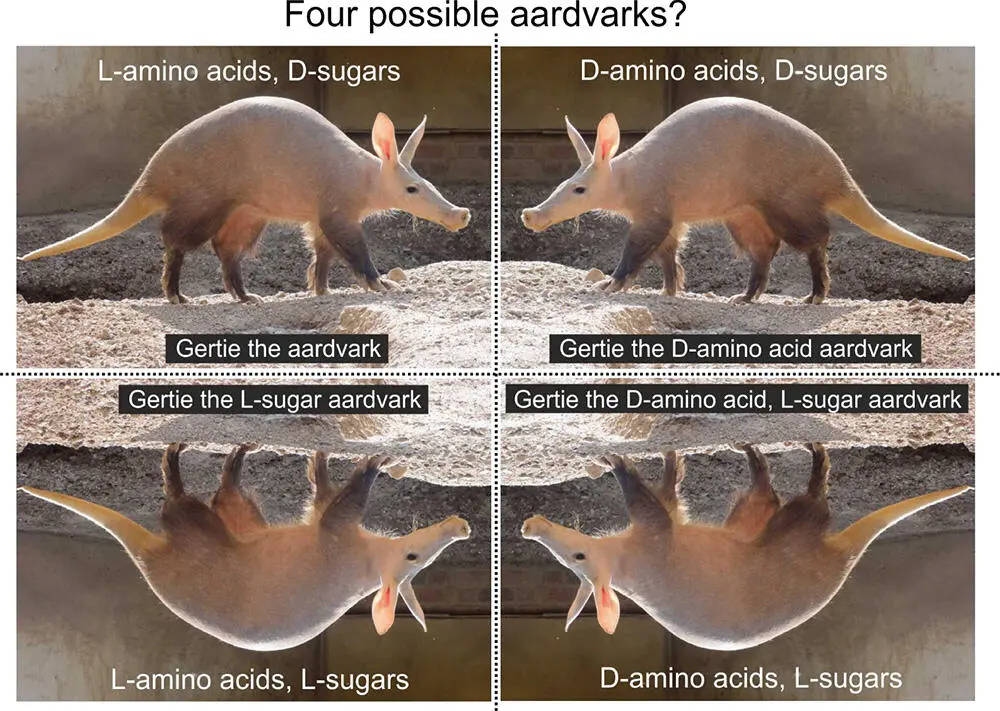
Figure 4.8 Different chiralities of life? Gertie the aardvark is a rescued aardvark. She is made of L-amino acids and D-sugars. Is it theoretically possible for Gertie to exist in the three other chiral combinations of L- and D-amino acids or L- and D-sugars?
Now an interesting thing about life on Earth is that almost all the amino acids used in life are of the L form. The D form is very rare, although D-amino acids are found in the cell membranes of bacteria. They reappear in the next chapter. The reason why life predominantly uses one form of amino acids is not fully understood, but it might have something to do with molecular recognition. As many biochemical interactions involve one molecule slotting into another to carry out chemical reactions, a system of life that was a mix of L and D forms would cause great complexity because we would need proteins with active sites that could recognize either the L or D form of molecules. It seems plausible to speculate that once a biochemical architecture emerged that had a preponderance to use either the L or D form, then that choice would have been perpetuated and amplified. Life on Earth developed a biochemistry based on the L form. Later in the textbook, we explore the possibility that the preference for the L form in life was caused by a pre-existing enantiomeric excess of L forms of amino acids in the prebioticcompounds from which life originated.
4.7 Carbohydrates (Sugars)
Other important molecules in life form chains. Carbohydrates are used in structural support and as energy- storage molecules (which is why people on diets are interested in how much carbohydrate they eat). Carbohydrates are hydrated carbon atoms with the generic formula CH 2O and multiples thereof. They are made up of chains of individual sugars such as glucose, C 6H 12O 6, or fructose, which has the same chemical formula as glucose, but a different structure (it is an isomer; Figure 4.9).
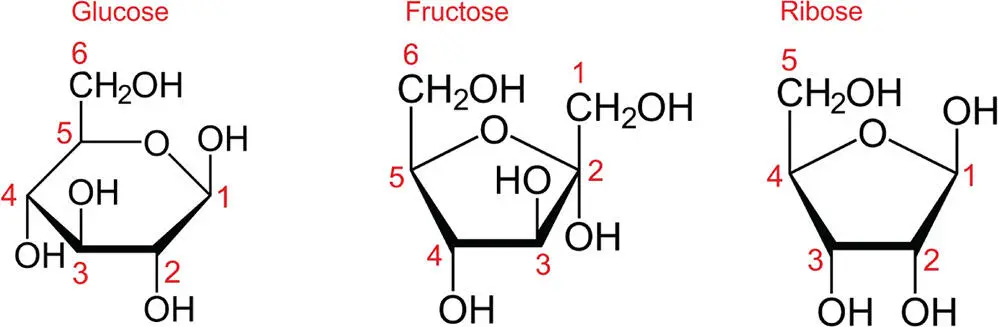
Figure 4.9 The molecular structure of the sugars: glucose, fructose, and ribose. The figure shows the numbering convention on the carbon atoms. Note that the carbon atoms within the rings are not indicated with the letter “C,” but occur where the numbers are shown.
A sugar with six carbon atoms is called a hexose (hence despite their different structures, glucose and fructose are hexose sugars, as they both contain six carbon atoms). A sugar with five carbon atoms is called a pentose. Riboseis such an example (Figure 4.9). This sugar is found in the structure of ribonucleic acid (RNA) as part of the repeating ribose–phosphate backbone.
Sugars join through a glycosidic bond to form chains, analogous to the peptide bonds in proteins. O-glycosidic bonds are oxygen-bridged links between sugar molecules (Figure 4.10). Figure 4.10 shows the example of maltose formed by a link between the –OH bond of one glucose (the 4 carbon position) and the hemiacetal group of another glucose (that is the carbon with an –OH group and a link to the oxygen atom in the sugar ring – the 1 carbon position in glucose). This explains why they are sometimes called 1,4 glycosidic linkages. Alternatively, a link between the 1 carbon of a glucose molecule and the 2 carbon of a fructose molecule (the hemiacetal carbon) produces the sugar sucrose (a 1,2 glycosidic link). Like the formation of the peptide bond in proteins, glycosidic linkages are condensation reactions in which a water molecule is lost during the reaction.
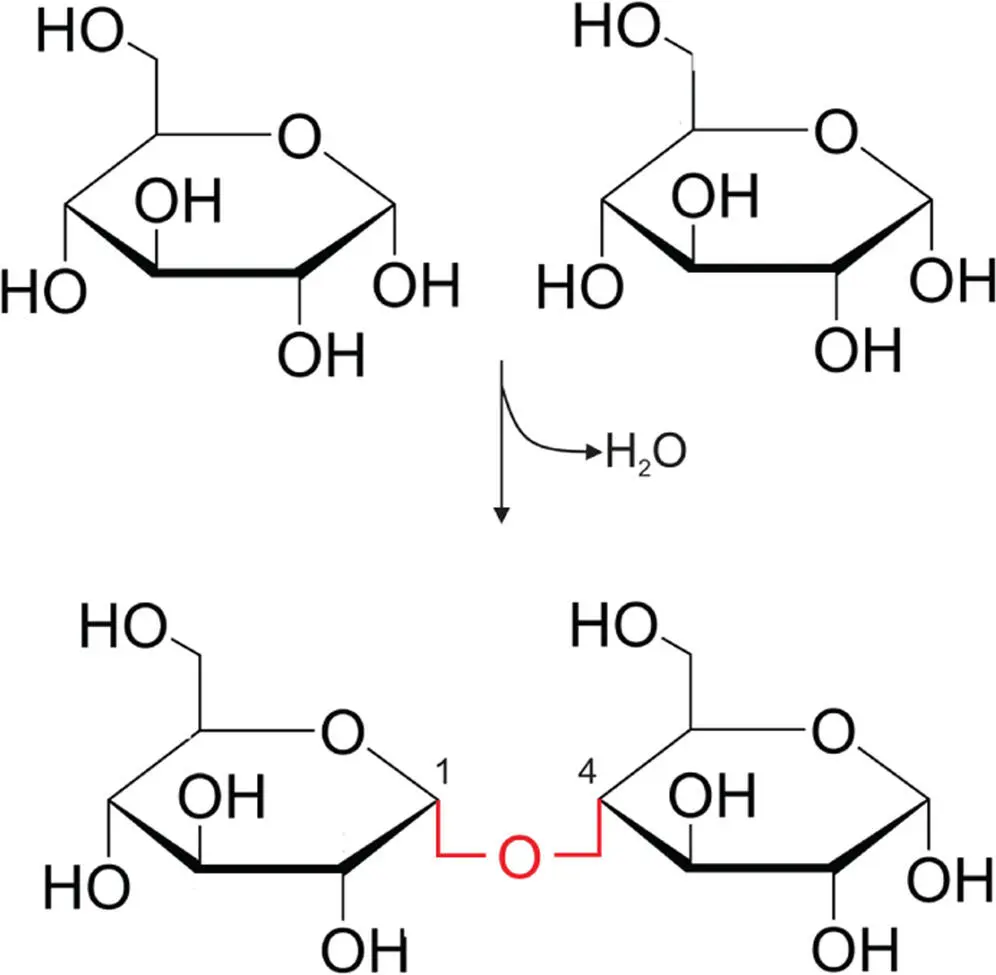
Figure 4.10 Glycosidic bonds allow sugar molecules to be linked together. In this case, two glucose molecules have linked together to form the two-sugar molecule maltose. By adding further units, we can produce polysaccharides (carbohydrates).
Carbohydrate polymers can be produced by linking many sugar molecules together with glycosidic bonds. These carbohydrates are sometimes called polysaccharides.
A further subtlety, but one crucial for life, is the way in which the glycosidic links are formed. For example, the 1,4 glycosidic link can exist in a 1,4 alpha or 1,4 beta form. The 1,4 alpha form occurs when the –OH group is below the plane of the glucose ring (alpha glucose), while the beta form occurs when the –OH is above the ring (beta glucose) (Figure 4.11). The differences between these two forms of glucose may seem a trivial point of fact, but the consequences of the links formed between them are immense. In the former case, the linking together of many alpha glucose molecules results in the polysaccharide molecule starch. This material is used in energy storage in many organisms, and in the human diet it is found in potatoes, wheat, rice, and other foods. The linkage of beta glucose into a polysaccharide produces the material cellulose, an important structural component of plants and the most abundant polymer in the biosphere. Cellulose is indigestible to humans, since we lack the enzymes to break it down. Some organisms, such as termites, can break it down, as they possess microbes in their guts ( symbionts) capable of carrying out the enzymatic degradation of the material. Thus, subtle chemical differences in bonds within sugar molecules have biosphere-level consequences, showing the profound link between life at the planetary scale and events at the atomic scale.
Читать дальшеИнтервал:
Закладка:
Похожие книги на «Astrobiology»
Представляем Вашему вниманию похожие книги на «Astrobiology» списком для выбора. Мы отобрали схожую по названию и смыслу литературу в надежде предоставить читателям больше вариантов отыскать новые, интересные, ещё непрочитанные произведения.









Обсуждение, отзывы о книге «Astrobiology» и просто собственные мнения читателей. Оставьте ваши комментарии, напишите, что Вы думаете о произведении, его смысле или главных героях. Укажите что конкретно понравилось, а что нет, и почему Вы так считаете.