Charles S. Cockell - Astrobiology
Здесь есть возможность читать онлайн «Charles S. Cockell - Astrobiology» — ознакомительный отрывок электронной книги совершенно бесплатно, а после прочтения отрывка купить полную версию. В некоторых случаях можно слушать аудио, скачать через торрент в формате fb2 и присутствует краткое содержание. Жанр: unrecognised, на английском языке. Описание произведения, (предисловие) а так же отзывы посетителей доступны на портале библиотеки ЛибКат.
- Название:Astrobiology
- Автор:
- Жанр:
- Год:неизвестен
- ISBN:нет данных
- Рейтинг книги:3 / 5. Голосов: 1
-
Избранное:Добавить в избранное
- Отзывы:
-
Ваша оценка:
Astrobiology: краткое содержание, описание и аннотация
Предлагаем к чтению аннотацию, описание, краткое содержание или предисловие (зависит от того, что написал сам автор книги «Astrobiology»). Если вы не нашли необходимую информацию о книге — напишите в комментариях, мы постараемся отыскать её.
offers an introductory text that explores the structure of living things, the formation of the elements required for life in the Universe, the biological and geological history of the Earth, and the habitability of other planets. Written by a noted expert on the topic, the book examines many of the major conceptual foundations in astrobiology, which cover a diversity of traditional fields including chemistry, biology, geosciences, physics, and astronomy.
The book explores many profound questions such as: How did life originate on Earth? How has life persisted on Earth for over three billion years? Is there life elsewhere in the Universe? What is the future of life on Earth?
is centered on investigating the past and future of life on Earth by looking beyond Earth to get the answers. Astrobiology links the diverse scientific fields needed to understand life on our own planet and, potentially, life beyond. This new second edition:
Expands on information about the nature of astrobiology and why it is useful Contains a new chapter “What is Life?” that explores the history of attempts to understand life Contains 20% more material on the astrobiology of Mars, icy moons, the structure of life, and the habitability of planets New ‘Discussion Boxes’ to stimulate debate and thought about key questions in astrobiology New review and reflection questions for each chapter to aid learning New boxes describing the careers of astrobiologists and how they got into the subject Offers revised and updated information throughout to reflect the latest advances in the field Written for students of life sciences, physics, astronomy and related disciplines, the updated edition of
is an essential introductory text that includes recent advances to this dynamic field.
Astrobiology — читать онлайн ознакомительный отрывок
Ниже представлен текст книги, разбитый по страницам. Система сохранения места последней прочитанной страницы, позволяет с удобством читать онлайн бесплатно книгу «Astrobiology», без необходимости каждый раз заново искать на чём Вы остановились. Поставьте закладку, и сможете в любой момент перейти на страницу, на которой закончили чтение.
Интервал:
Закладка:
Discussion Point: Why Does Life Use the 20 Particular Amino Acids it Has?
There are hundreds of amino acids in nature, but life usually only uses 20; on rare occasions, it uses two additional ones. Is this a chance outcome of evolutionary processes that could have picked many other permutations? This question has been investigated by a number of researchers. In one study, 50 amino acids naturally found in meteorites were taken (assuming that meteorites could have been one plausible source of amino acids when life first emerged), and using a computer program, a selection of amino acids were sampled from this set of 50 that have a broad coverage of several important characteristics for building a protein: (i) a range of sizes, (ii) different charges, and (iii) a range of hydrophobicities (a tendency to repel water). Remarkably, when you run a program to select the group of amino acids that has the best coverage across these characteristics, our own selection of 20 amino acids is the best in a million different possible combinations. Other permutations and combinations of amino acids also show that the terrestrial set is unusual in its use as a toolbox of amino acids for building proteins. You might like to investigate the literature at the end of this discussion point further and explore for yourself how the amino acids for life emerged and what might have been the selection pressures that resulted in the amino acids found in proteins. How much chance do you think there was in this selection? If life emerged on another planet and uses proteins, do you think it would end up using the same amino acids?
Freeland, S.J. and Hurst, L.D. (1998). The genetic code is one in a million. Journal of Molecular Evolution 47: 238–248.
Freeland, S.J., Knight, R.D., Landweber, L.F. et al. (2000). Early fixation of an optimal genetic code. Molecular Biology and Evolution 17: 511–518.
Philip, G.K. and Freeland, S.J. (2011). Did evolution select a nonrandom “alphabet” of amino acids? Astrobiology 11: 235–240.
In Figure 4.3 you can see the variety of amino acids created by changing the −R side group. As well as being designated by their full names, amino acids are also given a three-letter code (Figure 4.3) and a one-letter code ( Appendix A.6). The −R groups confer upon amino acids different properties. Some are polar, which means they like to dissolve in water on account of their ability to take part in hydrogen bonding. They include serine, asparagine, and histidine. Some are hydrophobic(they repel water), such as alanine, valine, and leucine. At the pH of the cell, some are positively charged (such as lysine and histidine) and some are negatively charged (such as aspartate and glutamate) and can therefore form ionic links as part of salt bridges (see Chapter 3). These different properties alter the way in which amino acids along a protein chain interact with one another and thus how a long chain of amino acids will fold together to make a three-dimensional molecule.
Although Figure 4.3 shows correctly the general structure of amino acids, their behavior in the cell is subtler. At cellular pH (near to 7), the amino group will tend to attract a proton from the carboxyl group so that it has a net positive charge, and the carboxyl group has a net negative charge (Figure 4.4). The overall molecule has zero charge, but there is an uneven charge distribution on the molecule. Such a molecule is called a zwitterion, and amino acids are an important example of such molecules. In reality, things are even more complicated than this, since the amino acid will also interact with water molecules in the cell. The proton in the amino group will tend to be donated to the water. Thus, the interplay between water molecules, the local pH, and the amino acid subtly modulates the chemical behavior of amino acids. This is also true of the −R group, whose charge and chemical interactions are modified by the surrounding pH. These intricacies are of enormous importance in modifying the biochemical behavior and function of proteins.

Figure 4.4 Amino acids are zwitterions. At cellular pH, they have the structure above.
Amino acids are assembled together in chains through peptide bonds, whereby the amino and carboxyl group of two amino acids react to form a bond with the release of a water molecule in a dehydration reaction (Figure 4.5). This process of polymerization can go on until proteins are built that contain many hundreds of amino acids. The result of this linking together of amino acids is a protein chain, sometimes called a polypeptide. The sequence of amino acids that makes up the chain is called the primary sequence. This sequence of amino acids could be written down from either end of the chain, which would cause confusion. By convention, the sequence is reported from the end that has the dangling amino group (the N-terminus) through to the other end with the dangling carboxyl group (the C-terminus).
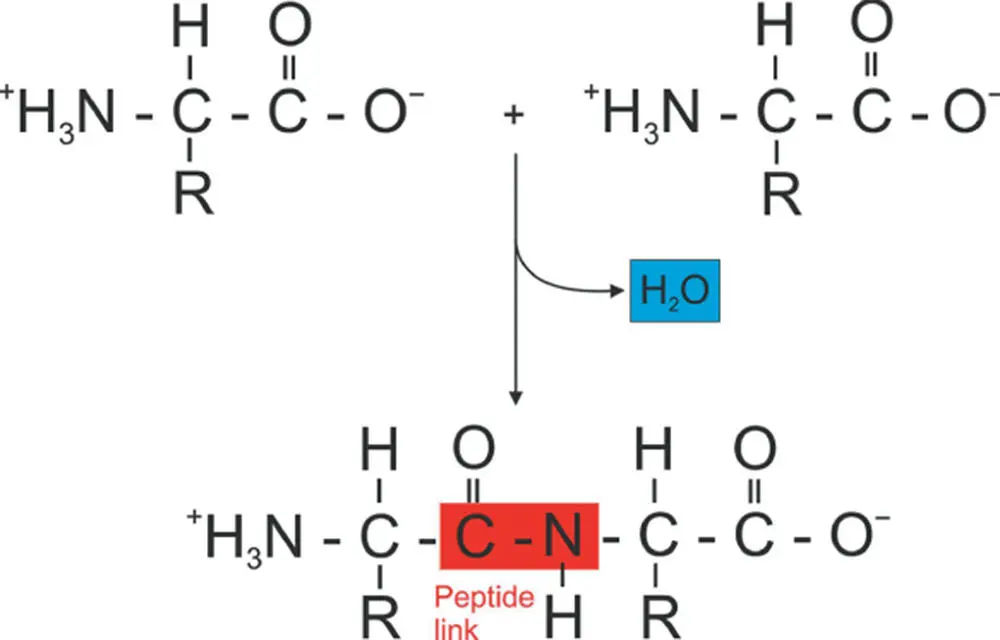
Figure 4.5 The formation of a peptide bond between two amino acids. This dehydration reaction (involving the release of a water molecule) allows for the assembly of polypeptide protein chains.
The exact sequence of the amino acids determines what the protein will do in the cell. An obvious question to ask is how this long chain of amino acids is turned into something useful.
Some of the charged amino acids bind with one another from different places on the chain to form ionic bonds (e.g. the positively charged aspartic acid binds ionically to the negatively charged lysine), as we saw in Chapter 3. Some amino acids form covalent bonds, for example two cysteine amino acids that contain sulfur form a disulfide bridge, as we also discussed in Chapter 3. Thus, the primary sequence comes together to form hairpins, helices, and other structures which are referred to as the secondary structure. The complete atomic arrangement within a whole protein is called the tertiary structure. It is this three-dimensional structure that can now do useful biological work. Sometimes individual proteins come together to make an even larger protein. These protein subunits form a multimericstructure, and we refer to this arrangement as the quaternary structure.
In enzymes, the three-dimensional arrangement of amino acids evolves to facilitate the attachment of substrates to carry out a reaction and then the release of the products, carrying out this reaction many times sequentially. The site within a protein where the amino acids are configured in such a way that their side groups can bind reactants and catalyze a chemical reaction is called the active site.
4.6 Chirality
An important feature of amino acids is that they are chiral. The exception to this is glycine. The best, and most iconic, way to explain this is with your hands. Place your left hand on a table palm down. Now place your right hand on top of it, palm down. They don't exactly overlap. Your left hand's thumb sticks out to the right, your right hand's thumb to the left. That is because they are mirror images. They are non-superimposable (Figure 4.6).
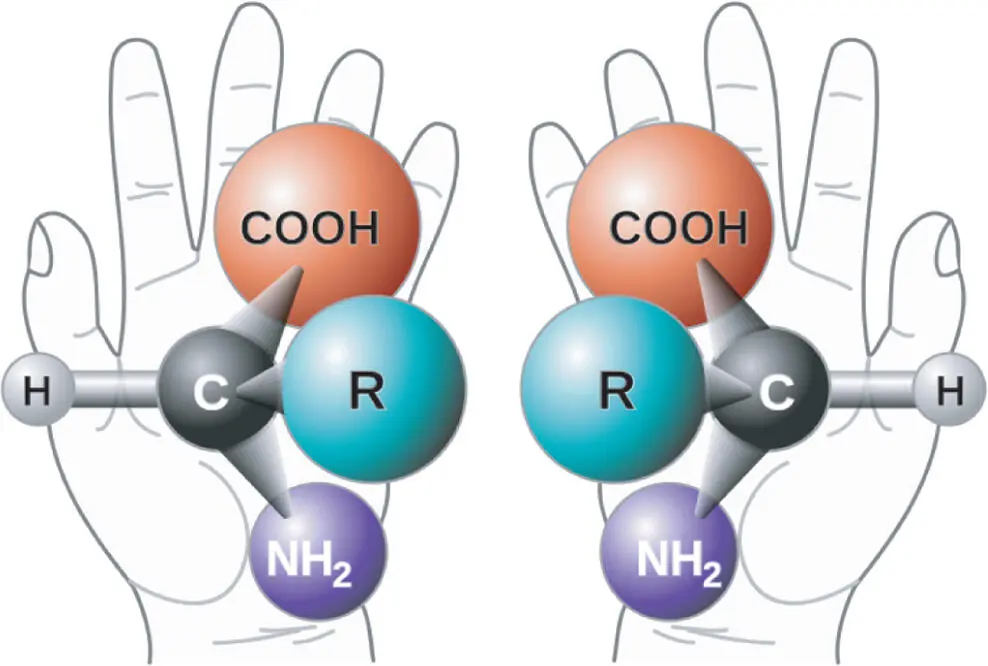
Figure 4.6 Chirality illustrated with hands and the generic structure for amino acids.
Читать дальшеИнтервал:
Закладка:
Похожие книги на «Astrobiology»
Представляем Вашему вниманию похожие книги на «Astrobiology» списком для выбора. Мы отобрали схожую по названию и смыслу литературу в надежде предоставить читателям больше вариантов отыскать новые, интересные, ещё непрочитанные произведения.











Обсуждение, отзывы о книге «Astrobiology» и просто собственные мнения читателей. Оставьте ваши комментарии, напишите, что Вы думаете о произведении, его смысле или главных героях. Укажите что конкретно понравилось, а что нет, и почему Вы так считаете.