Charles S. Cockell - Astrobiology
Здесь есть возможность читать онлайн «Charles S. Cockell - Astrobiology» — ознакомительный отрывок электронной книги совершенно бесплатно, а после прочтения отрывка купить полную версию. В некоторых случаях можно слушать аудио, скачать через торрент в формате fb2 и присутствует краткое содержание. Жанр: unrecognised, на английском языке. Описание произведения, (предисловие) а так же отзывы посетителей доступны на портале библиотеки ЛибКат.
- Название:Astrobiology
- Автор:
- Жанр:
- Год:неизвестен
- ISBN:нет данных
- Рейтинг книги:3 / 5. Голосов: 1
-
Избранное:Добавить в избранное
- Отзывы:
-
Ваша оценка:
Astrobiology: краткое содержание, описание и аннотация
Предлагаем к чтению аннотацию, описание, краткое содержание или предисловие (зависит от того, что написал сам автор книги «Astrobiology»). Если вы не нашли необходимую информацию о книге — напишите в комментариях, мы постараемся отыскать её.
offers an introductory text that explores the structure of living things, the formation of the elements required for life in the Universe, the biological and geological history of the Earth, and the habitability of other planets. Written by a noted expert on the topic, the book examines many of the major conceptual foundations in astrobiology, which cover a diversity of traditional fields including chemistry, biology, geosciences, physics, and astronomy.
The book explores many profound questions such as: How did life originate on Earth? How has life persisted on Earth for over three billion years? Is there life elsewhere in the Universe? What is the future of life on Earth?
is centered on investigating the past and future of life on Earth by looking beyond Earth to get the answers. Astrobiology links the diverse scientific fields needed to understand life on our own planet and, potentially, life beyond. This new second edition:
Expands on information about the nature of astrobiology and why it is useful Contains a new chapter “What is Life?” that explores the history of attempts to understand life Contains 20% more material on the astrobiology of Mars, icy moons, the structure of life, and the habitability of planets New ‘Discussion Boxes’ to stimulate debate and thought about key questions in astrobiology New review and reflection questions for each chapter to aid learning New boxes describing the careers of astrobiologists and how they got into the subject Offers revised and updated information throughout to reflect the latest advances in the field Written for students of life sciences, physics, astronomy and related disciplines, the updated edition of
is an essential introductory text that includes recent advances to this dynamic field.
Astrobiology — читать онлайн ознакомительный отрывок
Ниже представлен текст книги, разбитый по страницам. Система сохранения места последней прочитанной страницы, позволяет с удобством читать онлайн бесплатно книгу «Astrobiology», без необходимости каждый раз заново искать на чём Вы остановились. Поставьте закладку, и сможете в любой момент перейти на страницу, на которой закончили чтение.
Интервал:
Закладка:
There is a variety of reasons why carbon is the basic atomic building block of life. It forms stable bonds with many other elements, such as H, N, O, S, and P. Some of these bonds are more common than others. C  H bonds are ubiquitous throughout life, but C S are rarer (they are found in the amino acid cysteine and used to make disulfide bridges in proteins). C P bonds are rare but can be found in alkyl phosphonates. P is more commonly found in phosphodiester bonds, such as in adenosine triphosphate ( ATP), where the P is linked to O atoms that are themselves linked to carbon. Bonds between carbon and other atoms are stable, but not so strong to make it necessary to use large quantities of energy to break them (if that were the case, it would be difficult for life to break down and metabolize compounds). The energy it takes to break bonds with H (413 kJ mol −1), N (308 kJ mol −1), O (360 kJ mol −1), S (272 kJ mol −1), P (264 kJ mol −1), and other carbon atoms (347 kJ mol −1) is quite similar, which means that carbon can interchange between these atoms without much energy being required or released. This gives carbon versatility in being involved in the breaking down and forming of new complex molecules. Furthermore, carbon forms stable carbon–carbon double and triple bonds, which further increases the diversity of possible compounds.
Molecules containing carbon range in structure from chains to rings. The simplest carbon molecules are alkanes [with the formula C nH (2n+2)]. If n = 1 then the molecule is CH 4or methane, which is very common on Saturn's moon Titan, and underground on Earth where it is produced by microbes called methanogens. If n = 2 the molecule is C 2H 6, which is ethane, another common organic molecule in the Universe. The substitution of hydrogen with other atoms results in functional groups of wide use in different biochemical functions. For example, esters have the general formula –COO–R (where R is an alkyl group; an alkyl group is any group with the general formula C nH 2n+1). These turn up in the membranes of cells. Amino (–NH 2) and carboxyl (–COOH) groups attach to carbon to form amino acids, the units used to make proteins. The phosphate group, –PO 4, is attached to, or incorporated into, a whole variety of molecules including membrane lipids, DNA, and many enzymes. Alcohols are carbon compounds with an –OH group, used by microorganisms in energy-yielding reactions. And the list goes on, a vast array of compounds made possible by the covalent bonding of carbon to the CHNOPS elements, which includes other carbon atoms.
4.4 The Chains of Life
If we had to identify one feature of life that stands out when we are discussing the formation of molecules, we would probably say that it has a propensity to form chains. Perhaps this isn't surprising. Life is complex, and if we want to build complex molecules, we would intuitively suggest that the best way to do this is to take simple molecules and string them together into more complex chains. All the major classes of molecules in life result from this process of putting single molecules (monomers) together into chains (polymers) in the process of polymerization.
In this chapter, we look at the four major classes of molecules from which life is made and consider their basic characteristics. As we study these molecules, think about the features that are common between them, particularly in light of an astrobiologist's question of what is universal about them. In advance, you will notice that all of them are chains, and despite performing quite different functions, all of them are assembled by linking together monomers of different molecules.
Discussion Point: Searching for Life Without Knowing Anything About it
When we search for life on other planets, it seems that we have no choice but to base this search on the life that we know on Earth. However, is that the case? Is there a way of searching for life while making the minimum number of assumptions about its biochemistry? You might like to discuss with your fellow students what features of life could be universal, but that make no assumptions about the particular chemical make-up of life. For example, life tends to form chains of monomers that then assemble into larger structures. In our own form of life, proteins, carbohydrates, membrane lipids, and nucleic acids are examples. In general, non-biological processes do not form chains as long as proteins (several hundred to over a thousand amino acids). One way to search for life could be to build a machine that looks for long chains of molecules. Chirality is another characteristic of biology. The use of almost exclusively L-amino acids in terrestrial life may be a result of it selecting only one form so that biochemistry does not suffer the inefficiency of having to use, and thus build enzyme and other metabolic systems to deal with, two enantiomers of the same amino acid. Would all life have a chiral preference for L or D forms of amino acids and sugars? Could we search for life by searching for an excess of one particular enantiomer? Consider other facets of life that could be universal and could provide a way to detect it while minimizing assumptions about its particular biochemical make-up.
Johnson, S.S., Anslyn, E.V., Graham, H.V. et al. (2018). Fingerprinting non-terran biosignatures. Astrobiology 18: 915–922.
MacDermott, A.J, Barron, L.D., Brack, A. et al. (1996). Homochirality as the signature of extra-terrestrial life. Origins and of Life and Evolution of Biospheres 26: 246–247.
4.5 Proteins
The first major class of molecules that play a substantial role in building living things is proteins. Proteins are involved in many functions. They can act as catalysts, carrying out chemical reactions. These proteins are called enzymes. Proteins are also used in cell membranes to transport molecules, and they are found as structural materials and electron transfer molecules in energy acquisition in the cell.
Proteins are composed of chains of amino acids. Amino acids are molecules made up of a central carbon atom called the alpha carbon that has four side groups attached to it. Two of the groups are an amine (–NH 2) and a carboxyl (–COOH) group. There is a hydrogen atom attached as the third side group. The fourth side group is sometimes called the “–R” group and it can be a variety of different combinations of atoms. It is this side group that is altered in the wide variety of amino acids found in biology (Figure 4.3).
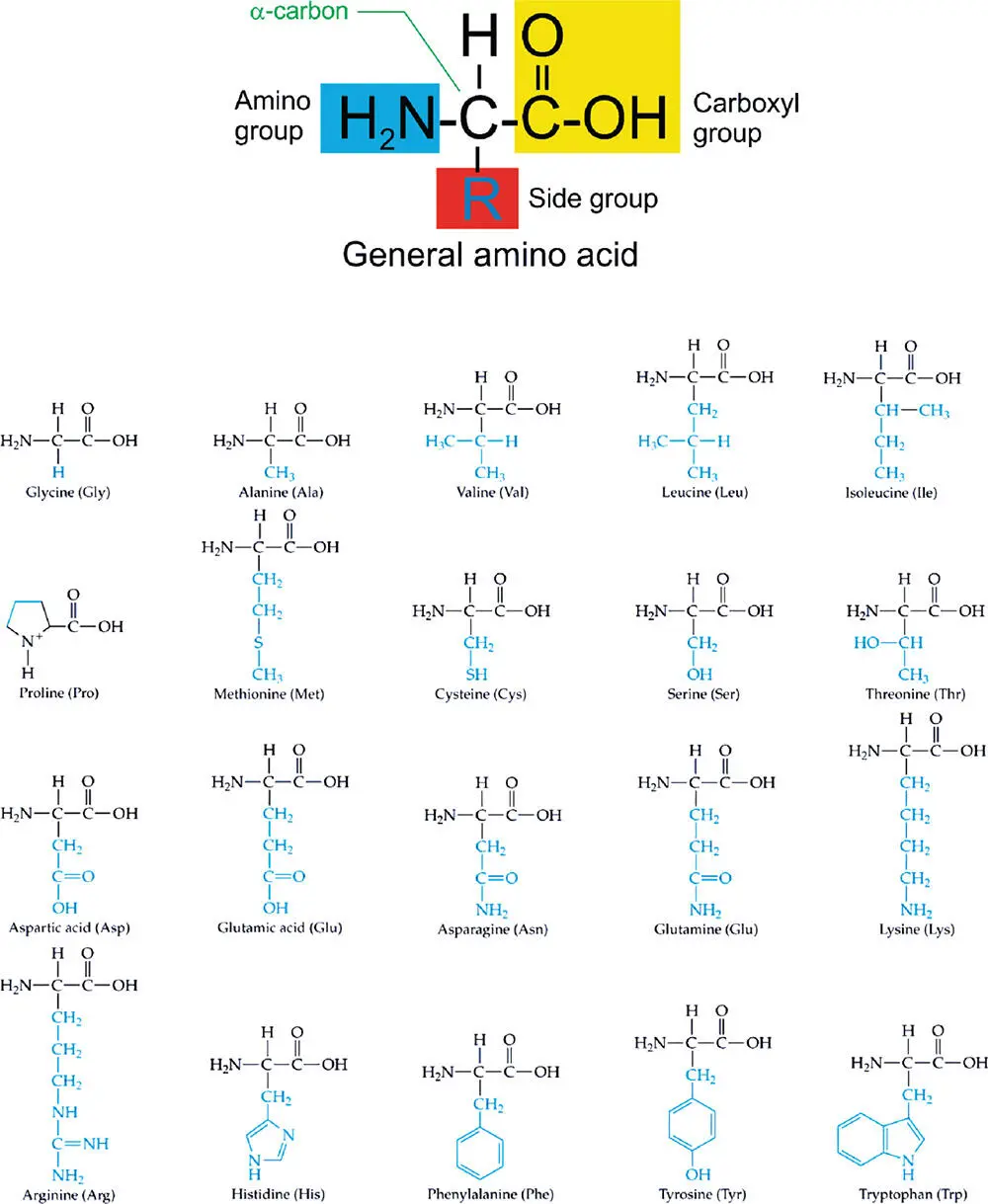
Figure 4.3 The 20 common amino acids found in life. The figure shows the different chemical structure of the side groups (in blue). Also shown in brackets is the three-letter designation of each amino acid.
Source: Reproduced with permission of wikicommons.
Although there are various amino acids in nature, with over 500 known, only 20 of these compounds are commonly used in life (Figure 4.3), with two others more rarely used (selenocysteine and pyrrolysine). Life therefore uses a very select number. We don't really know why this is the case. It might be like asking why someone building a house doesn't use all the wonderful variety of bricks that are available from their local garden store. It makes no sense to use all of them because that would result in incompatibility between brick types and too much complexity to get the job done. If 20 amino acids allow for a life form to come into existence and reproduce, then there is no evolutionary selection pressure to use more amino acids. Another reason could be that they are the best of all possible amino acids that could have been used by life. Their biochemical characteristics may have favored the use of these particular 20 amino acids in the earliest types of cells. You might like to read the following Discussion Point, which investigates this idea further.
Читать дальшеИнтервал:
Закладка:
Похожие книги на «Astrobiology»
Представляем Вашему вниманию похожие книги на «Astrobiology» списком для выбора. Мы отобрали схожую по названию и смыслу литературу в надежде предоставить читателям больше вариантов отыскать новые, интересные, ещё непрочитанные произведения.











Обсуждение, отзывы о книге «Astrobiology» и просто собственные мнения читателей. Оставьте ваши комментарии, напишите, что Вы думаете о произведении, его смысле или главных героях. Укажите что конкретно понравилось, а что нет, и почему Вы так считаете.