Charles S. Cockell - Astrobiology
Здесь есть возможность читать онлайн «Charles S. Cockell - Astrobiology» — ознакомительный отрывок электронной книги совершенно бесплатно, а после прочтения отрывка купить полную версию. В некоторых случаях можно слушать аудио, скачать через торрент в формате fb2 и присутствует краткое содержание. Жанр: unrecognised, на английском языке. Описание произведения, (предисловие) а так же отзывы посетителей доступны на портале библиотеки ЛибКат.
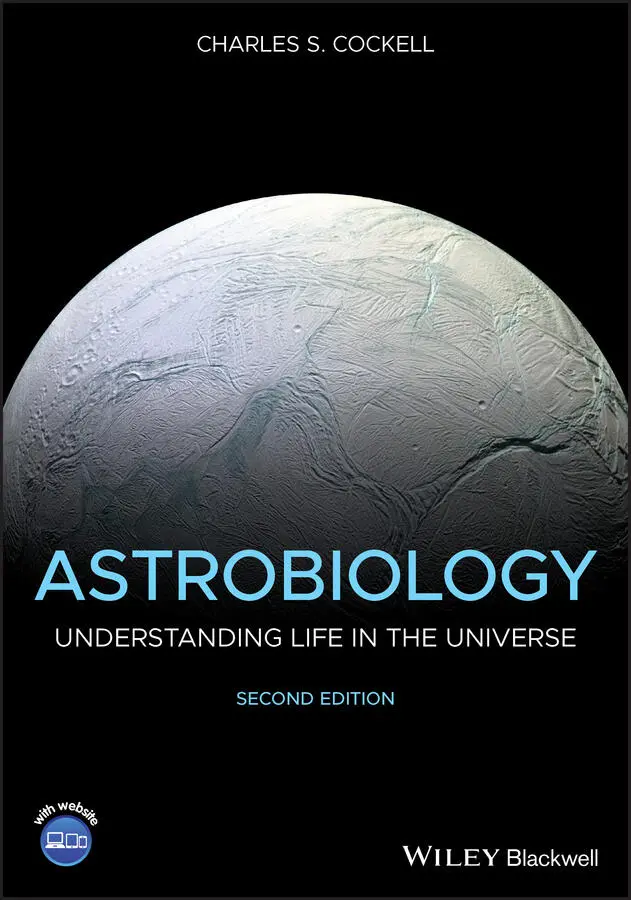
- Название:Astrobiology
- Автор:
- Жанр:
- Год:неизвестен
- ISBN:нет данных
- Рейтинг книги:3 / 5. Голосов: 1
-
Избранное:Добавить в избранное
- Отзывы:
-
Ваша оценка:
Astrobiology: краткое содержание, описание и аннотация
Предлагаем к чтению аннотацию, описание, краткое содержание или предисловие (зависит от того, что написал сам автор книги «Astrobiology»). Если вы не нашли необходимую информацию о книге — напишите в комментариях, мы постараемся отыскать её.
offers an introductory text that explores the structure of living things, the formation of the elements required for life in the Universe, the biological and geological history of the Earth, and the habitability of other planets. Written by a noted expert on the topic, the book examines many of the major conceptual foundations in astrobiology, which cover a diversity of traditional fields including chemistry, biology, geosciences, physics, and astronomy.
The book explores many profound questions such as: How did life originate on Earth? How has life persisted on Earth for over three billion years? Is there life elsewhere in the Universe? What is the future of life on Earth?
is centered on investigating the past and future of life on Earth by looking beyond Earth to get the answers. Astrobiology links the diverse scientific fields needed to understand life on our own planet and, potentially, life beyond. This new second edition:
Expands on information about the nature of astrobiology and why it is useful Contains a new chapter “What is Life?” that explores the history of attempts to understand life Contains 20% more material on the astrobiology of Mars, icy moons, the structure of life, and the habitability of planets New ‘Discussion Boxes’ to stimulate debate and thought about key questions in astrobiology New review and reflection questions for each chapter to aid learning New boxes describing the careers of astrobiologists and how they got into the subject Offers revised and updated information throughout to reflect the latest advances in the field Written for students of life sciences, physics, astronomy and related disciplines, the updated edition of
is an essential introductory text that includes recent advances to this dynamic field.
Astrobiology — читать онлайн ознакомительный отрывок
Ниже представлен текст книги, разбитый по страницам. Система сохранения места последней прочитанной страницы, позволяет с удобством читать онлайн бесплатно книгу «Astrobiology», без необходимости каждый раз заново искать на чём Вы остановились. Поставьте закладку, и сможете в любой момент перейти на страницу, на которой закончили чтение.
Интервал:
Закладка:
Carbon is used as the backbone of most complex molecules in life as we shall shortly see. Carbon comes in both inorganic and organic carbonforms. Inorganic carbon is carbon that lacks C  H bonds and includes minerals such as calcium carbonate (CaCO 3). The form we are interested in, at least in terms of the assembly of life, is organic carbon, or carbon combined with elements such as H, N, and O. The name organic carbon, is rather unfortunate. It was originally derived from the view that such carbon could be found only in living things, although we now know that organic carbon compounds can be formed by non-biological processes.
What about the other five elements? Hydrogen is bound to many atoms, for example in –CH, –NH 2, –SH groups, and it is common in all organic compounds found in life (as well as being in life's solvent, water, in addition to oxygen). It usually ends carbon chains. You will remember from Chapter 3that the hydrogen atom requires one electron to fill its electron shell. It tends to bind where there is an electron going spare, giving it a ubiquitous presence in many molecules in life.
Nitrogen is found in many carbon-based ring structures and amino acidsand confers a greater degree of complexity on the range of organic molecules possible.
Oxygen is an essential atom in many organic compounds. It is found in ring structures, in –OH groups (for example in sugars and alcohols) and other bonds, again expanding the range of organic complexity.
Phosphorus is found in many proteins and in molecules such as adenosine triphosphate (ATP) involved in energy transfer in the cell. It is also found in the nucleic acids, such as DNA.
Sulfur is found in amino acids, such as cysteine (as we saw in Chapter 3, these take part in forming disulfide bridges that contribute to the three-dimensional structure of proteins), and it is found in iron–sulfur clusters involved in electron transfer in the cell.
These particular elements are found everywhere in life on account of a number of characteristics. They are neither too reactive nor inert, making stable covalent bonds with carbon. Apart from hydrogen, these elements can make multiple covalent bonds, making them versatile in linking between atoms. They generally have a sufficient natural abundance to make them widespread and available (this is not always the case, since ecosystems can be limited in one or more of these basic elements).
Needless to say, the CHNOPS elements must be in a biologically accessible state. For example, nitrogen gas (N 2) is energetically difficult to break up. The strength of the nitrogen–nitrogen triple bond (941 kJ mol −1) is such that only certain bacteria with nitrogen fixationpathways can accomplish this task. Other organisms require nitrogen in more readily accessible states, such as ammonium (NH 4 +) or nitrogen oxides, such as nitrate (NO 3 −). Thus, the mere presence of nitrogen gas on a planet theoretically provides a source of N, but acquisition of this element requires evolutionary innovations which on Earth are restricted to certain specific organisms.
Another excellent example is the ubiquitous compound: water (H 2O). It clearly presents a potential source of hydrogen and oxygen atoms. Yet, in general, it is not easily broken up by biology (the H–OH bond energy has a relatively high value of 498.7 kJ mol −1). Oxygenic photosynthetic organisms ( Chapter 6) can accomplish the splitting of water as a source of electrons for photosynthetic energy acquisition. They have a specific water-splitting metal cluster in their photosystem that allows for this process. There is no known organism that has such a system to use water as a source of hydrogen and oxygen atoms for building biological molecules. This is likely because these atoms can be acquired less energetically from other sources. Non-biological processes can break down water, making its constituent atoms more available. For example, radiolysis, the breakdown of water by ionizing radiation, can release hydrogen, which is accessible to life.
To say that habitability is defined by the presence of biologically available CHNOPS elements may seem facile, but it is important to keep in mind the suggested source of these elements in any environment being studied for its habitability and how accessible they are.
Discussion Point: Are the Minimal CHNOPS Elements a Universal Requirement for Life?
That all life on Earth uses six core elements might suggest that whatever the architecture of life, these are the minimum elemental requirements. You might like to question this idea. Could life be constructed with an even smaller subset as a minimal requirement? One study of cell metabolism was motivated by the observation that phosphorus is often geochemically unavailable or poorly available on planetary surfaces. The availability of phosphorus in our biosphere is linked to our oxygenated atmosphere that makes phosphorus readily dissolved in its oxidized form, phosphate, and our extensive biosphere and hydrological cycle that erodes phosphate-containing minerals, such as apatite. The authors suggested that it might be possible to assemble metabolic pathways without phosphorus. Metabolic pathways free of phosphorus can be proposed using known pathways in cells (a so-called systems biologyapproach) that are rich in enzymes that have iron–sulfur clusters and use thioester(sulfur-containing) couplings rather than phosphate couplings. Is such a pathway a relic or fossil of a pre-P era in life? Even if early life on Earth did use phosphorus, can such theoretical ideas lead to a demonstration of how life could evolve without using phosphorus? Might CHNOS be the minimal elemental requirements for life?
Goldford, J.E., Hartman, H., Smith, T.F. et al. (2017). Remnants of an ancient metabolism without phosphate. Cell 168: 1126–1134.
Of course, any given organism uses a wide variety of other elements. For example, metal ions, such as iron and copper, are involved in energy transfer in life because of their ability to give and accept electrons (discussed in Chapter 6). Calcium is found in calcium phosphate, used to make bones in animals. Vanadium is used by some microbes in the enzyme that takes nitrogen gas from the atmosphere and makes this nitrogen available for biological processes (nitrogen fixation). And so on. At the end of this book (Appendix A.1), you can see an “Astrobiological Periodic Table” where the main biological uses of elements across the Table are shown. These non-CHNOPS elements are used in more specific situations than the CHNOPS elements, where their properties fulfill some function that has been selected by evolution. In an informal way, we can think of the process of evolution as selecting CHNOPS to build the chassis of life and rummaging around in the Periodic Table selecting other elements whose specific chemical characteristics turn out to be useful in particular biochemical roles and for which there is a selective advantage.
4.3 Carbon Is Versatile
The elements of life come together in combinations to form molecules. The most common elemental backbone of these molecules is carbon, for example in the simplest amino acid, glycine, shown in Figure 4.2, in which two carbon atoms form the core of this molecule. Most of these atoms, as shown for glycine, are bound together covalently. The abundance of carbon in biological molecules means that we often refer to life on Earth as “carbon-based.”
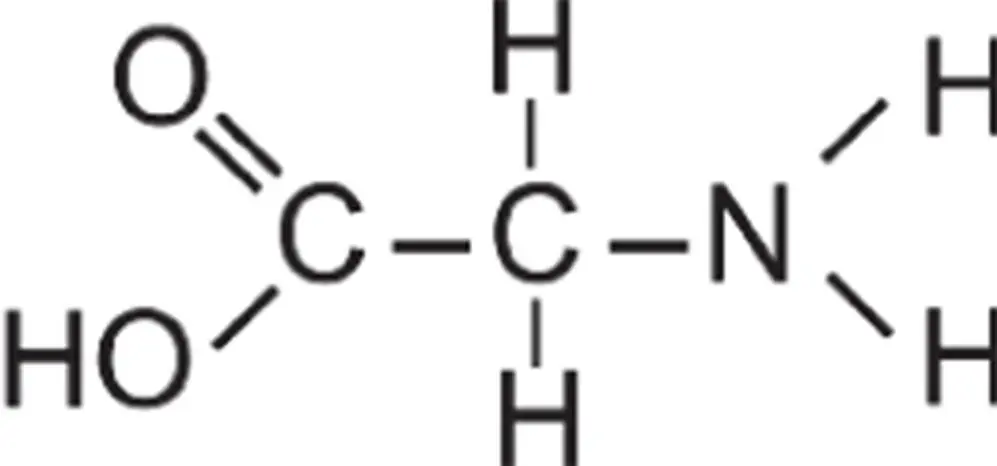
Figure 4.2 The organic molecule glycine, the simplest amino acid.
Читать дальшеИнтервал:
Закладка:
Похожие книги на «Astrobiology»
Представляем Вашему вниманию похожие книги на «Astrobiology» списком для выбора. Мы отобрали схожую по названию и смыслу литературу в надежде предоставить читателям больше вариантов отыскать новые, интересные, ещё непрочитанные произведения.








Обсуждение, отзывы о книге «Astrobiology» и просто собственные мнения читателей. Оставьте ваши комментарии, напишите, что Вы думаете о произведении, его смысле или главных героях. Укажите что конкретно понравилось, а что нет, и почему Вы так считаете.