Howdunit
Здесь есть возможность читать онлайн «Howdunit» — ознакомительный отрывок электронной книги совершенно бесплатно, а после прочтения отрывка купить полную версию. В некоторых случаях можно слушать аудио, скачать через торрент в формате fb2 и присутствует краткое содержание. Жанр: unrecognised, на английском языке. Описание произведения, (предисловие) а так же отзывы посетителей доступны на портале библиотеки ЛибКат.
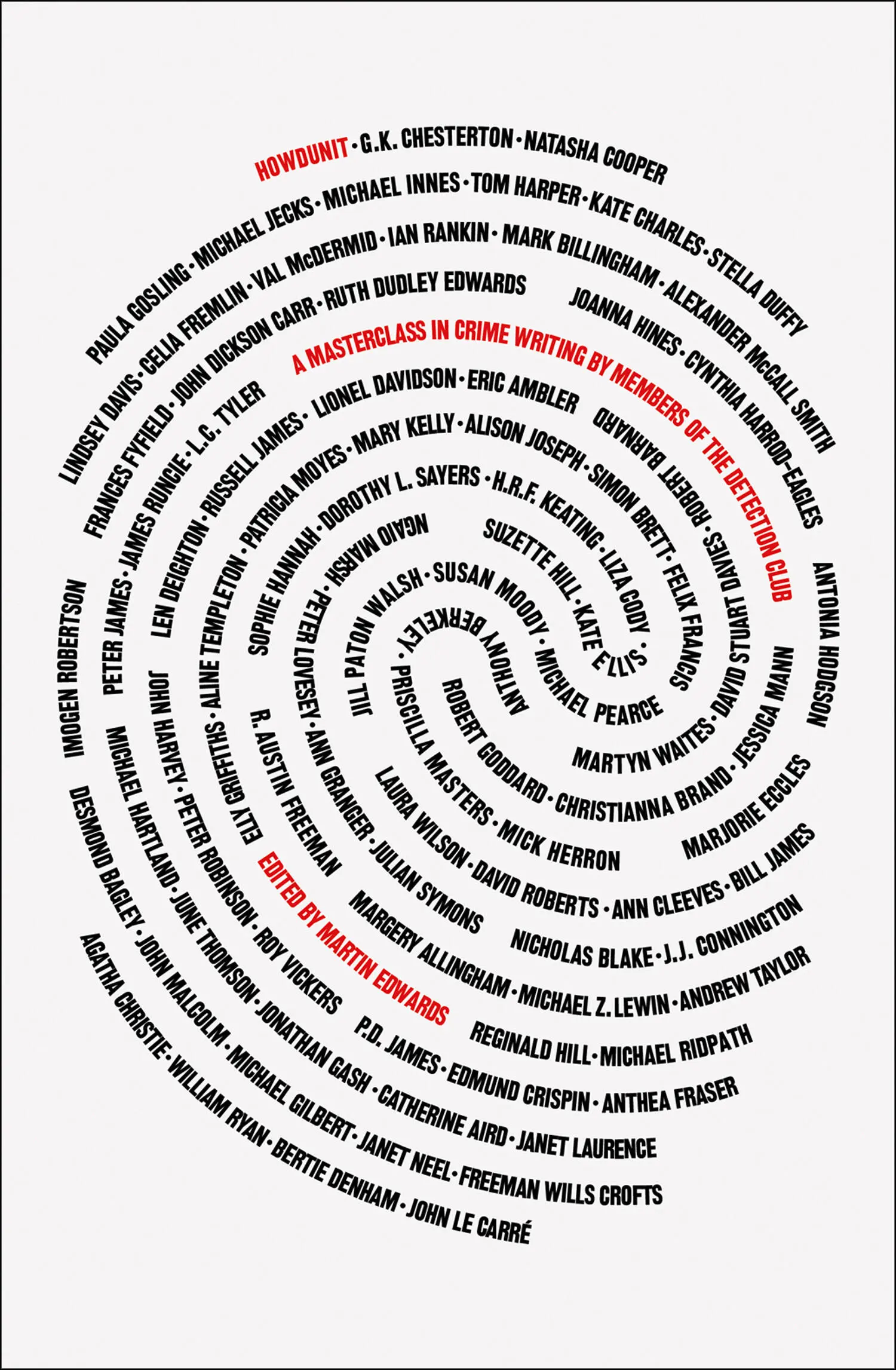
- Название:Howdunit
- Автор:
- Жанр:
- Год:неизвестен
- ISBN:нет данных
- Рейтинг книги:5 / 5. Голосов: 1
-
Избранное:Добавить в избранное
- Отзывы:
-
Ваша оценка:
Howdunit: краткое содержание, описание и аннотация
Предлагаем к чтению аннотацию, описание, краткое содержание или предисловие (зависит от того, что написал сам автор книги «Howdunit»). Если вы не нашли необходимую информацию о книге — напишите в комментариях, мы постараемся отыскать её.
Howdunit — читать онлайн ознакомительный отрывок
Ниже представлен текст книги, разбитый по страницам. Система сохранения места последней прочитанной страницы, позволяет с удобством читать онлайн бесплатно книгу «Howdunit», без необходимости каждый раз заново искать на чём Вы остановились. Поставьте закладку, и сможете в любой момент перейти на страницу, на которой закончили чтение.
Интервал:
Закладка:
I’m the eighth and current President of the Club, and my predecessors include such legendary figures as Chesterton, Dorothy L. Sayers, and Agatha Christie. The Club has a rich history, and I charted its early years in The Golden Age of Murder ; suffice it to say here that the Club is simply a social association, a small dining club with membership by invitation. It’s very different from the Crime Writers’ Association, a much larger professional organization for anyone who has published a crime book, together with associates involved in the business of crime writing. The two organizations are not competitors and they enjoy a warm relationship; the four most recent presidents of the Club also chaired the CWA. Although the two organizations’ archives are distinct, together they comprise the British Crime Writing Archives, which for the past few years have been celebrated by an annual summer festival at Gladstone’s Library in north Wales.
In contrast to the position with the CWA, the number of members of the Club has always been limited, and as an organization that exists to have occasional dinners in London, its membership is predominantly British. There are no formal restrictions, and several Americans, including such contrasting authors as John Dickson Carr and Patricia Highsmith, have been members; so was the New Zealander Ngaio Marsh. The general principle is that membership is for life, and in fact Sayers had abandoned writing detective novels a decade before she became the Club’s third President. The enduring appeal of the Club has much to do with its small size, and with the spirit of collegiality between everyone who attends the dinners. From the Club’s inception, the list of eminent guest speakers at the main autumn dinner, currently held at the Ritz, has been impressive and eclectic.
Right from the start of the Club’s existence, it has subsidized its activities – well, the consumption of those splendid but rather pricey dinners – by producing crime stories. The first two joint ventures were collaborative cross-media mysteries broadcast by the infant BBC and published serially in The Listener , and on 23 July 1930 the Corporation also aired ‘Plotting a Detective Story’, a fifty-minute talk given by Berkeley and Sayers. The audience was reckoned to exceed twelve million people – a reach that, today, any prime-time British TV show or indeed publisher would kill for.
These groundbreaking initiatives were rapidly followed by the Club’s first novel, The Floating Admiral . This joint effort was concocted by no fewer twelve authors and boasted a preface by Chesterton. Almost ninety years on, it remains in print, and has recently been translated into several foreign languages. Further innovative books followed over the years, including stories in which Club members wrote about each other’s detectives, a collection of true-crime essays, and a set of stories about supposedly perfect crimes solved by a superintendent from Scotland Yard. The Club’s most recent publications are The Sinking Admiral , a twenty-first-century homage to its famous forerunner masterminded by Simon Brett, and a short story collection, Motives for Murder .
From the 1930s until the post-war era, these publications helped to keep the Club solvent and even enabled the hire of a couple of rooms in Soho, where the Club’s library was kept. But, as with most small membership organizations, the Club has never been flush with cash, and Sayers’ correspondence contains occasional outpourings of anguish about the parlous state of its finances. During the 1940s, and occasionally in succeeding decades, the Club’s very survival has been uncertain. The rented rooms are long gone, and so is the library. And the march of time prompts another question: in the twenty-first century, is there really any need for the Detection Club? How can it still have value and relevance in the era of social media and innumerable festivals, conventions and other opportunities for crime writers to get together with each other, as well as with fans?
My own, far from unbiased, opinion, is that the Club is such an agreeable institution, and so historically significant, that it deserves to be cherished. Quite apart from the convivial nature of the dinners, there is a growing interest in the heritage of crime fiction around the world, and the Club and its members have made a major contribution to that heritage. The Honkaku Mystery Writers of Japan is a club modelled on ours, and I’ve had the pleasure of meeting its President, while over the past three years alone, the Club’s history has been discussed and debated at events in countries as diverse as Estonia, the United States, Iceland, Canada, Dubai, Spain, and China. During the past twelve months it has also been celebrated by a BBC radio play and a French graphic novel. So if one looks beyond the superficial anachronisms, the Club is as ‘relevant’ as ever.
The real test is whether the small band of members considers that the Club remains worthwhile. If any doubt existed, this project has laid it to rest. Any editor will tell you that it’s one thing for seasoned authors to express interest in writing something and quite another to persuade them to produce it in a short space of time. My task was to approach busy authors with deadlines aplenty to plague their consciences, and also – because the project was a Club fundraiser in that fine tradition dating back to The Floating Admiral – to inveigle them into writing for free. All of us have a strong belief that writers should be properly valued and paid, now more than ever, with widespread research suggesting that literary incomes are in decline around the world (something that the aspiring author needs to keep in mind). But as the response to Howdunit shows, writers are also warm and generous people, and members of the Detection Club want it to continue to thrive.
Bestselling superstars showed themselves willing to put aside their current work-in-progress to contribute to this book. Even veteran members who hadn’t written a novel for years proved eager to participate. I found it thrilling to receive one manuscript after another and to marvel at the musings on so many different aspects of our craft. Members told me they were happy to contribute, first because of their enthusiasm for the Club, and secondly because they felt they had something worth saying about aspects of the writing process and the crime writer’s life.
The aim was not merely to produce a snapshot of the state of play in contemporary crime writing. Including historical material and illustrations, even cartoons, gives the book an added texture, highlighting changing fashions as well as truths about writing that are timeless. Families and estates of deceased contributors, aware of the strength of the members’ attachment to the Club, were remarkably supportive. The pieces by former members are usually shorter than those by current members, and I’ve written brief commentaries to link many of the contributions and to set certain pieces in context. Among other things, I hope readers will be tempted to read the books of contributors whose work they haven’t previously encountered.
Women writers have always played a central role in the Detection Club. Agatha Christie wasn’t by nature a ‘joiner’, but she became a member of the committee, and after Sayers’ death she held the Presidency for the rest of her life. In the early days, Secretaries of the Club included Lucy Malleson, who wrote as Anne Meredith and Anthony Gilbert, and Carol Rivett, alias E. C. R. Lorac; their more recent successors have included Mary Kelly and Jessica Mann. In the early years of the twenty-first century, distinguished writers such as P. D. James and Margaret Yorke continued to be prominent and loyal members who regularly attended the dinners, and the tradition continues to this day. So it seemed fitting for Liza Cody to contribute thoughts about the female perspective in crime fiction.
Читать дальшеИнтервал:
Закладка:
Похожие книги на «Howdunit»
Представляем Вашему вниманию похожие книги на «Howdunit» списком для выбора. Мы отобрали схожую по названию и смыслу литературу в надежде предоставить читателям больше вариантов отыскать новые, интересные, ещё непрочитанные произведения.

Обсуждение, отзывы о книге «Howdunit» и просто собственные мнения читателей. Оставьте ваши комментарии, напишите, что Вы думаете о произведении, его смысле или главных героях. Укажите что конкретно понравилось, а что нет, и почему Вы так считаете.