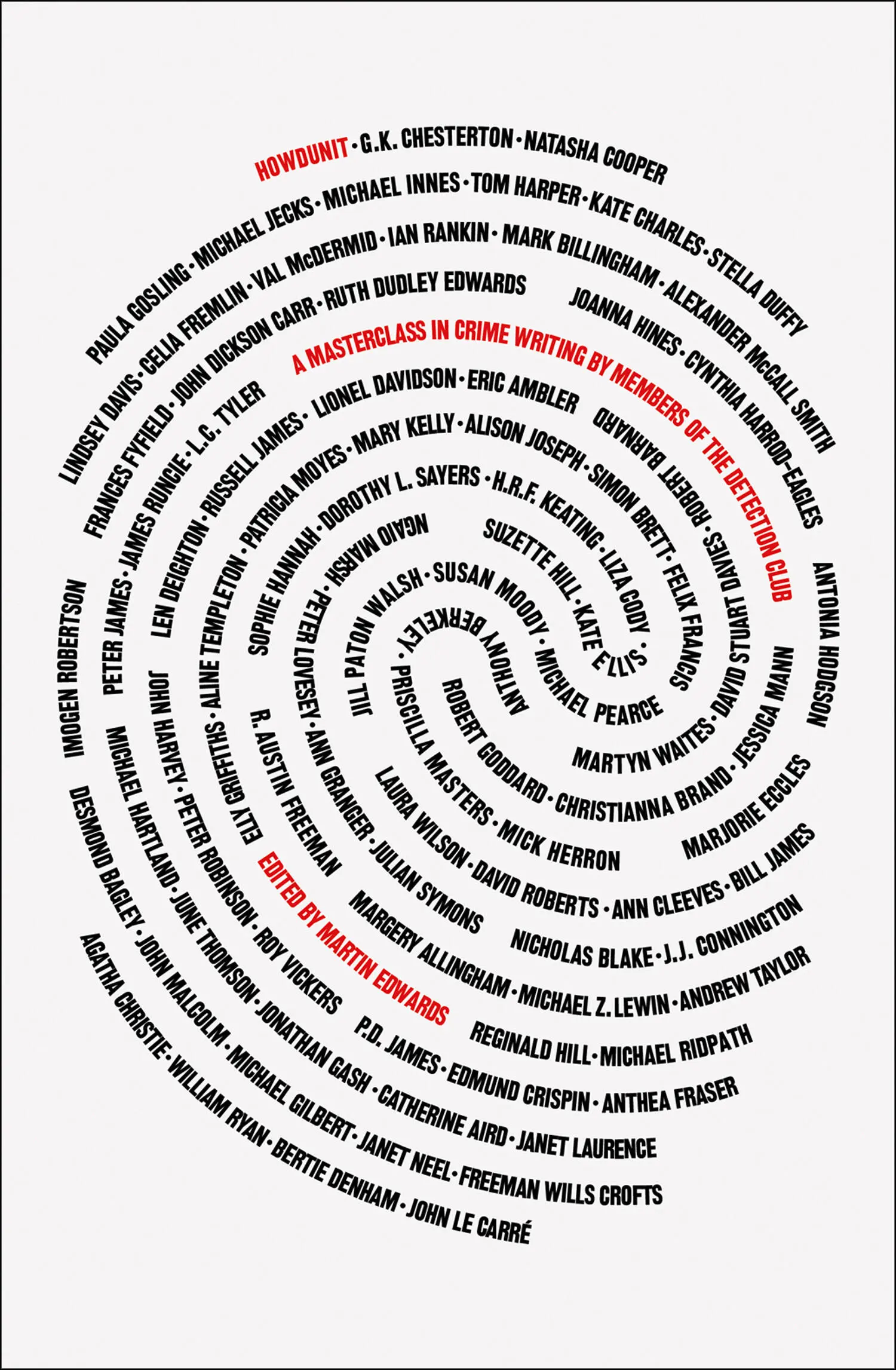
Howdunit
Здесь есть возможность читать онлайн «Howdunit» — ознакомительный отрывок электронной книги совершенно бесплатно, а после прочтения отрывка купить полную версию. В некоторых случаях можно слушать аудио, скачать через торрент в формате fb2 и присутствует краткое содержание. Жанр: unrecognised, на английском языке. Описание произведения, (предисловие) а так же отзывы посетителей доступны на портале библиотеки ЛибКат.
- Название:Howdunit
- Автор:
- Жанр:
- Год:неизвестен
- ISBN:нет данных
- Рейтинг книги:5 / 5. Голосов: 1
-
Избранное:Добавить в избранное
- Отзывы:
-
Ваша оценка:
Howdunit: краткое содержание, описание и аннотация
Предлагаем к чтению аннотацию, описание, краткое содержание или предисловие (зависит от того, что написал сам автор книги «Howdunit»). Если вы не нашли необходимую информацию о книге — напишите в комментариях, мы постараемся отыскать её.
Howdunit — читать онлайн ознакомительный отрывок
Ниже представлен текст книги, разбитый по страницам. Система сохранения места последней прочитанной страницы, позволяет с удобством читать онлайн бесплатно книгу «Howdunit», без необходимости каждый раз заново искать на чём Вы остановились. Поставьте закладку, и сможете в любой момент перейти на страницу, на которой закончили чтение.
Интервал:
Закладка:
Each contributor is a past or present member of the Detection Club, the world’s oldest social network of crime writers. Publication of Howdunit coincides with the Club’s ninetieth birthday, so there is one essay for each year of the Club’s life to date. Over the past nine decades, many of Britain’s preeminent authors in the genre have belonged to the Club. Their work includes spy, thriller, and adventure fiction, as well as traditional detective stories and novels of psychological suspense. It is high time that their collective wisdom appeared in a single volume. The emphasis is on present-day writing and writers, but our predecessors’ thoughts remain of interest. This is partly because they illustrate how much the writing life and literary fashions have changed, and partly because they show that quite a few challenges remain the same. Detection Club members take their work seriously – but we also take joy from it. That sense of pleasure ripples through the contributions, from Lindsey Davis’s thoughts on literary style to Simon Brett’s rueful reflections about the prospect of having one’s masterpiece adapted by other hands.
A century ago, the Club’s first President, G. K. Chesterton, wrote with pungent wit, ‘It is a well-known fact that people who have never succeeded in anything end by writing books about how to succeed; and I do not see why this principle should not be applied to success in the writing of detective stories as well as in lower and less glorious walks of life.’ But I like to think that Chesterton would have approved of this book, and would be delighted to see his own opinions appear alongside those of his contemporaries and successors.
From the Club’s formation in 1930, Detection Club members, with Anthony Berkeley Cox and Dorothy L. Sayers taking a vigorous lead, set about raising the literary standards of the genre. In those early days, bestselling thrillers tended to be shoddily written and jingoistic, so membership was confined to authors who had produced at least two detective novels of ‘acknowledged merit’, a standard occasionally applied in a rather haphazard manner. Thriller writers were excluded unless they also wrote detective stories in the classic vein. After the Second World War, when it became obvious even to the diehards that first-rate authors such as Eric Ambler were writing thrillers, the absurdity of continuing the exclusion was recognized and it was abandoned.
In its infancy, the Club was popularly associated with the idea of laying down ‘rules’ about how to write detective stories. The rules and their purpose have been shrouded in myths and misunderstandings. For a start, the rules were conceived by Ronald Knox, renowned as a satirist, before the Club was founded. And they were written tongue-in-cheek: an ordained priest, Knox presented them as a gentle skit on the Ten Commandments. Some of the ‘rules’, such as ‘The detective must not himself commit the crime’, were futile, taking the idea of ‘fair play’ towards the reader too far and for no good reason. He made one or two sensible points: for instance, when he says that twin brothers and doubles ‘must not appear unless we have been duly prepared for them’, he was simply arguing against the use of inelegant trickery that might fool readers but only at the cost of exasperating them. Above all, he was arguing for common sense in the writing of mysteries, urging practitioners to shun the absurd plot contrivances and racial stereotypes that abounded in early twentieth-century crime writing.
Cox, who founded the Club, and wrote innovative and influential crime fiction as Anthony Berkeley and Francis Iles, delighted in breaking the so-called ‘rules’ in his work, and so did many of his fellow members. But over the years, the joke got lost. One often-repeated canard is that Agatha Christie came close to being drummed out of the Club because The Murder of Roger Ackroyd was deemed to breach its rules. This is pure invention; the truth is that the novel was published four years before the Club came into existence, and it was much admired by Cox, Sayers, and Christie’s other colleagues.
It’s tempting to go to the other extreme, and suggest that the only rule for crime writers is that there are no rules. Writing is a process of trial and error, and each person has to work out what suits them best. Even so, the experiences of skilled practitioners, past and present, are instructive as well as intriguing. And who better, in Britain at least, to compile such a book than members of the Detection Club?
When I proposed, at the Club’s AGM in February 2019, that we collaborate on a book of this kind in order to boost our finances, I was unsure of the likely reaction. As it turned out, everyone was highly enthusiastic. The meeting also agreed to dedicate the book to Len Deighton, our longest-serving member, as a way of celebrating the golden anniversary of his election to the Club. As for the guiding concept of the book, Felix Francis summed it up as ‘How we dunit’. In other words, we’d talk about our own experiences, expressing personal views rather than laying down an earnest update of Knox’s jokey commandments. The Club’s publishers, HarperCollins, loved the idea, and in the months that followed, Howdunit took shape.
The result is not a textbook or manual; readers wishing to delve into the minutiae of police and courtroom procedure, forensic science, and the law of libel should look elsewhere. Instead the contributors offer a treasure trove of wit, wisdom, and anecdotes. You will find out here which author was the first novelist to use a word processor, who wrote what has been described as the first ‘electronic novel’, how a Booker Prize nomination led to a commission to revive a great detective of the Golden Age, and a good deal more. There is even a step-by-step case study in correspondence of the making of a collaborative crime classic, which illustrates that the creative process is an extraordinary mixture of pleasure and pain. And because there is no limit to the talents in the Detection Club, there are also several cartoons by ‘Clewsey’, whose name conceals a collaboration of three members, one of whom trained in graphic design …
I suggested broad topics that members might like to write about, and offered more detailed ideas to anyone who asked for them, but I didn’t try to impose conformity of approach or message or to eliminate contradictions. I wanted contributors to express themselves without feeling constrained by editorial diktats. When you are lucky enough to have the chance to work with such a gifted group of authors, it would be crazy not to give them free rein. The genre is a broad church, encompassing so many types of story, and it would be strange if all crime writers had same opinions or went about their task in the same way. As will become evident, they don’t. In these pages you can hear (just as you can if you attend a major literary festival) many different voices. The contributors have diverse opinions about everything from writer’s block to the crime novelist’s mission.
Some writers plot or outline in advance before writing the first word of a story, while others write from the seat of their pants, setting off on the journey of novel writing without having the faintest idea of where it will take them. Both approaches are explored in Howdunit , along with many other areas where there is room for divergent attitudes and approaches. To suggest that one view is invariably ‘right’ and another is ‘wrong’ is naive. Just as different criminals favour different m.o.s, so different crime novelists follow different paths when creating their mysteries. They also favour different types of crime fiction; this book aims to show the rich potential of the genre. The value of the personal views expressed by contributors lies in the way they illuminate the pros and cons, the choices that any writer needs to make. We don’t offer the false comfort of definitive answers where none exist, although there are also areas of widespread consensus – for instance, that writers with fertile imaginations can find ideas anywhere. The question for any individual is ultimately: what works for you?
Читать дальшеИнтервал:
Закладка:
Похожие книги на «Howdunit»
Представляем Вашему вниманию похожие книги на «Howdunit» списком для выбора. Мы отобрали схожую по названию и смыслу литературу в надежде предоставить читателям больше вариантов отыскать новые, интересные, ещё непрочитанные произведения.



Обсуждение, отзывы о книге «Howdunit» и просто собственные мнения читателей. Оставьте ваши комментарии, напишите, что Вы думаете о произведении, его смысле или главных героях. Укажите что конкретно понравилось, а что нет, и почему Вы так считаете.