Howdunit
Здесь есть возможность читать онлайн «Howdunit» — ознакомительный отрывок электронной книги совершенно бесплатно, а после прочтения отрывка купить полную версию. В некоторых случаях можно слушать аудио, скачать через торрент в формате fb2 и присутствует краткое содержание. Жанр: unrecognised, на английском языке. Описание произведения, (предисловие) а так же отзывы посетителей доступны на портале библиотеки ЛибКат.
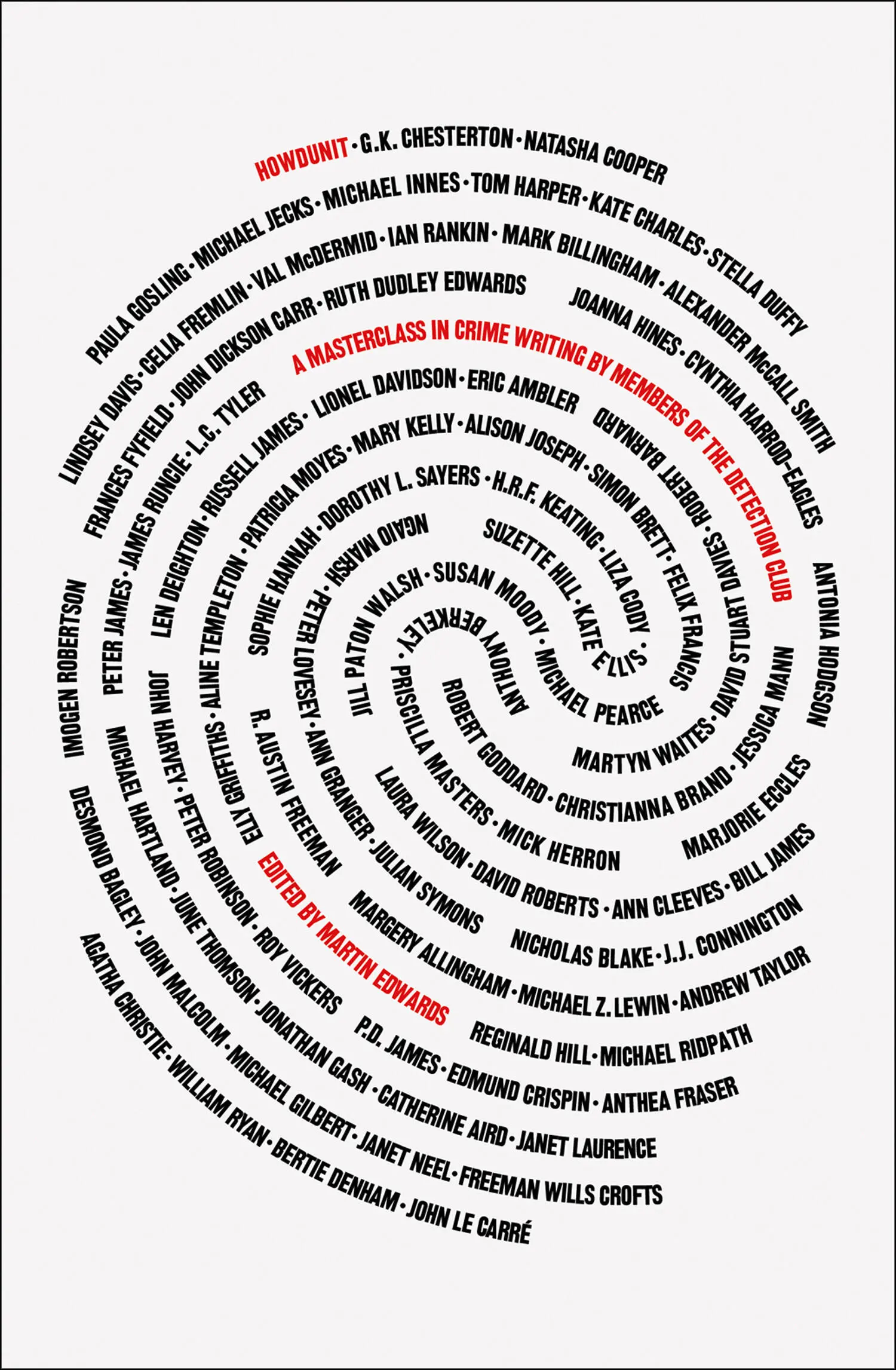
- Название:Howdunit
- Автор:
- Жанр:
- Год:неизвестен
- ISBN:нет данных
- Рейтинг книги:5 / 5. Голосов: 1
-
Избранное:Добавить в избранное
- Отзывы:
-
Ваша оценка:
Howdunit: краткое содержание, описание и аннотация
Предлагаем к чтению аннотацию, описание, краткое содержание или предисловие (зависит от того, что написал сам автор книги «Howdunit»). Если вы не нашли необходимую информацию о книге — напишите в комментариях, мы постараемся отыскать её.
Howdunit — читать онлайн ознакомительный отрывок
Ниже представлен текст книги, разбитый по страницам. Система сохранения места последней прочитанной страницы, позволяет с удобством читать онлайн бесплатно книгу «Howdunit», без необходимости каждый раз заново искать на чём Вы остановились. Поставьте закладку, и сможете в любой момент перейти на страницу, на которой закончили чтение.
Интервал:
Закладка:

‘Something Should Happen Now’: Narrative Hooks
Peter Robinson
I always get nervous when I’m asked to write about the craft of fiction. As I teach creative writing courses often, I have read a lot of books on the subject. You know the sort of thing: 5 Shortcuts to Perfect Plotting , 3 Techniques for Creating Award-winning Characters , 10 Simple Steps to Writing the Greatest Crime Novel Ever Written, and so on. But when I write, I don’t think about these books; I just follow my gut instinct. As a jazz pianist needs to practise scales before moving on to wild improvisations, so a writer needs to become familiar with and internalize the basics of his craft in order to set off on a flight of fancy. For what is a novel, after all, but a flight of fancy? You may have studied plotting, structure, dialogue, description, action and character as separate strands of the writing process, and done all the requisite exercises, but when you start working on a book, they all tend to blur into one another, and when the writing is going well most writers rarely stop to make sure they have adhered to the three-, five- or seven-act structure, got their plot points in the right places or put in enough narrative hooks. When it comes right down to it, I can’t really know what will hook ‘the reader’, but I do know what hooks me. And I’m a reader, too, so maybe I’m my own best audience?
What is a narrative hook? Perhaps the best way to think of it is as anything that keeps a reader turning the pages. The writer’s least favourite question is ‘Where do you get your ideas?’ Usually when people ask that, they mean the outlandish overall concept for the book, such as a serial killer who skins his victims, but when you get right down to it, a book isn’t made of one idea. Every sentence is an idea. And in the same way, every page, or at least every scene or every chapter, needs narrative hooks. Perhaps the first lesson, then, is that you should always think of narrative hooks in the plural.
Beginnings are notoriously difficult; there’s no way around that. The main problem is that many writers, especially beginners, tend to put too much exposition up front. Someone is murdered in a particularly gruesome fashion in the first sentence, then the writer spends two pages giving us the victim’s life story. There’s very little narrative hook in that. Some more cunning writers try to get around this problem by using a startling prologue as their hook, often written in the present tense and italicized. This prologue, though full of atmosphere, mystery and menace, appears at first to have no relation whatsoever to the story that follows, and the reader is hooked on wanting to know what the hell it is there for. Eventually, all is revealed. The problem with this is that it has become a cliché. I should know; I’ve done it once or twice. In his ten rules for writing, Elmore Leonard advises us to avoid prologues. I wouldn’t take this as an absolute rule, but perhaps it is better to avoid routinely including prologues.
Too much attention is also given to hooking your reader with the opening sentence. Yes, it is all well and good if you can come up with a real humdinger, but in most cases, you won’t. By all means aspire to perfection, but remember, you can always come back to it later. What you really need to do is get the story moving. Becoming obsessed with the opening sentence is often a sure-fire way of procrastinating. If you’re not careful, you’ll end up like Camus’s Joseph Grand in La Peste , who was such a perfectionist that he couldn’t get beyond writing and rewriting the first sentence of his book.
Not all opening sentences hook the reader as strongly as Ruth Rendell’s A Judgement in Stone , in which she not only names the murderer but supplies the motive. The entire opening scene of this book merits study for any writer, as Rendell continues to describe the crime and its outcome in a way that seems to be ‘giving away’ everything we expect to find out bit by bit in the course of the reading the whole novel. Instead of encouraging us to stop reading, however, this technique proves to be perfect narrative hook, perhaps because it leads us to become more interested in how it all unfolds rather than simply what happens and to whom. As we read, we find ourselves watching a car crash in slow motion.
The lesson here is to think beyond the first sentence to the whole opening scene, for that is where you must set your first hooks. Most readers are generous enough to allow a writer a couple of chapters before deciding whether to give up or carry on. That’s where to concentrate your efforts. An agent or editor, should you be fortunate enough to come to the attention of one, will also read at least a few pages.
The first scene or chapter usually introduces the setting and the main character and kick-starts the plot, or sets the groundwork for it. It also sets the tone for what is to follow, and it must also raise a lot of questions we want answered or set up situations we want to see resolved. It gives you more than enough opportunities get your hooks into your readers. You need to give them a feel for the world they’ll be spending the next few hours in. The books we enjoy most are the ones that envelop and absorb us the most completely, that give us a place, or places, to inhabit, interesting characters to love or hate, action and dialogue that we want to go back and spend time with day after day, a fully realized world that we can immerse ourselves in. When you finish a book like that you should be feeling both joy and sadness. Sadness that it’s over, of course, but also joy because you had the experience, and you can have it again and again with more of that author’s books. If you understand that as a reader, you will also understand it as a writer. It will be your task to create that world, to provide that experience for others. It doesn’t matter whether you’re planning a series or just a stand-alone; the more you give the reader that glorious sensation of immersion in the fictional world you have created, the more successful your books will be.
The opening scene is where you must set your first and most powerful hooks. Think of it as a seduction. They need to know what kind of world they will be entering and what sort of ride they may be in for. For the hook is all about creating a world. It’s OK to be subtle, but make sure you set up possibilities, hints, whispers, a vivid setting, something that grabs the reader’s attention and makes her want to keep reading. Make the reader fall in love with the story. It’s as simple as that. And as difficult.
And after that? Don’t let up. Keep the hooks coming. My first editor went over my first manuscript with me, page by page. There were yellow Post-it notes everywhere, and around page thirty or so I noticed that she had written in pencil at the top of the page: ‘Something should happen now.’ Something happened five pages later, but she had sensed that my pacing was off, that I had set up a hook that didn’t pay off quickly enough, and I knew I needed to cut five pages from my first thirty to make something happen sooner. That was an important lesson to learn.
Of course, a hook may be greater or lesser in magnitude. There are big hooks, of which you will need fewer, and little hooks, of which you will need many. Yes, we may be hooked by the big concept – will the protagonist stop the serial killer before he kills and skins the young journalist we have come to like. But while all of that big stuff is important, and should always be in your mind, you should not lose track of the numerous little hooks you need to keep the story moving along. ‘Something should happen now.’ Maybe just a little thing. But something. Maybe in a subplot. One example is a relationship. The protagonist is having problems with his girlfriend, say, or his wife, or family. We should care about this and want things to be resolved. Or it could also be a health issue, the result of an X-ray, or a work problem – conflict with one’s boss or partner, perhaps – but it is all grist for the hook mill. You have so many opportunities. Don’t waste them. It’s like the fairground plate-spinner or juggler. The more plates your protagonist has to keep spinning, or the more balls in the air, the faster your reader will turn the pages. And if once in a while he lets a plate fall and break or drops a ball, then it means he’s only human, and the broken plate or dropped ball can work as a narrative hook itself, perhaps misdirecting us for a while.
Читать дальшеИнтервал:
Закладка:
Похожие книги на «Howdunit»
Представляем Вашему вниманию похожие книги на «Howdunit» списком для выбора. Мы отобрали схожую по названию и смыслу литературу в надежде предоставить читателям больше вариантов отыскать новые, интересные, ещё непрочитанные произведения.

Обсуждение, отзывы о книге «Howdunit» и просто собственные мнения читателей. Оставьте ваши комментарии, напишите, что Вы думаете о произведении, его смысле или главных героях. Укажите что конкретно понравилось, а что нет, и почему Вы так считаете.