Museum Transformations
Здесь есть возможность читать онлайн «Museum Transformations» — ознакомительный отрывок электронной книги совершенно бесплатно, а после прочтения отрывка купить полную версию. В некоторых случаях можно слушать аудио, скачать через торрент в формате fb2 и присутствует краткое содержание. Жанр: unrecognised, на английском языке. Описание произведения, (предисловие) а так же отзывы посетителей доступны на портале библиотеки ЛибКат.
- Название:Museum Transformations
- Автор:
- Жанр:
- Год:неизвестен
- ISBN:нет данных
- Рейтинг книги:4 / 5. Голосов: 1
-
Избранное:Добавить в избранное
- Отзывы:
-
Ваша оценка:
Museum Transformations: краткое содержание, описание и аннотация
Предлагаем к чтению аннотацию, описание, краткое содержание или предисловие (зависит от того, что написал сам автор книги «Museum Transformations»). Если вы не нашли необходимую информацию о книге — напишите в комментариях, мы постараемся отыскать её.
Museum Transformations — читать онлайн ознакомительный отрывок
Ниже представлен текст книги, разбитый по страницам. Система сохранения места последней прочитанной страницы, позволяет с удобством читать онлайн бесплатно книгу «Museum Transformations», без необходимости каждый раз заново искать на чём Вы остановились. Поставьте закладку, и сможете в любой момент перейти на страницу, на которой закончили чтение.
Интервал:
Закладка:
In the principal and the most ambitious of the modules in the new exhibit, “Coniston Massacre,” the museum seeks to do more than represent the past in terms of the work of memory, secure in the knowledge that this is one of those properly documented incidents whose veracity even critics like Windschuttle accept. (It was chosen, too, in order to demonstrate that the frontier was longlasting and not simply a phenomenon of a long-ago nineteenth century.) Its text panels include a nuanced account of a series of killings of Aboriginal people by a police-led party in Central Australia in 1928 which is based on contemporary historical sources including an official board of inquiry. Nonetheless, this module also foregrounds a modern-day Aboriginal perspective and links between past and present in the form of a video in which an Aboriginal woman, Theresa Napurrula Ross, tells, in Aboriginal language, of her father bearing witness to the killings (which can be seen at http://www.nma.gov.au/exhibitions/first_australians/resistance/coniston_massacre/film_about_yurrkuru) (Figure 3.3). Finally, while the museum abandoned the Wiradjuri War display, it might be said to have upheld the principle informing it, since it developed an online interactive virtual display about the debate over contrasting accounts of the past that focuses on the Bells Falls Gorge massacre story (see National Museum of Australia 2002).
The changes the museum has made in its representation of Aboriginal history in its modern history galleries, however, are more striking than the ones in the Gallery of the First Australians, especially in the “Landmarks” installation which replaced a gallery called “Nation.” This change occurred as part and parcel of a decision on the part of the museum’s curators to meet the calls of its national critics to celebrate the nation not by placing an emphasis on “national identity” or “national character” but rather on place or, more to the point, on “specific places and locales” (National Museum of Australia 2004c, 2–3). “A place-based history brings sharply into focus the centrality of the interwoven histories of Indigenous and non-Indigenous Australians – the complicated history of colonization – to any understanding of the Australian past,” the exhibition’s senior curator has argued: “Stories throughout Landmarks consider how settlers and Aboriginal peoples encountered each other as Europeans moved into the continent, how they fought and negotiated for access to land and resources, and developed sometimes amicable and sometimes disastrous modes of living together” (Wehner 2011). The emphasis on locale was deepened by the museum’s decision to reorganize its modern history galleries on the principle that objects would function as the primary carriers of information and creators of meaning in displays, and would be their very basis, instead of being merely used, as they had in most of the museum’s opening exhibitions, to illustrate abstract stories or themes principally communicated to audiences via words in various media. (For a discussion of this approach, see Wehner and Sear 2010.)
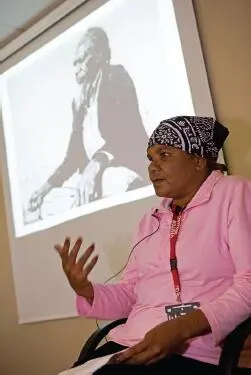
FIGURE 3.3Theresa Napurrula Ross, in front of a photo of her father, tells the story of the Coniston Massacre.
Photo: George Serras. Reproduced with permission of Theresa Napurrula Ross and the National Museum of Australia.
Consequently, most of the modules that make up “Landmarks” pay a great deal of attention to the Aboriginal past. The earliest ones, chronologically speaking, emphasize Aboriginal people’s prior presence and their displacement, dispossession, and death at the hands of the colonizers to a greater degree than the disbanded “Contested Frontiers” exhibit had done. For example, the opening text panel for “Colonial Foundations” states: “These [British] colonists founded towns in the lands of the Aboriginal peoples who had tended and shaped their country for thousands of years, beginning decades of conflict and negotiations over the control of the land.” This theme is pronounced in parts of this display called “Occupying the Country,” “Conquering Van Diemen’s Land,” and a “State of Unrest,” and even more so in a part of “Grazing the Grasslands.” Even in the module devoted to “Urban Life” there are parts that make reference to precolonial Aboriginal use of places and the fact that Aboriginal people were later removed from them by the British, while in “Spirit of Inquiry” there is a section devoted to the work an eminent anthropologist conducted among Aboriginal communities.
In the second major modern history gallery, now called “Australian Journeys,” the museum represents the journeys of discovery, exploration, and settlement of the Australian continent demanded by conservative critics, but also includes accounts of the journeys Aboriginal people made, as well as encounters they had with seafaring newcomers. In its third major modern history gallery, “Old New Land” (previously called “Entangled Destinies”), which represents the country’s environmental history, the museum has added a display about the role Aboriginal people played in the pastoral industry. Finally, in a further small gallery devoted to short biographical narratives, “Stories from the Emotional Heart of Australia,” the theme of separation features a racially inspired killing of a young Aboriginal man who had been removed from his kith and kin as a child.
Conclusion
The nature of the changes to the National Museum of Australia’s exhibits were, as we have noted, very different from what most people had anticipated. This outcome might be explained in several ways. It can be argued that the conservative government had lost interest in conducting a history war, and thus intervening in the museum’s work, once it succeeded in realizing its political agenda in respect of matters of race, which included Aboriginal policy. Further to this, it might be noted that the government’s influence does not seem to have reached far enough into the museum to enable it to determine the ways in which its curators went about their work. Finally, in this regard, it can be argued that the museum’s advisers and curators were canny enough to devise an approach to staging its exhibitions that allowed the museum to continue telling difficult histories.
More importantly, however, what I have recounted here apropos the National Museum of Australia suggests that the nature of the international difficult histories boom is such that its effects cannot be readily overturned. Museums around the world, especially national ones, are now expected to tell these stories, and many museums have embraced the demand to do this. More particularly, it seems that the deep-seated changes that took place in historical consciousness in settler societies such as Australia in the closing decades of the twentieth century mean that museums, especially national ones, will continue to adopt an approach to the task of representing the past informed by democratizing impulses that seek to refound the historical relationship between settlers and indigenous peoples on more just principles, even in the face of conservative reaction.
Acknowledgments
I wish to thank senior curators at the National Museum of Australia Jay Arthur, Michael Pickering, and Kirsten Wehner for discussing their work with me, Kirsten Wehner for guiding me to sources, and Michael Pickering for providing copies of some of this material.
References
ABC PM. 2001. “Did the Bells Falls Gorge Massacre Happen?” Accessed April 15, 2014. http://www.abc.net.au/pm/stories/s345657.htm.
Читать дальшеИнтервал:
Закладка:
Похожие книги на «Museum Transformations»
Представляем Вашему вниманию похожие книги на «Museum Transformations» списком для выбора. Мы отобрали схожую по названию и смыслу литературу в надежде предоставить читателям больше вариантов отыскать новые, интересные, ещё непрочитанные произведения.





Обсуждение, отзывы о книге «Museum Transformations» и просто собственные мнения читателей. Оставьте ваши комментарии, напишите, что Вы думаете о произведении, его смысле или главных героях. Укажите что конкретно понравилось, а что нет, и почему Вы так считаете.