Museum Transformations
Здесь есть возможность читать онлайн «Museum Transformations» — ознакомительный отрывок электронной книги совершенно бесплатно, а после прочтения отрывка купить полную версию. В некоторых случаях можно слушать аудио, скачать через торрент в формате fb2 и присутствует краткое содержание. Жанр: unrecognised, на английском языке. Описание произведения, (предисловие) а так же отзывы посетителей доступны на портале библиотеки ЛибКат.
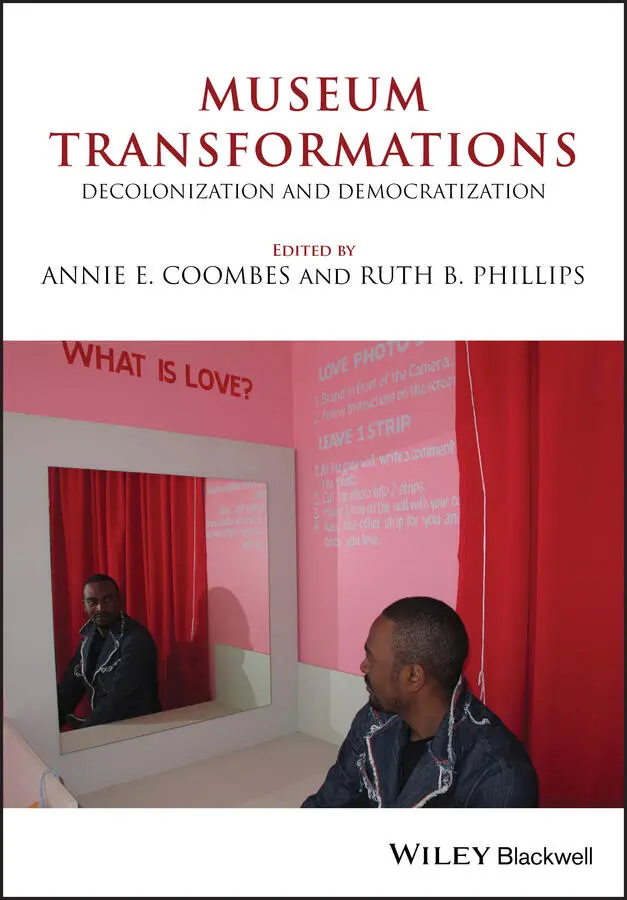
- Название:Museum Transformations
- Автор:
- Жанр:
- Год:неизвестен
- ISBN:нет данных
- Рейтинг книги:4 / 5. Голосов: 1
-
Избранное:Добавить в избранное
- Отзывы:
-
Ваша оценка:
Museum Transformations: краткое содержание, описание и аннотация
Предлагаем к чтению аннотацию, описание, краткое содержание или предисловие (зависит от того, что написал сам автор книги «Museum Transformations»). Если вы не нашли необходимую информацию о книге — напишите в комментариях, мы постараемся отыскать её.
Museum Transformations — читать онлайн ознакомительный отрывок
Ниже представлен текст книги, разбитый по страницам. Система сохранения места последней прочитанной страницы, позволяет с удобством читать онлайн бесплатно книгу «Museum Transformations», без необходимости каждый раз заново искать на чём Вы остановились. Поставьте закладку, и сможете в любой момент перейти на страницу, на которой закончили чтение.
Интервал:
Закладка:
In the case of the Wiradjuri War display, some of the critics who were sympathetic to the museum’s treatment of frontier conflict suggested that the display should never have been mounted or that it should be abandoned, and contended that it would have been wiser for the museum to have presented the history of mass killings of Aboriginal people by means of a display that recounted instances that are uncontested because they can be “properly documented” (Geoffrey Bolton, quoted in Yallop 2003; see Macintyre and Clark 2003, 215). However, this response, at best, overlooks three crucial matters. First, the museum had sought to tell a story not so much about settler violence as about Aboriginal resistance. Second, its mounting of this display was the outcome of an attempt by Aboriginal people to challenge settler authority or even sovereignty by presenting their stories and asserting their forms of historical knowledge and truth. Third, the museum’s staging of this display was in keeping with its commitment to presenting accounts of the past that had not always been part of the country’s history. Consequently, abandoning the Wiradjuri War display could be interpreted as a retrograde step by the museum and one that smacked of colonialism.
In the wake of the conservative attack on the Wiradjuri War display, the museum made a series of moves. First, the curator responsible for the frontier conflict exhibit pointed out that the purpose of the display was to provide a present-day indigenous perspective on frontier violence, though he also tried to defend it on empirical grounds by claiming that there was an autochthonous tradition for the massacre that had been passed down through the generations (ABC PM 2001; Manera 2001). Second, the museum held a conference to debate the way in which frontier conflict was represented there, in the course of which the historian Graeme Davison (2003, 212) suggested that it might have adopted a firmer position in the story being told in the display, even if only to make clear to visitors that it was presenting them with an account that largely sought to foreground a modern-day Aboriginal perspective of frontier conflict. Third, in a context in which conservative members of the museum’s council were characterizing the controversy over the display in terms of whether its accounts of the past should rely on “oral tradition or historical fact” (Tony Staley, quoted in Yallop 2003), and senior staff at the museum realized that any reference to a Wiradjuri oral tradition rendered it vulnerable to attack (all the more so as they grasped that Aboriginal people’s account was probably derived from the settler tradition), it sought to de-emphasize the importance of the Aboriginal account to the display (Foster 2003; McIntyre 2003). Fourth, the museum adopted a recommendation that Davison had made at the conference to prepare some supplementary material, creating a web-based student kit about “ how we know what we know about the past” which focused on the Wiradjuri War display as a case study (Davison 2003, 212; National Museum of Australia 2004b). Fifth, the museum decided it would prepare new text panels for the display in order to shed light on the controversy that had come to envelop the exhibit (National Museum of Australia 2004a, 10). And, finally, in the wake of a report of a review of the museum ordered by the conservative government barely a year after the museum had opened (to be discussed shortly), the museum decided to abandon the display and have a changeover of the story lines in the “frontier conflict” exhibit (National Museum of Australia 2004a).
Review and renewal
The review of the National Museum was informed by conceptions of nation, democracy, and history that were as conservative as they were conventional. The review panel believed that the nation must have a unitary historical narrative, that it should be largely factual in nature, and that all Australians should embrace this. Demanding that the museum have grand, compelling, and engaging narratives, the panel envisaged a story line that would be primarily Anglo-Celtic in nature, at least in the three principal galleries representing “the history of modern Australia.” This would see a return to problematic colonial tropes such as discovery and exploration. But the most troubling aspect of the review’s recommendations concerned its treatment of post-1788 Aboriginal history. Although it approved of the Gallery of First Australians’ treatment of indigenous culture , it angled to sequester indigenous history so that it appeared only in that part of the museum, presumably because it realized that consideration of it called into question the moral legitimacy of the settler nation. More especially, the review panel called for a very different account of frontier conflict by suggesting that violent clashes were simply caused by both parties having mistaken cultural assumptions. Finally, while the review panel urged the museum to devote space to alternative accounts of the past; it did not countenance alternative ways of representing the past such as those employed in the Wiradjuri War exhibit ( Review of the National Museum of Australia 2003). In the wake of the review, the frontier conflict exhibit and two of the principal modern history galleries have been changed, and parts of a third gallery in the latter section have been altered. However, none of this has occurred in the manner conservative forces hoped and supporters of the original exhibits feared.
The museum redesigned what had been “Contested Frontiers” in such a way as to make it clearer that the exhibit was situated in the Gallery of the First Australians and that it was consequently tasked with examining the history of the colonization of the country by focusing on the experience and the stories of Aboriginal people (National Museum of Australia 2004a; the exhibition can be viewed at National Museum of Australia 2011). The purpose of the new exhibit is announced by its name, “Resistance” or “Stories of Resistance,” and by an introductory text panel that emphasizes the variety of strategies that Aboriginal people adopted in an attempt to maintain their community and culture in the face of the changes wrought by colonization. The exhibit foregrounds the agency of particular Aboriginal people, both men and women, and seeks to appeal especially to Aboriginal audiences. In keeping with its purpose, the dominant background color in the exhibit has been changed from black to orange. The museum stresses that the story it seeks to tell belongs to the genre of memory rather than history. The second signpost that visitors encounter is labelled “Remembering Resistance,” and part of the text panel here reads: “the brutal events of the past remain vivid in the minds of many people today. Indigenous and non-Indigenous people continue to remember, commemorate, and come to terms with those events.” Most importantly, the four modules comprising the exhibit, like the two local ones in the abandoned exhibit, seek to reveal connections between the past and the present, and to show what the past means to Aboriginal people now and how it influences or informs what they do. In representing the story of Yagan, who was more or less an equivalent of the Wiradjuri’s Windradyne and the Bunuba’s Jandamurra, the museum tells not only of his cooperation and conflict with settlers in southwest Western Australia in the late 1820s and early 1830s and the decapitation, preservation, and transfer of his body to England after his death, but also of the successful quest of his people in recent decades to locate his remains and to repatriate them. Similarly, in a display telling the story of a Noongar woman, Fanny Balbuk, who passed away a hundred or so years ago, the museum notes that her cultural knowledge has been used recently in a native title claim made by her people.
Читать дальшеИнтервал:
Закладка:
Похожие книги на «Museum Transformations»
Представляем Вашему вниманию похожие книги на «Museum Transformations» списком для выбора. Мы отобрали схожую по названию и смыслу литературу в надежде предоставить читателям больше вариантов отыскать новые, интересные, ещё непрочитанные произведения.





Обсуждение, отзывы о книге «Museum Transformations» и просто собственные мнения читателей. Оставьте ваши комментарии, напишите, что Вы думаете о произведении, его смысле или главных героях. Укажите что конкретно понравилось, а что нет, и почему Вы так считаете.