Museum Transformations
Здесь есть возможность читать онлайн «Museum Transformations» — ознакомительный отрывок электронной книги совершенно бесплатно, а после прочтения отрывка купить полную версию. В некоторых случаях можно слушать аудио, скачать через торрент в формате fb2 и присутствует краткое содержание. Жанр: unrecognised, на английском языке. Описание произведения, (предисловие) а так же отзывы посетителей доступны на портале библиотеки ЛибКат.
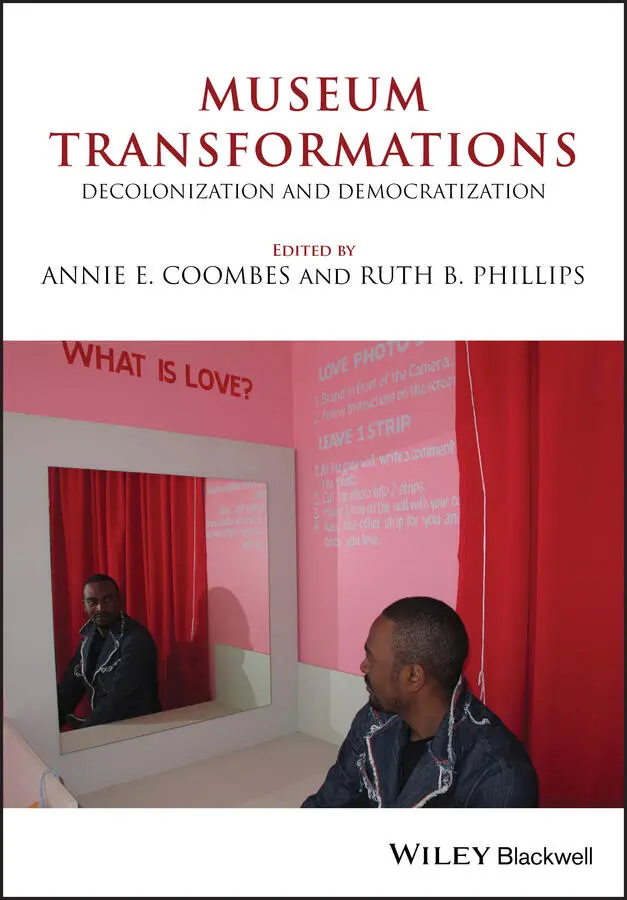
- Название:Museum Transformations
- Автор:
- Жанр:
- Год:неизвестен
- ISBN:нет данных
- Рейтинг книги:4 / 5. Голосов: 1
-
Избранное:Добавить в избранное
- Отзывы:
-
Ваша оценка:
Museum Transformations: краткое содержание, описание и аннотация
Предлагаем к чтению аннотацию, описание, краткое содержание или предисловие (зависит от того, что написал сам автор книги «Museum Transformations»). Если вы не нашли необходимую информацию о книге — напишите в комментариях, мы постараемся отыскать её.
Museum Transformations — читать онлайн ознакомительный отрывок
Ниже представлен текст книги, разбитый по страницам. Система сохранения места последней прочитанной страницы, позволяет с удобством читать онлайн бесплатно книгу «Museum Transformations», без необходимости каждый раз заново искать на чём Вы остановились. Поставьте закладку, и сможете в любой момент перейти на страницу, на которой закончили чтение.
Интервал:
Закладка:
Their treatment can be contrasted with the ways in which this past came to be represented in the closing decade or so of the twentieth century. Most importantly, perhaps, were the accounts of the past told by Aboriginal people themselves. These histories are mostly very local, focusing on places such as Bells Falls Gorge. They are usually based on Aboriginal people’s own sagas, myths, traditions, and legends, which are ways of relating the past that can be characterized as memorial rather than historical in nature inasmuch as they do not rest on traces of the past contemporaneous to the past being recounted. Moreover, these accounts do not seek to replicate empirical scholarly accounts of the frontier and so do not depend on a correspondence between the historical truth they claim and historical facts. Instead, they tend to render the past in terms of an event that their tellers believe is symbolic of the nature of Aboriginal–settler relations. Furthermore, there is often an acknowledged personal, familial, or kin connection between the narrator and the subject matter. Indeed, this subjective relationship between present and past provides the very raison d’être of most Aboriginal history. An account that typifies this kind of historical work, Mary Coe’s Windradyne: A Wiradjuri Koorie (1989), which tells the story of a massacre of some of her people, the Wiradjuri, at Bells Falls Gorge (57–58), will be discussed below.
A further contrast to the academic studies of frontier conflict can be found in local settler oral traditions that relate the frontier past in terms of massacres. One of these tells of a massacre of Aboriginal people at Bells Falls Gorge. In the mid-1990s an academic historian, David Roberts, carefully considered these as an example of what Eric Hobsbawm (1983) called “the invention of tradition.” Roberts discovered that there were massacre stories in manuscript sources dating from the late-nineteenth century that were similar to the one told in recent times about Bells Falls Gorge, and speculated that the story of that particular massacre might have emanated from accounts of killings at the time of the frontier in this area (the 1820s), but noted that there were no contemporary records to support the story of a massacre taking place at Bells Falls Gorge (Roberts 1995, 628–633).
As Aboriginal history became popular among settler Australians, accounts representing frontier conflict in terms of massacres of Aboriginal people became more common, told in the form of narrative histories. A journalist, Roger Milliss, wrote a mammoth book Waterloo Creek (1992) which told the story of a massacre said to have occurred on Australia Day in 1838; and a missionary teacher turned historian, Neville Green, told another local story, The Forrest River Massacres (1995), which was framed by an oral tradition Aboriginal people had related to him several decades after the event. As well as these kinds of scholarly books, which were published by trade rather than academic presses, there were more popular books on frontier conflict that were prepared for publication for Australia’s bicentenary, such as Bruce Elder’s Blood on the Wattle: Massacres and the Maltreatment of Australian Aborigines since 1788 (1988) and Al Grassby and Marji Hill’s Six Australian Battlefields: The Black Resistance to Invasion and the White Struggle against Colonial Oppression (1988).
Neither of these two books involved any proper historical research by the authors, but they, as well as Mary Coe’s Windradyne , played an important role in what amounted to a transformation of the story about a massacre at Bells Falls Gorge. As both the genre in which this narrative was related and the context in which it was recounted changed, so too did the way the story was told and the claims that were made for it. “In these,” Roberts points out, “highly dramatised accounts of naked atrocity were produced, replete with descriptions of soldiers advancing in a pincer movement around an Aboriginal camp, of Aboriginal women grabbing their children and leaping over the cliffs, of broken bodies piling up on the rocks below and the water running red with the blood of murdered Wiradjuri” (2003, 154). Moreover, these accounts disguised or disregarded the fact that there is no contemporary historical evidence for such a massacre.
Finally, a further historical genre, documentary film, told the story of frontier conflict. In this form of history there was a similarly greater focus on massacres rather than the small-scale instances of killing that were more typical of the violence that occurred on the frontiers of settlement. This was true of films that had academic advisers (such as the Australian Broadcasting Commission’s 1997 documentary Frontier ) but even more so of films reliant on those who had no such training. The latter included a film that tells the story of the Bells Falls Gorge Massacre, Windradyne, Wiradjuri Resistance: The Beginning (1993), whose script was based on Mary Coe’s book. In many historical films, spectacle and metaphor tend to be more important than factual data and logical argument, serving to create what film historian Robert Rosenstone has called “a different kind of work about the past, history as ‘symbol’ rather than as ‘reality’” (2006, 16). At the same time, most filmic history tends to render the past proximate rather than distant as it seeks to make history vivid and enable the viewer to experience the past (Rosenstone 2006, 16, 166). In the case of Windradyne , its very brief but dramatic account of the massacre is enhanced by panoramic shots of the gorge interspersed with images of Aboriginal children running through the bush trying to escape only to die. Similar affective strategies are, of course, employed in museum exhibits.
Bells Falls Gorge and the Wiradjuri War exhibit
Most of the democratizing impulses I have been discussing informed the display in the National Museum under consideration here, not least because it was the product of a process of consultation with Aboriginal people that the museum undertook in keeping with its commitment to be a place of “real and challenging dialogue between cultures” (Casey 2001, 7–8; Manera 2001). Called “1823–1825 The Wiradjuri War,” it was one of four modules that made up an exhibit “Contested Frontiers: Battles for the Land 1788–1928” (which can be seen at http://nma.gov.au/schools_bellsfalls/main.html) (Figure 3.1). The atmospherics of “Contested Frontiers” were somber, indeed mournful, with subdued lighting and the sound of a cello playing. At the threshold, a text panel summarized its themes:
It soon became apparent to Aboriginal people around Sydney Harbour that the British intended to stay. As the frontiers of colonization expanded, Aboriginal groups resisted. Guerilla wars were fought along a rolling frontier for a century and a half. Today the names of resistance leaders such as Windradyne and Jandamurra are virtually unknown outside their communities.
In the center of the exhibit were “Rolling frontiers” and “Wars of conquest, wars of resistance.” “Rolling frontiers” consisted of a map of Australia showing the gradual spread of British settlement marked by flashing lights indicating the location of major episodes of conflict, which included the Myall Creek and Coniston massacres, while the place-names “Slaughterhouse Creek,” “Massacre Bay,” “Battle Mountain,” and “Attack Spring” were projected onto the floor to signify killings committed by settlers. “Wars of conquest, wars of resistance” included a major text panel that similarly focused on Europeans and reflected what had become a scholarly consensus about the nature of frontier relations: increasing conflict as the British occupied more and more Aboriginal land, a shift over time in the balance of power that favored the newcomers, and considerable loss of life, especially for Aboriginal people. This, like the introductory panel, implied that the story being told was based on historical sources but that the past the displays related was the subject of both remembering and forgetting.
Читать дальшеИнтервал:
Закладка:
Похожие книги на «Museum Transformations»
Представляем Вашему вниманию похожие книги на «Museum Transformations» списком для выбора. Мы отобрали схожую по названию и смыслу литературу в надежде предоставить читателям больше вариантов отыскать новые, интересные, ещё непрочитанные произведения.





Обсуждение, отзывы о книге «Museum Transformations» и просто собственные мнения читателей. Оставьте ваши комментарии, напишите, что Вы думаете о произведении, его смысле или главных героях. Укажите что конкретно понравилось, а что нет, и почему Вы так считаете.