Museum Transformations
Здесь есть возможность читать онлайн «Museum Transformations» — ознакомительный отрывок электронной книги совершенно бесплатно, а после прочтения отрывка купить полную версию. В некоторых случаях можно слушать аудио, скачать через торрент в формате fb2 и присутствует краткое содержание. Жанр: unrecognised, на английском языке. Описание произведения, (предисловие) а так же отзывы посетителей доступны на портале библиотеки ЛибКат.
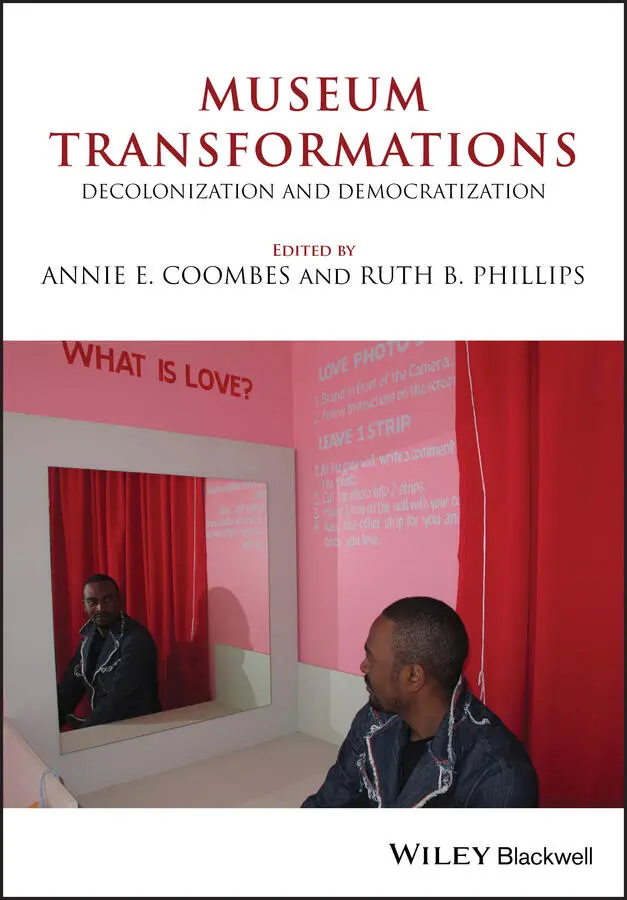
- Название:Museum Transformations
- Автор:
- Жанр:
- Год:неизвестен
- ISBN:нет данных
- Рейтинг книги:4 / 5. Голосов: 1
-
Избранное:Добавить в избранное
- Отзывы:
-
Ваша оценка:
Museum Transformations: краткое содержание, описание и аннотация
Предлагаем к чтению аннотацию, описание, краткое содержание или предисловие (зависит от того, что написал сам автор книги «Museum Transformations»). Если вы не нашли необходимую информацию о книге — напишите в комментариях, мы постараемся отыскать её.
Museum Transformations — читать онлайн ознакомительный отрывок
Ниже представлен текст книги, разбитый по страницам. Система сохранения места последней прочитанной страницы, позволяет с удобством читать онлайн бесплатно книгу «Museum Transformations», без необходимости каждый раз заново искать на чём Вы остановились. Поставьте закладку, и сможете в любой момент перейти на страницу, на которой закончили чтение.
Интервал:
Закладка:
The emphasis on social action that grew out of movements of decolonization and institutional critique has coincided with a technological revolution whose transformative impact has reached into every corner of human activity. Museums have sought to exploit new media not only to enhance their physical exhibitions and expand their publics, but also to archive their own exhibitionary histories. Critical museology, with its focus on museum and exhibition histories, has drawn renewed attention to institutional archives and their value in documenting progressive phases of experimentation. Reesa Greenberg’s chapter (20) explores the highly variable ways in which a series of landmark feminist art exhibitions have been documented on their respective museums’ websites. Her analysis illustrates the almost serendipitous nature of the permanent legacy left by even the largest and most revisionist of temporary exhibition projects. While some of these sites attempt to reproduce a real-space exhibition and thereby extend its life, others preserve an archival record of the exhibition as a past historical event. As Greenberg shows, the contrasting structures and levels of information required by these different approaches are not always well defined in relation to web design, inclusiveness of data, and other features.
But new media also have necessary limitations and these are perhaps most evident in the social dimensions of museum experience that are lost in the creation of virtual exhibitions. These can either be adaptations of real-space exhibitions or self-standing entities that have no real-space correlatives. Here, too, a great deal of experimentation has been underway, but certain limitations are intrinsic to the medium, as exemplified by the web versions of the two exhibitions commemorating Canadian Aboriginal residential schools that are discussed by Jonathan Dewar in Chapter 4. Like other virtual exhibitions, they can be accessed anywhere the Internet is available, and they will be seen by people unable to visit the physical exhibits. But they will also largely be viewed in isolation, without the social bonding that is possible when visitors share an experience in real time and space. The transformative power of new media is, however, most evident in its ability to create access to heritage materials for viewers who may be located thousands of kilometers away from its physical storage. In this context, Paul Basu’s discussion of the Sierra Leone Heritage website in Chapter 15shows how inventive uses of web technology can make it possible to combine remote access to collections, multivocal interpretation, and the exhibition of intangible culture in ways not possible in conventional museum spaces.
Conclusion
Change in museums, as in other institutions of modernity, results from negotiations of traditions and adaptations of technologies. The case studies presented in this volume evidence the importance of pressures exerted on museums for decolonization and greater democratization. Both, of course, have deep roots in twentieth-century cultural politics, but they have gained momentum from the speeded-up flows of capital, people, and media and their active engagements with institutions shaped by imperialism and modernity (Appadurai 1996). We opened this introduction by posing a question about the degree to which these changes amount to something we could call “transformation,” understood as a true paradigm shift that has evolved in response to these new demands and opportunities.
We would like to end where we began – with a Northwest Coast masquerade performance, this time by the contemporary Git Hayetsk dance group. 28The group’s cofounder Mique’l Dangeli has explained the functions of their masked dances, past and present, as sites for transgenerational knowledge transmission and reflection on historical experience – roles that closely parallel those assigned to the modern museum. As an academic scholar, she has also researched the work of B. A. Haldane, a pioneering Tsimshian photographer who had a prolific practice in Dangeli’s community of Metlakatla, Alaska, during the early twentieth century. Although Haldane’s photographs document both community members’ accommodations of modernity and their resistance to the erasure of their traditions, his work had been forgotten in the late twentieth century (Dangeli forthcoming). Dangeli decided to restore knowledge silenced by the colonial archive in two complementary ways, one modern and museological and the other traditional and performative. In 2007 she arranged an exhibition of Haldane’s photographs at Metlakatla, 29and in 2009 she created the Visual Sovereignty Dance, centering on a new nax nox , or ceremonial being (see Figure 0.4):
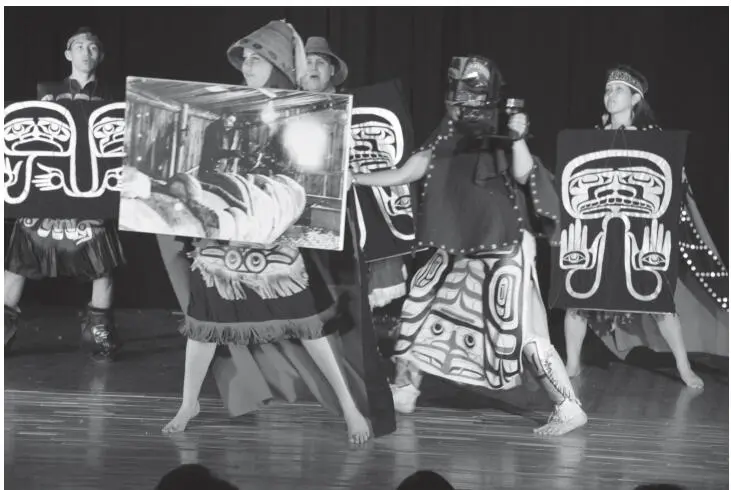
FIGURE 0.4Visual Sovereignty Dance performed by Git Hayetsk at Masq’alors! International Mask Festival, St. Camille, Quebec, 2013.
Courtesy of Mique’l Dangeli. Photo: Valerie Calusic.
During the dance four of B.A.’s photographs are revealed … The dance reaches a climax towards the end where the nax nox [masked dancer] creates new images by taking digital photographs of witnesses and the context of the performance. The nax nox turning the camera on to the viewers is a declaration of visual sovereignty in honor of today’s Indigenous photographers whose process of creation changes as new technology develops, all the while remaining deeply rooted in Indigenous visuality and ways of knowing. (Dangeli forthcoming).
The museum and its collections are, of course, key components of the colonial archive which has so often silenced the modernity and agency of Indigenous peoples. Yet it is also an essential resource for projects of restoration, and collaboration with museums has thus been integral to the work of the Git Hayetsk. By the same token, collaboration with Indigenous artists and researchers has become essential to museums as they seek to decolonize. The Git Hayetsk dancers regularly perform in museums so that they can revivify the “objects” and “artifacts” in the glass cases and on the storage shelves (Dangeli 2011). “Recently,” Dangeli has written, “we have become compelled to acknowledge the nax nox , those ceremonial beings who remain confined in museums and archives by creating new masks in their image to be brought to life publically with songs and dances” (2011, 44).
The effort we make to have our presence known, as living peoples and cultures, by dancing in museums aims both to disrupt the static nature of their display and to bring strength to our ceremonial beings, whose lives have been severed from the human interaction, sound, and movement that makes them and us whole. Further complicating our relationship with museums is the fact that, although our ability to engage with our ceremonial beings is stifled by the way institutions distance them from us, the willingness of museums to support our efforts (for example, by inviting our dance group to perform and allowing us to research their archives) contributes to my ability as a halaayt and Mike’s aptitude as a gitsonk . There is no doubt that the history of our cultural oppression permeates the power dynamics inherent to these relationships … our belief in and practice of nax nox and halaayt has the power to subvert the parameters of confinement of our ceremonial beings. (Dangeli 2011, 45–46)
Nax nox beings, Dangeli writes, “have the ability to bring change into the world – to strengthen, to defeat, to scare, to make peace, to give hope” (2011, 38). Her critique and the agency she claims for the Git Hayetsk dancers return us to the potential for transformation of the museum itself through its commitment to democratization and decolonization. Both work to reanimate histories that have been silenced, collections that have been ignored, and dimensions of cultural diversity whose disappearance has been prematurely declared. The move to transform museums is one that aims to establish new sites for mutual recognition, healing and knowing that acknowledge and respect difference and share authority. These processes are incomplete and subject to episodes of arrest and retreat. The gains that have been made are fragile. Yet the case studies set out in the chapters of this volume evidence important and precious steps that have been taken and trace a path whose permanence we must work to ensure.
Читать дальшеИнтервал:
Закладка:
Похожие книги на «Museum Transformations»
Представляем Вашему вниманию похожие книги на «Museum Transformations» списком для выбора. Мы отобрали схожую по названию и смыслу литературу в надежде предоставить читателям больше вариантов отыскать новые, интересные, ещё непрочитанные произведения.





Обсуждение, отзывы о книге «Museum Transformations» и просто собственные мнения читателей. Оставьте ваши комментарии, напишите, что Вы думаете о произведении, его смысле или главных героях. Укажите что конкретно понравилось, а что нет, и почему Вы так считаете.