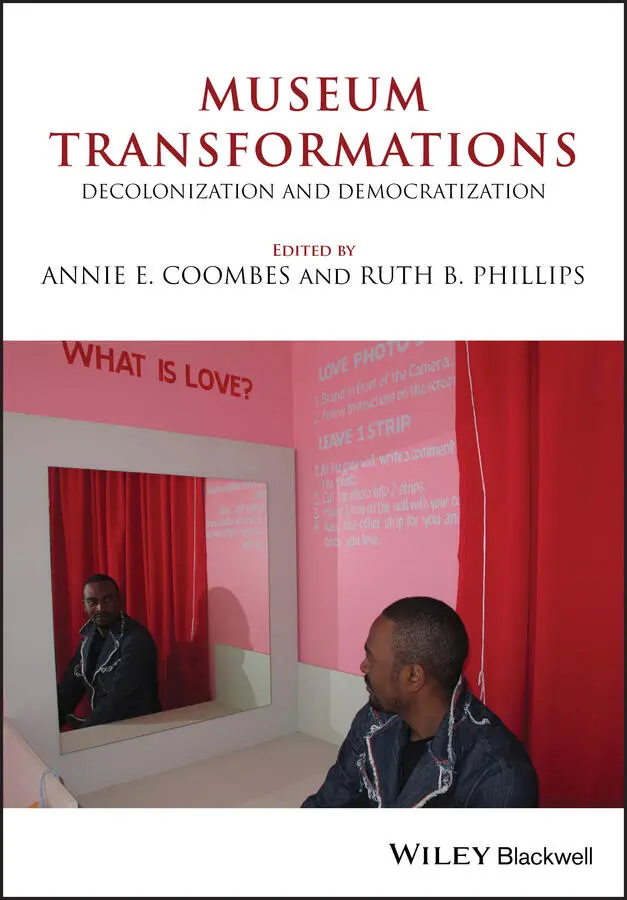
Museum Transformations
Здесь есть возможность читать онлайн «Museum Transformations» — ознакомительный отрывок электронной книги совершенно бесплатно, а после прочтения отрывка купить полную версию. В некоторых случаях можно слушать аудио, скачать через торрент в формате fb2 и присутствует краткое содержание. Жанр: unrecognised, на английском языке. Описание произведения, (предисловие) а так же отзывы посетителей доступны на портале библиотеки ЛибКат.
- Название:Museum Transformations
- Автор:
- Жанр:
- Год:неизвестен
- ISBN:нет данных
- Рейтинг книги:4 / 5. Голосов: 1
-
Избранное:Добавить в избранное
- Отзывы:
-
Ваша оценка:
Museum Transformations: краткое содержание, описание и аннотация
Предлагаем к чтению аннотацию, описание, краткое содержание или предисловие (зависит от того, что написал сам автор книги «Museum Transformations»). Если вы не нашли необходимую информацию о книге — напишите в комментариях, мы постараемся отыскать её.
Museum Transformations — читать онлайн ознакомительный отрывок
Ниже представлен текст книги, разбитый по страницам. Система сохранения места последней прочитанной страницы, позволяет с удобством читать онлайн бесплатно книгу «Museum Transformations», без необходимости каждый раз заново искать на чём Вы остановились. Поставьте закладку, и сможете в любой момент перейти на страницу, на которой закончили чтение.
Интервал:
Закладка:
Pulla, Siomonn. 2008. “‘Would You Believe That, Dr. Speck?’ Frank Speck and The Redman’s Appeal for Justice .” Ethnohistory 55(2): 183–201.
Putnam, James. 2009. Art and Artifact: The Museum as Medium . London: Thames & Hudson
Redfield, Robert. 1959. “Art and Icon.” In Aspects of Primitive Art , edited by Robert Redfield, Melville J. Herskovits, and Gordon F. Ekholm, 12–40. New York: Museum of Primitive Art.
Sharpley, Richard. 2005. “Travels to the Edge of Darkness: Towards a Typology of Dark Tourism.” In Taking Tourism to the Limit , edited by Chris Ryan, Stephen J. Page, and Michelle Aicken, 215–228. London: Elsevier.
Smithsonian Institution. 2014. “Recovering Voices: Documenting and Sustaining Endangered Languages and Knowledge.” Accessed April 16, 2014. http://anthropology.si.edu/recovering_voices/index.htm.
Stone, P., and Richard Sharpley. 2008. “Consuming Dark Tourism: A Thanatological Perspective.” Annals of Tourism Research 35(2): 574–595.
Taylor, Charles. 1992. “The Politics of Recognition.” In Multiculturalism: Examining the Politics of Recognition , edited by Amy Gutman, 25–74. Princeton: Princeton University Press.
United Nations. 2007. United Nations Declaration on the Rights of Indigenous Peoples . Accessed April 16, 2014. http://www.un.org/esa/socdev/unpfii/documents/DRIPS_en.pdf.Vogel, Susan, ed. 1988. Art/Artifact: African Art in Anthropology Collections . New York: Center for African Art.
Wilson, David. 1984. The British Museum: Purpose and Politics . London: British Museum.
1
THE HOLOCAUST MEMORIAL IN BERLIN AND ITS INFORMATION CENTER
Concepts, Controversies, Reactions
Sibylle Quack
On May 10, 2005, 60 years after the end of World War II, the Memorial to the Murdered Jews of Europe and its underground information center officially opened in Berlin (see Figure 1.1). Located prominently in the center of Berlin close to the Brandenburg Gate and the Federal Parliament, the memorial has attracted millions of visitors from all over the world. The huge sculpture was designed by architect Peter Eisenman (originally conceptualized in cooperation with sculptor Richard Serra) and consists of a large field of 2711 greyish blue concrete slabs (or stelae) of different heights, some of them reaching up to 4.7 meters. It is accessible from all sides. The slabs are set at different angles and arranged in a grid pattern. They stand on uneven ground and in tight rows so that it is too narrow for two people to walk side by side between them. The deeper one gets inside, the more the noise of the surrounding city is muted. The memorial is rather abstract. It does not carry any information; it does not give a direction; and it leaves one alone with one’s feelings. Only the underground information center, which is located at the southeastern side of the Memorial and is not easily visible from above, provides a focus. Here, an exhibition of the Holocaust informs about its historical context, traces the personal stories of Holocaust victims from all over Europe, and tells the visitor what the memorial is about.
“The unforgettable and the memorable are not the same,” the Italian philosopher Giorgio Agamben pointed out in a chapter about the memorial in 2005. As he beautifully put it, the ensemble of the memorial with its underground center stands for two very heterogenic dimensions of memory: the visitor who walks through the memorial “step by step leaves behind the memory that can be recorded and archived, and enters the unforgettable.” The center underneath, which documents the history of the Holocaust, embodies the “memorable.” It is the “immaterial edge” between both levels which in the writer’s eyes is the essence of the site (Agamben 2005). This chapter will explore the special relationship between the memorial and the center, and include some of the reactions of visitors.
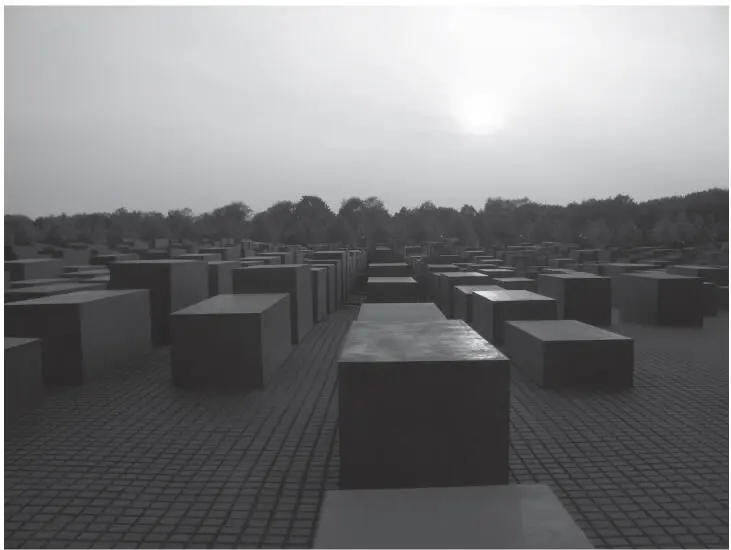
FIGURE 1.1The Memorial to the Murdered Jews of Europe in Berlin, facing the Tiergarten in the evening sun.
© Foundation Memorial to the Murdered Jews of Europe, 2012.
The long process of debating and building the memorial was part of Germany’s attempt to come to terms with the country’s Nazi past. Discussions surrounding it intensified after Germany’s reunification and the reconstruction of Berlin as the capital of the reunited country. They took place against a backdrop of violent racist attacks against foreigners in the 1990s, including arson in several cities (Hoyerswerda, Rostock, Mölln, Solingen, and others). The memorial debate was accompanied by theoretical discussions and controversies that touched on basic questions of German collective identity: What role does remembrance of the Holocaust play in the collective memory of a reunited Germany? How can a country deal with an atrocious past such as Auschwitz? How should the victims be remembered? Who should be included? Should a national memorial be built apart from the original places where the killings took place? Will history and active memory be “disposed” once the memorial has been built? Is the debate itself actually a more lively memorial than a huge stony sculpture can ever be? This chapter will not describe all facets of these debates which have been documented elsewhere (Cullen 1999; Heimrod, Schlusche, and Seferens 1999; Jeismann 1999; Reichel 1999; Young 2000; Niven 2002; Stavingski 2002; Kirsch 2003; Thünemann 2003; Carrier 2005; Leggewie and Meyer 2005). Instead, after providing a brief summary of how the divided country dealt with the Nazi past over the decades, I will focus on the making of the underground center exhibition and its reception. While many studies have focused on the controversies surrounding the memorial and its opening, as well as its impressive artistic design, they have not paid enough attention to the subterranean exhibition. Not much has been published about the complicated process of its making which was also accompanied by high sensitivities and contention, in part carried over from the decade-long debate about the memorial itself. Divergent interests and demands regarding the design and content of the information center often seemed irresolvable. It is a fascinating story about how controversies and fights can be overcome and can end in an astonishing result: a highly regarded and exceptional site of Holocaust remembrance in the heart of Berlin. The information center at the Holocaust Memorial has become one of the most visited exhibitions in the German capital. Only recently have scholars come to recognize its importance and begun to analyze it more seriously (Dekel 2008; 2011; Sion 2008; Baumann 2011; Klein 2012). This chapter deals with important steps and developments during the process of making the exhibition.
After the Holocaust
After the end of World War II, with its tremendous crimes and the atrocities of the Holocaust committed by the Germans, Germany was defeated and divided. In 1949 two states the German Democratic Republic (GDR) in the east, and the Federal Republic of Germany (FRG) in the west were founded. Both states tried to gain legitimacy from what they considered to be the lessons of the past. Their dealing with the Nazi past was embedded in the politics and ideologies of the Cold War. While East Germany became a communist state and shrugged off responsibility by construing itself as the successor of the resistance against the Nazis, West Germany built up a democratic society with the help of the Allies and tried to reintegrate itself into the Western world. Part of these integration efforts was to accept responsibility for the Nazi crimes, to pay restitution, and to work on the reconciliation with Jews and the state of Israel.
Читать дальшеИнтервал:
Закладка:
Похожие книги на «Museum Transformations»
Представляем Вашему вниманию похожие книги на «Museum Transformations» списком для выбора. Мы отобрали схожую по названию и смыслу литературу в надежде предоставить читателям больше вариантов отыскать новые, интересные, ещё непрочитанные произведения.





Обсуждение, отзывы о книге «Museum Transformations» и просто собственные мнения читателей. Оставьте ваши комментарии, напишите, что Вы думаете о произведении, его смысле или главных героях. Укажите что конкретно понравилось, а что нет, и почему Вы так считаете.