Museum Transformations
Здесь есть возможность читать онлайн «Museum Transformations» — ознакомительный отрывок электронной книги совершенно бесплатно, а после прочтения отрывка купить полную версию. В некоторых случаях можно слушать аудио, скачать через торрент в формате fb2 и присутствует краткое содержание. Жанр: unrecognised, на английском языке. Описание произведения, (предисловие) а так же отзывы посетителей доступны на портале библиотеки ЛибКат.
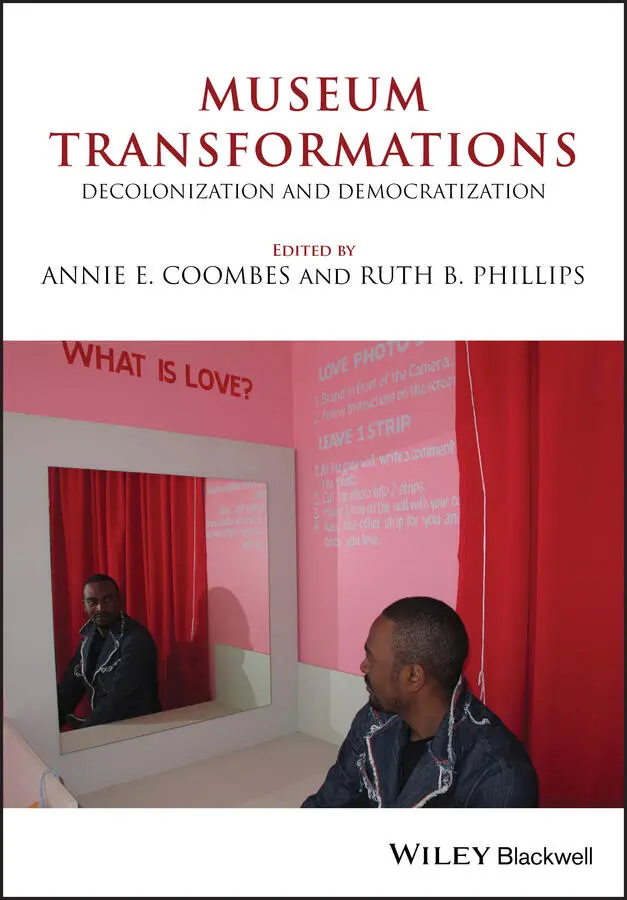
- Название:Museum Transformations
- Автор:
- Жанр:
- Год:неизвестен
- ISBN:нет данных
- Рейтинг книги:4 / 5. Голосов: 1
-
Избранное:Добавить в избранное
- Отзывы:
-
Ваша оценка:
Museum Transformations: краткое содержание, описание и аннотация
Предлагаем к чтению аннотацию, описание, краткое содержание или предисловие (зависит от того, что написал сам автор книги «Museum Transformations»). Если вы не нашли необходимую информацию о книге — напишите в комментариях, мы постараемся отыскать её.
Museum Transformations — читать онлайн ознакомительный отрывок
Ниже представлен текст книги, разбитый по страницам. Система сохранения места последней прочитанной страницы, позволяет с удобством читать онлайн бесплатно книгу «Museum Transformations», без необходимости каждый раз заново искать на чём Вы остановились. Поставьте закладку, и сможете в любой момент перейти на страницу, на которой закончили чтение.
Интервал:
Закладка:
In this volume, contributions by Mieke Bal and by Terry Kurgan, Alexander Opper, and Tegan Bristow explore the social agency of exhibitionary projects involving film and interactive electronic media in mediating experiences of diasporic and migrant populations in eastern Europe and South Africa. Whereas in the early twentieth century the typical museum of modernity saw its role as assimilating newcomers to Western culture, today many museums are discovering a new and activist potential to mediate cultural frictions that arise in processes of globalization and immigration.
Museum experiments
As we have noted, there is a clear overlap between the strategies museums have been developing to advocate for social justice and the culture of experimentation discussed in the third group of essays. The more a museum commits itself to social agency as a central mandate rather than a potential that comes into play only occasionally, the more it will seek new ways to achieve this goal. Some areas of ongoing innovation are not, of course, new – museums have long consciously sought new styles of exhibition and architectural design, and embraced new technologies that could help them fulfill their core mandates to preserve, display, educate, and entertain. Early twenty-first-century exhibitions present us with a spectrum of examples which combine the spectatorial and the experiential in different ratios. Many of the most venerable art museums – Florence’s Uffizi, Berlin’s Gemäldegalerie, New York’s Metropolitan Museum of Art – remain primarily spectatorial, although they may offer longer explanatory labels and innovative educational programs. At the other end of the spectrum is the Dennis Severs House in Spitalfields, London, where the visitor enters an eighteenth-century domestic environment which works on the historical imagination through sensory perceptions of light and shadow, smell and sound. Most of the exhibitions discussed in this volume fall somewhere in between these two ends of the spectrum, and many have sought to draw on new media to enrich and deepen the visitor’s experience. In summarizing a number of experimental exhibitions created in recent years, Basu and Macdonald write that, “rather than making complex realities more vividly simple … the issue has more often been how to engage with complexity, how to create a context that will open up a space for conversation and debate, above all how to enlist audiences as co-experimenters, willing to try for themselves” (2007, 16).
In the sphere of history museums, those devoted to the Holocaust exhibit a particularly wide range of approaches to design. At one end of the spectrum is the minimalist design of the museum at Berlin’s Monument to the Murdered Jews of Europe discussed by Sybille Quack in Chapter 1. The deep stillness and contemplative and somber mood it instills in visitors contrasts strongly with the guided tour taken by visitors at the Museum of Tolerance in Los Angeles, which ends in a recreated Nazi gas chamber and requires them to make an active choice on exiting to walk either through a doorway labeled “prejudiced” or one labeled “not prejudiced.” Both anthropology and art museums have increasingly turned to contemporary artists for techniques to disrupt conventional narratives and modes of display. 25In some instances these interventions are essentially charged with doing the work of reinterpreting the museum’s collections. This happened quite literally in 2011 when the £24 million refurbishment of the Royal Albert Memorial Museum’s (RAMM) displays opened in Exeter, England. As a way of invoking the colonial relations underpinning their collection of eighteenth-century silverware, the museum simply copied an intervention made famous by Fred Wilson in his installation Mining the Museum , originally created as a critical commentary on the collection of the Maryland Historical Society in 1992 where Wilson had installed slave shackles in the display of silverware. Artists have often gone further to produce a more critical curatorial voice than the museum staff responsible for a museum’s permanent galleries. In other instances, as noted earlier in our discussion of the placement of Sokari Douglas Camp’s contemporary work in the British Museum’s Sainsbury Galleries of African Art, such interventions may end up condoning the lacunae in the museum’s narrative and work, against the artist’s own intentions. This is particularly poignant in Douglas Camp’s case because of her well-known sympathies for Ken Saro-Wiwa which resulted in her producing a Living Memorial to Ken Saro-Wiwa . The sculpture, in the form of a steel bus, was unveiled in November 2006 outside The Guardian newspaper’s central London offices. Saloni Mathur’s chapter (23) discusses a more overtly critical art intervention in the Victoria Memorial Museum in Kolkata. Like other artists’ interventions commissioned by museums, this was a temporary installation which thus raises the issue of the ephemerality of many experimental projects. Where postcolonial critique is allowed to be doled out only in small doses, its agency is necessarily limited, leaving behind only the trace of the catalog or the listing in the past exhibitions section of a museum website.
This was also the case with a 1993 intervention commissioned from the Canadian Anishinaabe artist Robert Houle by Toronto’s Art Gallery of Ontario (AGO). Houle’s Anishinaabe Walker Court was a site-specific response to the German artist Lothar Baumgarten’s 1985 Monument for the Native Peoples of Ontario , which the museum had purchased for its permanent collection. The Baumgarten work, kept on continuous view for more than eight years, consists of an elegiac inscription of the names of the Native peoples of the province, including Houle’s nation, painted in trompe l’oeil Roman typeface on the neoclassical arches of the AGO’s historic Walker Court. 26In 1992, in response to this work, Houle renamed the space “Anishinaabe Walker Court” and lettered the names of First Nations in a modern lower-case font, each enclosed by quotation marks, on the walls of the arcade surrounding the Walker Court. 27The dialogue between Houle and Baumgarten concerning the false construct of the “disappearing Indian” animated the AGO for a space of months before Houle’s work was dismantled.
The desire to find new ways to recreate the relationship between museums and their publics can lead to a shift in emphasis from the museum as a repository and a place where the authoritative knowledge of academically trained curators is disseminated to the public, to the museum as a site of dialogue, debate, healing, and advocacy for social justice. Stimulated by desires to further democratization and decolonization, museums have sought to introduce new voices and perspectives into their displays and narratives, and they have also looked for new modes of outreach that can deliver museum collections, exhibitions, and programs to larger, more diverse, and often distant publics. Christopher Morton and Gilbert Oteyo, in Chapter 14, have explored the ethical and intellectual issues raised when attempting to exhibit archival photographs from different periods in Kenya’s history to the communities represented in them. In Chapter 16Kimberly Christen discusses the challenges, benefits, and transformational impacts on conventional museum practices of online curating in her analysis of projects involving the Waramungu Aboriginal community in the Central Desert of Australia and the Inuvialuit peoples of the western Canadian Arctic (see Khan 2002; Lang, Reeve, and Wollard 2006; Harrison, Byrne, and Clarke 2013).
To be fully realized, however, the transformation of the museum must engage all areas of museum activity, not only exhibitions and research, but also education, marketing, and even registration and conservation. Miriam Clavir’s chapter (17) examines the challenges to traditional Western concepts of conservation, a profession with particularly close ties to Western concepts of science and historical preservation. She shows how some museum conservators have sought to create more elastic practices informed not just by the priority of physical preservation but also by diverse concepts of cultural preservation. Clavir developed her own approach at the University of British Columbia’s Museum of Anthropology, an institution that also introduced the model of visible storage into modern museology in 1976. Indigenous artists have used this facility, which makes collections visibly accessible to the general public in glass-fronted cases and plexiglass-topped drawers, to study historical works as sources for their own renewal of these carving traditions – a notable artistic development that was gaining momentum during those years. In the 2010 redesign of its visible storage, the museum took a further and more transformative step. Rather than organizing its collections, as previously, according to a Western system of classification, it consulted members of originating communities regarding how they wanted their collections to be ordered and displayed. Jennifer Kramer’s chapter (21) discusses one of the museum’s consultations and the resulting installation. Gwyneira Isaac ( Chapter 13) explores the related example of the Zuni nation’s A:shiwi A:wan Museum and Heritage Center in conversation with its director, Jim Enote. There, too, an Indigenous community is using the development of its museum as a context for recovering Indigenous modes of conceptualizing and categorizing knowledge.
Читать дальшеИнтервал:
Закладка:
Похожие книги на «Museum Transformations»
Представляем Вашему вниманию похожие книги на «Museum Transformations» списком для выбора. Мы отобрали схожую по названию и смыслу литературу в надежде предоставить читателям больше вариантов отыскать новые, интересные, ещё непрочитанные произведения.





Обсуждение, отзывы о книге «Museum Transformations» и просто собственные мнения читателей. Оставьте ваши комментарии, напишите, что Вы думаете о произведении, его смысле или главных героях. Укажите что конкретно понравилось, а что нет, и почему Вы так считаете.