Lucy Mayblin - Migration Studies and Colonialism
Здесь есть возможность читать онлайн «Lucy Mayblin - Migration Studies and Colonialism» — ознакомительный отрывок электронной книги совершенно бесплатно, а после прочтения отрывка купить полную версию. В некоторых случаях можно слушать аудио, скачать через торрент в формате fb2 и присутствует краткое содержание. Жанр: unrecognised, на английском языке. Описание произведения, (предисловие) а так же отзывы посетителей доступны на портале библиотеки ЛибКат.
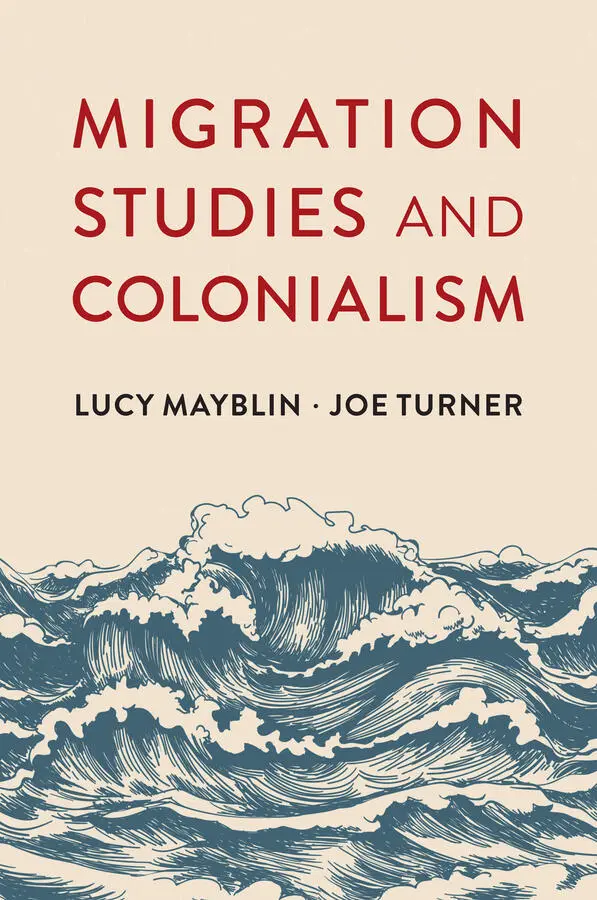
- Название:Migration Studies and Colonialism
- Автор:
- Жанр:
- Год:неизвестен
- ISBN:нет данных
- Рейтинг книги:5 / 5. Голосов: 1
-
Избранное:Добавить в избранное
- Отзывы:
-
Ваша оценка:
Migration Studies and Colonialism: краткое содержание, описание и аннотация
Предлагаем к чтению аннотацию, описание, краткое содержание или предисловие (зависит от того, что написал сам автор книги «Migration Studies and Colonialism»). Если вы не нашли необходимую информацию о книге — напишите в комментариях, мы постараемся отыскать её.
This book starts from the premise that colonial histories should be central to migration studies and explores what it would mean to really take that seriously. To engage with this task, Lucy Mayblin and Joe Turner argue that scholars need not forge new theories but must learn from and be inspired by the wealth of literature that already exists across the world. Providing a range of inspiring and challenging perspectives on migration, the authors’ aim is to demonstrate what paying attention to colonialism, through using the tools offered by postcolonial, decolonial and related scholarship, can offer those studying international migration today.
Offering a vital intervention in the field, this important book asks scholars and students of migration to explore the histories and continuities of colonialism in order to better understand the present.
Migration Studies and Colonialism — читать онлайн ознакомительный отрывок
Ниже представлен текст книги, разбитый по страницам. Система сохранения места последней прочитанной страницы, позволяет с удобством читать онлайн бесплатно книгу «Migration Studies and Colonialism», без необходимости каждый раз заново искать на чём Вы остановились. Поставьте закладку, и сможете в любой момент перейти на страницу, на которой закончили чтение.
Интервал:
Закладка:
In this context, border thinking entails using alternative knowledge traditions and non-European languages of expression in order to reimagine theories of the social, the economic and the political. Examples of border thinking might include Islamic philosophical and scientific thought or First Nation epistemological traditions (Coburn 2016; Smith 2012). Examples of the enactment of border thinking might include the Haitian Revolution and the more contemporary World Social Forum (Santos 2008; Scott 2018; Trouillot 1995). According to decolonial theorists, these alternative perspectives introduce other cosmologies into the hegemonic discourse of western modernity which are not unwittingly committed to, or restrained by, its frame. Border thinking on themes related to international migration is already happening. Mignolo sites the location of border thinking in the Third World but, in acknowledging actually existing mobilities, he then charts ‘its routes of dispersion travelled through migrants from the Third to the First World’,which are then found in ‘immigrant consciousness’ (Mignolo 2011b: 274). Postcolonial intellectual Frantz Fanon then developed his immigrant consciousness at the point of migrating from Martinique to France (Fanon 2008 [1952]). Upon discovering that he was seen first and foremost as a ‘negro’ in France, he thus brought border thinking to France through the immigrant consciousness, encapsulated in the quote ‘Oh, my body, make of me always a man who questions’. Equally, work on settler colonialism and within indigenous studies offers multiple challenging perspectives from the borders of colonial/modern thought which rethinks the power relations at stake in contexts of immigration (see chapter 4; see also Chatterjee 2019; Gonzales 2012; Jones 2009; Klooster 2013; Lugones 1992; Pulido 2018; Rodríguez 2014; Stanley et al. 2014). Whether such thought is transforming hegemonic ideas about international migration is then another question.
Rojas argues that the universalizing colonial logic of capitalist modernity ‘eliminates entire life-worlds, declaring them non-credible alternatives’ (Rojas 2016: 370). The universalizing logic is not equitable, however; modern reason is often thought of as superior to other systems of knowledge. Central to modernization is the distinction between culture and nature. Culture defined the subject that knows; nature defines the object to be known. Because nature is ‘out there’ and is knowable through reasoned examination, it must then be universal and equally accessible on the same terms, irrespective of the cultural background of the knower. As Reiter (2018: 7) points out, ‘to think that the European way of explaining the world is somehow closer to the way the world really is is naive’. Such an assumption is culturally particular, and yet it is nevertheless universalizing. Against this universalizing project, one alternative – a pluriversal politics – offers, according to Rojas, ‘a more just coexistence of worlds that exceeds what is possible under a colonial and capitalist logic’ (Rojas 2016: 370). The pluriverse, then, is about recognizing that modern ways of understanding the world sit alongside other ways of understanding the world which are different, even incomprehensible, from a modern/colonial perspective (Seth 2013). These different ontologies and epistemologies do not exist in a hierarchy but in an ‘ecology of knowledges’ (Santos 2008), or an ‘epistemological mosaic’ (Connell 2018). Nevertheless, some of them may offer solutions to global problems, such as climate change or extreme inequality, which modernity lacks the tools to solve.
If border thinking and the pluriverse look towards the diversity of ways of imagining and understanding the world from different locations, Gurminder K. Bhambra’s work on connected sociologies (2007, 2010, 2014), which is discussed further in chapter 4, is about drawing attention to the actual interconnectedness of the world over time. This is complementary to border thinking and the pluriverse, rather than necessarily at odds with it. Drawing on the work of Sanjay Subrahmanyam (1997), Bhambra is interested in overcoming the gap between general historical frameworks (which tend, even when critical, to be Eurocentric) and the many particular contexts and experiences that they then ignore. Subrahmanyam argued that the histories of different places are often analytically isolated from each other because of the way academic work happens, and he suggested that, through looking at the connections between places, deeper insights were gained. Rather than then looking at the diversity of particularity and relating it to European modernity in an implied or explicit hierarchy, or suggesting cultural relativism and reifying difference, Bhambra (inspired by Subrahmanyam) suggests that a focus on interconnectedness allows us to more adequately understand the world historically and contemporaneously. Focusing on interconnections, argues Bhambra (2010: 140), ‘allows for the deconstruction of dominant narratives at the same time as being open to different perspectives, and seeks to reconcile them systematically’.
Historical examples of international interconnection abound, which, once acknowledged, make it difficult to contemplate topics such as democracy, human rights or nationhood without understanding these to have emerged from and in global interconnectedness (as opposed to from within the geographical space of Western Europe exclusively). But Bhambra’s intention is not to simply argue for a reconstruction of how we understand history and its impact on the present. She goes further in arguing for connected sociologies, which in the present assume the world to be made up of a set of interconnections and influences, and within this context do not centre on particular locations such Europe or the West. In this sense, the South–South migration agenda, which is a burgeoning area of scholarship at the time of writing (Fiddian-Qasmiyeh 2015; Fiddian-Qasmiyeh and Daley 2019), might find theoretical inspiration in her interventions.
Conclusion
This chapter has described and discussed one of the most fundamental insights offered by post- and decolonial scholarship: the critique of the dominant discourse of modernity. It has explained how modernity can be understood as a way of thinking about the world in temporal and spatial terms, and how this framework then has far-reaching implications for the social sciences, including for migration researchers. The chapter has discussed Eurocentrism and the ways in which ‘Europe’ and ‘the West’ are symbolic geographies, containers of modernity, which shift over time and are not territorially delimited. After a detour into the ‘migration and development’ literature as an illustrative example of an area of migration studies that might benefit from being rethought in light of these insights on modernity and Eurocentrism, the chapter ended with a brief exploration of some proposals for overcoming Eurocentrism. Taking seriously the intellectual contributions to social scientific thought discussed in this chapter, we might strive to make our work more adequate to the task of understanding the world from different vantage points, plural as it is.
Having offered this important exposition on post- and decolonial thinking on time, space and modernity, the next chapter moves into a more specific engagement with the concept of race. Ideas of race, and ideologies and practices of racism, are deeply entangled with colonial histories and also migration histories. If migration studies is to take seriously the need to engage with past and present colonialisms, and their legacies and continuities, an engagement with race is essential. While migration studies scholars seem to have shied away from race as a concept, they can rest assured that others have been busy theorizing the social, economic, cultural and political through the lens of race for a very long time. We draw upon this deep and rich body of intellectual work to discuss how migration scholars can (indeed must) start to seriously engage with thinking on race without becoming trapped in essentialist and racist logics.
Читать дальшеИнтервал:
Закладка:
Похожие книги на «Migration Studies and Colonialism»
Представляем Вашему вниманию похожие книги на «Migration Studies and Colonialism» списком для выбора. Мы отобрали схожую по названию и смыслу литературу в надежде предоставить читателям больше вариантов отыскать новые, интересные, ещё непрочитанные произведения.









Обсуждение, отзывы о книге «Migration Studies and Colonialism» и просто собственные мнения читателей. Оставьте ваши комментарии, напишите, что Вы думаете о произведении, его смысле или главных героях. Укажите что конкретно понравилось, а что нет, и почему Вы так считаете.