Lucy Mayblin - Migration Studies and Colonialism
Здесь есть возможность читать онлайн «Lucy Mayblin - Migration Studies and Colonialism» — ознакомительный отрывок электронной книги совершенно бесплатно, а после прочтения отрывка купить полную версию. В некоторых случаях можно слушать аудио, скачать через торрент в формате fb2 и присутствует краткое содержание. Жанр: unrecognised, на английском языке. Описание произведения, (предисловие) а так же отзывы посетителей доступны на портале библиотеки ЛибКат.
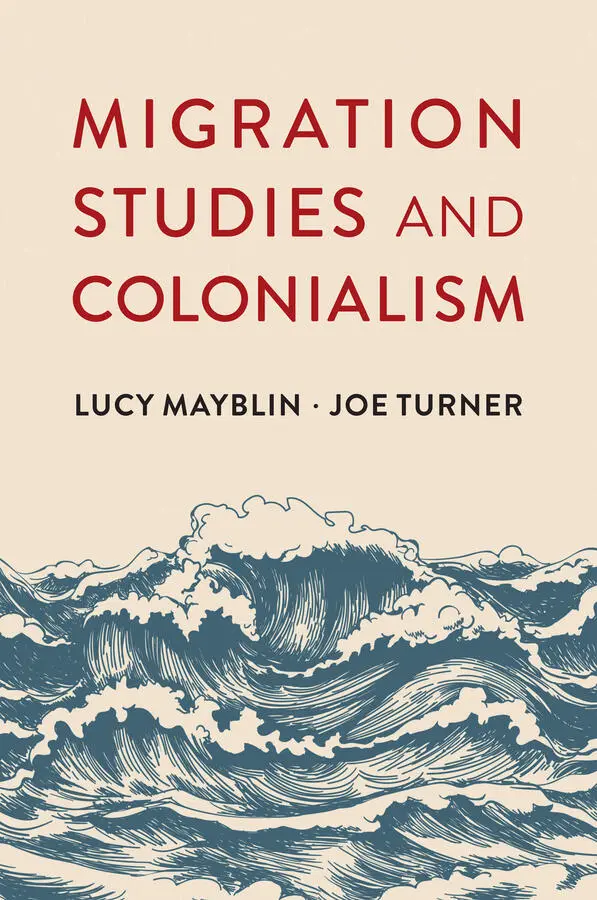
- Название:Migration Studies and Colonialism
- Автор:
- Жанр:
- Год:неизвестен
- ISBN:нет данных
- Рейтинг книги:5 / 5. Голосов: 1
-
Избранное:Добавить в избранное
- Отзывы:
-
Ваша оценка:
Migration Studies and Colonialism: краткое содержание, описание и аннотация
Предлагаем к чтению аннотацию, описание, краткое содержание или предисловие (зависит от того, что написал сам автор книги «Migration Studies and Colonialism»). Если вы не нашли необходимую информацию о книге — напишите в комментариях, мы постараемся отыскать её.
This book starts from the premise that colonial histories should be central to migration studies and explores what it would mean to really take that seriously. To engage with this task, Lucy Mayblin and Joe Turner argue that scholars need not forge new theories but must learn from and be inspired by the wealth of literature that already exists across the world. Providing a range of inspiring and challenging perspectives on migration, the authors’ aim is to demonstrate what paying attention to colonialism, through using the tools offered by postcolonial, decolonial and related scholarship, can offer those studying international migration today.
Offering a vital intervention in the field, this important book asks scholars and students of migration to explore the histories and continuities of colonialism in order to better understand the present.
Migration Studies and Colonialism — читать онлайн ознакомительный отрывок
Ниже представлен текст книги, разбитый по страницам. Система сохранения места последней прочитанной страницы, позволяет с удобством читать онлайн бесплатно книгу «Migration Studies and Colonialism», без необходимости каждый раз заново искать на чём Вы остановились. Поставьте закладку, и сможете в любой момент перейти на страницу, на которой закончили чтение.
Интервал:
Закладка:
A dialogue across ‘posts’ may therefore be helpful in order to explore the messy reality of the world beyond the neat categories that we have created to aid our understanding of it (Kangas and Salmenniemi 2016; Krivonos 2019; Krivonos and Näre 2019). When we look at the histories of colonialism, socialism and capitalism, what we in fact find are connected histories (Bhambra 2014). Chari and Verdery (2009) think ‘between the posts’ because post-socialism and postcolonialism are not just about particular geographical spaces, they are about historical representations of space and time which have implications for knowledge and practice everywhere, not just in locations which were colonized. Thus what they draw attention to is that in order to comprehend the world, we need to explore the consequences of colonialism and decolonization, and Soviet socialism and its end, for spaces beyond those directly involved. The concept of coloniality allows us to do this; the coloniality of power, knowledge and being are not geographically limited in their reach, and the colonial articulation of modernity is pervasive but differentially experienced around the world.
Important in this discussion is the symbolic power of ‘the West’ as a container of modernity, where the West is differentially conceived, depending on where one is positioned. For example, Krivonos (2019) has found that for young Russian migrants in Helsinki (Finland), the city represents western modernity, and indeed whiteness, even while the location of Finland as European, western or ethnically ‘white’ has historically been contested (see also Krivonos and Näre 2019). The West, then, is a symbolic geography , as are all of the other taxonomies of civilization. They are bound up with how we imagine other peoples and places and how we imagine and represent ourselves (Bhabha 2005 [1994]). Postcolonial scholars have argued that each makes sense only in terms of its opposite(s) (Said 1995 [1978]). The Orient, for Said, was a fiction invented by Occidentals and only contained meaning as a site of tradition, exoticism, chaos and magic in its relation to the modernity, normality, order and reason of the Occident. In this context, where modernity is located in the symbolic geography of the ‘West’, the uncivilized can only mimic the civilized – the copy is not the same as the original (Bhabha 2005 [1994]).
Where and who is and can be modern changes over time. This is also intermeshed with ideas of racial inclusion and differentiation. Because modernity has a racial (biological but also cultural) content rooted in colonialism, coloniality is at all times imbued with a racial sorting logic. That is not to suggest that racial categories are static or always about phenotype. For example, the Irish are now generally considered to be modern and white, and Finns are more modern and whiter than Russians through joining the European Union (Ignatiev 1995; Krivonos and Näre 2019). These common-sense logics of inclusion and differentiation are not rational, but they do appear rational to many people, including academic researchers. Thinking with modernity therefore draws our attention to the ways in which whiteness, Europeanness, Christianity and ‘the West’ occupy a semantic field with shifting emphases (Hall 1996a; Hesse 2007). To reduce this field to economics (GDP, income per capita) is to miss many layers of understanding.
Modernity, migration and development
Where these discussions of modernity and Eurocentrism find their most immediate and obvious application in migration studies is in the field of migration and development. There are two main perspectives on this: the developmental perspective, which is interested mainly in the effect of migration on development; and the migration perspective, which is mainly interested in the effect of development on migration. In relation to the former, for a long time, a key question within migration studies has been ‘whether migration encourages development of the countries of origin or, conversely, hinders such development’ (Castles, de Haas and Miller 2014: 69). On the one hand, migration is thought to aid development in sending countries through ‘brain gains’ and remittances, and on the other hand migration is thought to lead to ‘brain drains’ and to therefore hinder development. The general consensus appears to swing, pendulum-like, between these two perspectives (de Haas 2010, 2012). From the migration-focused perspective, which is of great interest to (perhaps even led by) governments and policy actors in the Global North, the argument has been about whether development increases rates of migration through providing people with the financial means to migrate, or whether it allows them to stay in their countries of origin as a wider range of jobs and opportunities open up (see Clemens 2014). As Raghuram (2009: 104) has pointed out, ‘almost all theorisations of this link assume migration to be something that can be contained, regulated or influenced, [and] development as normatively good’. Few of these perspectives challenge the idea of ‘development’ itself as a problematic colonial framework.
De Haas (2012) dates the migration and development debate back to the post-Second World War period. Indeed, this is the period in which decolonization began apace and in which ‘development’ replaced civilization as the primary language of progress through which the modernization project was articulated because ‘development’ as a project, we must recognize, is a project of modernization in which ‘developing’ countries are engaged in an externally facilitated effort to catch up with the West (Escobar 1995). Development, as a discourse, aspiration, project, practice and set of social relations, then, cannot be understood without recognizing the colonial context from whence it emerged. The idea of development has of course come under significant critical scrutiny for its damaging Eurocentric assumptions (Ake 2000 [1979]; Escobar 1995; Esteva and Babones 2013; Sardar 1999). Nyamnjoh, writing on the expansive topic of development discourses in Africa, explains:
Development for Africa is a theme fraught with a multiplicity of western-generated ideas, models and research paradigms, all with the purported goal of alleviating poverty. This discourse is carried on mainly by economists and other social scientists who limit the question of development to the problematic of achieving economic growth within the context of neo-liberal economic principles. Notwithstanding the fact that there are now novel paradigms of development that search for solutions under the theoretical rubric of alternative development, the problem is rarely studied in a holistic manner. (Nyamnjoh 2004: 162; see also Ake 2000 [1979] for an earlier intervention in this vein)
In 1992, Sachs described development as ‘like a ruin in the intellectual landscape’, obsolete owing to its clear failure to achieve what it had set out to do (Sachs 1992: 6; see also Rutazibwa 2018). Yet the post-Cold War period has not seen development become obsolete as a discourse or project; it seems to receive as much attention, funding, focus and effort as ever before. In this vein, Sardar (1999: 49) succinctly explains that ‘development continues to mean what it has always meant: a standard by which the West measures the non-West’, though we must of course acknowledge that it is not only western governments and NGOs that buy into the development discourse.
Nevertheless, the development discourse, according to its critics, does centre western knowledge about how to develop, and it decentres non-western knowledge systems which might offer an alternative to development (Escobar 1995). In more extreme critiques development has become something to be feared in many places, as it brings pollution, consumerism, the destruction of communities and cultures, and all of the individual and collective harms of global market capitalism – though such perspectives have not gone uncontested (Cooper and Packard 1997; Esteva and Babones 2013; Nilsen 2016). Nevertheless, these critiques, most vocally under the ‘post-development’ agenda (see Rahnema and Bawtree 1997), have, as noted above, not decreased the dominance of ‘development’ as a discourse within or outside of the academy.
Читать дальшеИнтервал:
Закладка:
Похожие книги на «Migration Studies and Colonialism»
Представляем Вашему вниманию похожие книги на «Migration Studies and Colonialism» списком для выбора. Мы отобрали схожую по названию и смыслу литературу в надежде предоставить читателям больше вариантов отыскать новые, интересные, ещё непрочитанные произведения.








Обсуждение, отзывы о книге «Migration Studies and Colonialism» и просто собственные мнения читателей. Оставьте ваши комментарии, напишите, что Вы думаете о произведении, его смысле или главных героях. Укажите что конкретно понравилось, а что нет, и почему Вы так считаете.