Lucy Mayblin - Migration Studies and Colonialism
Здесь есть возможность читать онлайн «Lucy Mayblin - Migration Studies and Colonialism» — ознакомительный отрывок электронной книги совершенно бесплатно, а после прочтения отрывка купить полную версию. В некоторых случаях можно слушать аудио, скачать через торрент в формате fb2 и присутствует краткое содержание. Жанр: unrecognised, на английском языке. Описание произведения, (предисловие) а так же отзывы посетителей доступны на портале библиотеки ЛибКат.
- Название:Migration Studies and Colonialism
- Автор:
- Жанр:
- Год:неизвестен
- ISBN:нет данных
- Рейтинг книги:5 / 5. Голосов: 1
-
Избранное:Добавить в избранное
- Отзывы:
-
Ваша оценка:
Migration Studies and Colonialism: краткое содержание, описание и аннотация
Предлагаем к чтению аннотацию, описание, краткое содержание или предисловие (зависит от того, что написал сам автор книги «Migration Studies and Colonialism»). Если вы не нашли необходимую информацию о книге — напишите в комментариях, мы постараемся отыскать её.
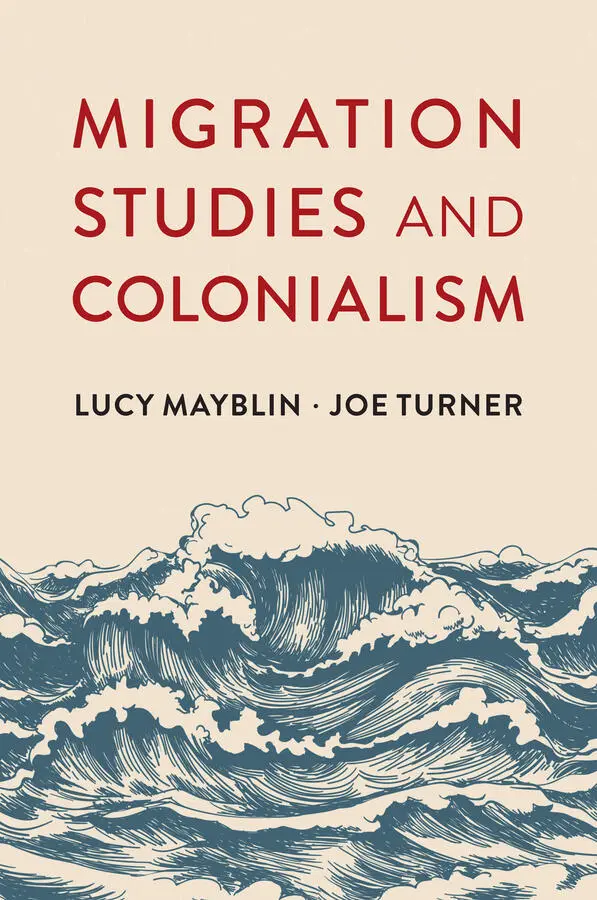
This book starts from the premise that colonial histories should be central to migration studies and explores what it would mean to really take that seriously. To engage with this task, Lucy Mayblin and Joe Turner argue that scholars need not forge new theories but must learn from and be inspired by the wealth of literature that already exists across the world. Providing a range of inspiring and challenging perspectives on migration, the authors’ aim is to demonstrate what paying attention to colonialism, through using the tools offered by postcolonial, decolonial and related scholarship, can offer those studying international migration today.
Offering a vital intervention in the field, this important book asks scholars and students of migration to explore the histories and continuities of colonialism in order to better understand the present.
Migration Studies and Colonialism — читать онлайн ознакомительный отрывок
Ниже представлен текст книги, разбитый по страницам. Система сохранения места последней прочитанной страницы, позволяет с удобством читать онлайн бесплатно книгу «Migration Studies and Colonialism», без необходимости каждый раз заново искать на чём Вы остановились. Поставьте закладку, и сможете в любой момент перейти на страницу, на которой закончили чтение.
Интервал:
Закладка:
While migration studies has tended to be dominated by well-funded research undertaken in the ‘developed’ or ‘First World’ of the ‘Global North’ or ‘the West’, it has then disproportionately focused on migration from the ‘developing’ or ‘Third’ World’ to the ‘First World’. That research institutions in the ‘Global North’ are better funded than those in the ‘Global South’ is (generally speaking) a consequence of long histories of colonial-era plunder, appropriation, exploitation, and wealth accumulation (Collyer et al. 2019; Keim et al. 2014). But the fact that this is not generally understood and reflected upon in the North then has implications for the social theories we develop to deal with international migration today (to paraphrase Bhambra). Because without acknowledging colonial history, South–North migrations become the primary migrations of interest in the world, become potentially illegitimate, become something detached from sedimented and unequal global racial and economic power relations. They become about individualized aspirations and motivations for a ‘better life’ set apart from the broader global historical contexts in which they might be understood.
How can we start to think against this current? Decoloniality offers us some of the theoretical tools to start to unthink what we have learnt about modernity. From decolonial scholars we gain the concept of coloniality/modernity, which articulates the intertwining of colonialism and colonial ways of viewing the world in hierarchical and civilizational terms (coloniality) with the rise of ‘modernity’ as a structuring frame through which the specialiness of Europe can be conceptualized (Escobar 2007; Mignolo 2000; Quijano 2000). Coloniality and modernity, then, are two sides of the same coin. Or, in other words, modernity was ‘colonial from its point of departure’ (Quijano 2000: 548). Capitalism, for example, did not endogenously emerge in Europe as a consequence of enlightenment, rationalism and industrial development. Rather, slavery and colonialism produced a concentration of wealth in European societies which funded the Industrial Revolution, allowed for global trading dominance and also offered technological inspiration for the emerging industries. For example, the cotton mills of Northern England used technologies taken from India (Bhambra 2007). Thus the emergence of capitalism is first and foremost a global colonial story, a story of racism and differentiation, despite the seductive power (for some) of the story of inherent European brilliance (Anievas and Nişancioğlu 2013; Banaji 2007; Bhattacharyya 2018; Hobson 2004). The point, really, is that modernity has its darker sides (Mignolo 2011a). It is not all wealth, democracy, freedom of speech and expression, employment, consumerism, and clean drinking water. It is also exploitation, appropriation, racism and subjugation.
No longer exclusively an affair of Europe or ‘the West’, modernity appears now to be everywhere: ‘the triumph of the modern lies precisely in its having become universal. From now on, it’s modernity all the way down, everywhere, until the end of times’, as Escobar (2007) has pointed out. In this context, ‘not only is radical alterity expelled forever from the realm of possibilities, all world cultures and societies are reduced to being a manifestation of European history and culture’ (Escobar 2007). By ‘radical alterity’, Escobar refers here to different ways of living; different sets of ambitions for the political, economic and social organization of societies; different ways of understanding and being and acting in the world beyond the hegemonic ideology of modernity spreading globally from an imagined western epicentre. The ‘coloniality’ concept in coloniality/modernity does not, therefore, simply refer to colonial ism . Instead, it is about a colonially inspired Orientalism in Said’s (1995 [1978]) terms, a worldview.
This ‘coloniality’ has been analytically disaggregated into a range of spheres, notably power, knowledge and being, as discussed in the Introduction. The coloniality of power refers to ‘the interrelation among modern forms of exploitation and domination’, or how western global domination is dependent on exploitation (Maldonado-Torres 2007: 242). Coloniality of knowledge relates to the ‘impact of colonization on the different areas of knowledge production’ (Maldonado-Torres 2007: 242). That is, where authoritative and influential knowledge is produced and proliferated, which knowledges are produced by which people, and which languages and media hold legitimacy and have greater global reach. This concept has clear relevance for migration studies and should give us pause to consider who produces ‘global’ knowledge, in which languages is it disseminated, where are they located and who is excluded from this conversation? Paul Gilroy (1993: 6) has articulated this from a different perspective (that of cultural studies) as ‘the struggle to have blacks conceived as agents, as people with cognitive capacities, and even with an intellectual history’. The coloniality of knowledge either denies this to be the case or admits it to be plausible but scratches its head in terms of where to find such an intellectual history. For the western academy, and indeed beyond, intellectual history is white.
‘Coloniality of being’ refers ‘to the lived experience of colonization and its impact on language’, or the way in which one speaks and thinks of one’s place in the world through the filter of coloniality (Maldonado-Torres 2007: 242). We might think of this in relation to W. E. B. Du Bois’s work on double consciousness. To be African American was, for Du Bois, to live with a double consciousness, simultaneously black and American, always living with this ‘two-ness’ and always seeing oneself through the eyes of white America. This concept of double consciousness has been elaborated and applied beyond the nineteenth-century US context (see Gilroy 1993) and its overlap with Maldonado-Torres’s (2007) concept of the ‘coloniality of being’ (in the Latin American context) might help to elaborate our understanding of both concepts. How we think about our place in the world is therefore related to how we imagine our geographical and temporal location in relation to modernity.
These insights into the spatial and temporal dimensions of modernity, which problematize the idea of traditional developing societies who are behind in time and need to catch up through modernizing, unravel many of the dominant understandings of contemporary international migration. They raise a set of questions which, if taken seriously, would alter the basis upon which much funded research on migration is undertaken. For example, whose mobility is, in this context, problematized and whose is not? When we look at this problematization in the context of colonial histories, what sorts of explanation for it appear plausible and which do not? What kinds of historical and contemporary interconnections have given rise to particular migration patterns and responses to them? Why would migration from a generalized ‘Global South’ be construed as threatening in the North? How do migrants understand the relations and differences between the places they have come from, and are going to, and how is their migration understood against the backdrop of histories of colonialism and ideas of modernity and unmodernity? In short, through thinking of modernity as a culturally produced time/space construct, we must then start to think through the lens of historical, as well as contemporary, interconnections. This is a theme we return to below.
Eurocentrism
The concept of Eurocentrism is closely aligned with these discussions around contesting the dominant conception of modernity. Knowledge production – the questions that we ask, the hypotheses that we come up with, the research methods that we employ, the frameworks through which we interpret our findings, the places we publish and the audiences that will consume our ideas – emerges from historically contingent social conditions and contexts. Alatas (2006) argues that because some countries (for him, the United Kingdom, France and the United States) are ‘world social science powers’, scholars in Asia must engage with their frameworks and scholarship, even as scholars in the world social science powers can completely ignore scholarly debates happening within Asia (or indeed elsewhere) (see also Gamage 2016). This is because these powers generate large volumes of published social science output, are well funded to undertake research internationally, have global reach and hold a global prestige that makes them impossible to ignore. They have both the resources, and access to visas, to conduct international research projects and the social position to make their findings about a variety of contexts plausible. Indeed, even within the fields of postcolonial and decolonial scholarship, the most famous scholars internationally are more often than not based in Global North institutions (Cusicanqui 2012). We have, then, according to Alatas (2006), dominant producers of global knowledge, who can write with authority about anywhere, and peripheral consumers of global knowledge, who can only write with authority about particular places and when doing so must use the frameworks of the global knowledge producers. Even when research focuses on the Global South (or racialized, migrant communities in the Global North), this is all too often an extractive research process (see Tilley 2017). When scholars in the Global South are engaged with the power structures of global knowledge production, this often means that they are treated as empiricists or area specialists rather than producers of ‘theory’ (often still seen as universal and generalizable). Keguro Macharia (2016a) calls this ‘being area-studied’. This, briefly put, is what Eurocentrism amounts to in the global academy.
Читать дальшеИнтервал:
Закладка:
Похожие книги на «Migration Studies and Colonialism»
Представляем Вашему вниманию похожие книги на «Migration Studies and Colonialism» списком для выбора. Мы отобрали схожую по названию и смыслу литературу в надежде предоставить читателям больше вариантов отыскать новые, интересные, ещё непрочитанные произведения.







Обсуждение, отзывы о книге «Migration Studies and Colonialism» и просто собственные мнения читателей. Оставьте ваши комментарии, напишите, что Вы думаете о произведении, его смысле или главных героях. Укажите что конкретно понравилось, а что нет, и почему Вы так считаете.