Lucy Mayblin - Migration Studies and Colonialism
Здесь есть возможность читать онлайн «Lucy Mayblin - Migration Studies and Colonialism» — ознакомительный отрывок электронной книги совершенно бесплатно, а после прочтения отрывка купить полную версию. В некоторых случаях можно слушать аудио, скачать через торрент в формате fb2 и присутствует краткое содержание. Жанр: unrecognised, на английском языке. Описание произведения, (предисловие) а так же отзывы посетителей доступны на портале библиотеки ЛибКат.
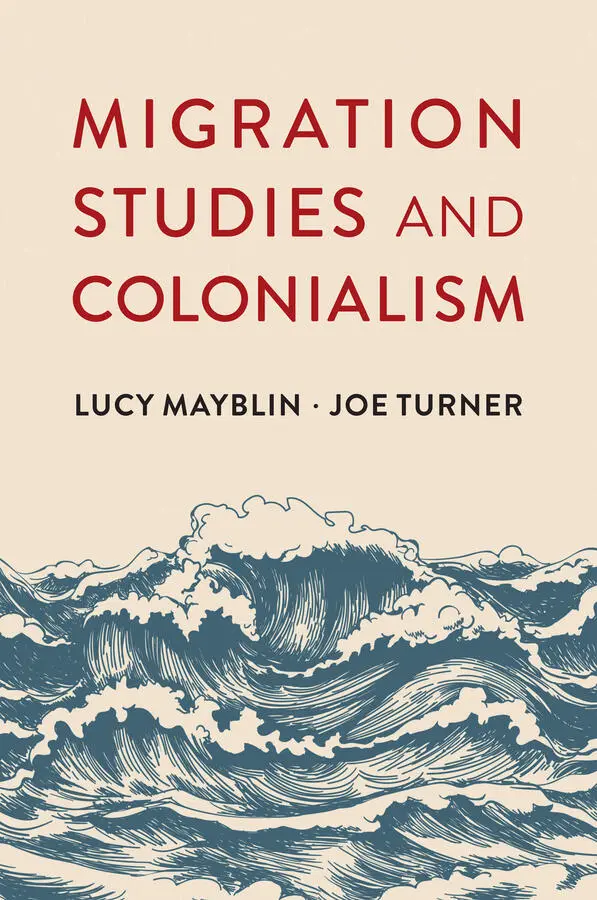
- Название:Migration Studies and Colonialism
- Автор:
- Жанр:
- Год:неизвестен
- ISBN:нет данных
- Рейтинг книги:5 / 5. Голосов: 1
-
Избранное:Добавить в избранное
- Отзывы:
-
Ваша оценка:
Migration Studies and Colonialism: краткое содержание, описание и аннотация
Предлагаем к чтению аннотацию, описание, краткое содержание или предисловие (зависит от того, что написал сам автор книги «Migration Studies and Colonialism»). Если вы не нашли необходимую информацию о книге — напишите в комментариях, мы постараемся отыскать её.
This book starts from the premise that colonial histories should be central to migration studies and explores what it would mean to really take that seriously. To engage with this task, Lucy Mayblin and Joe Turner argue that scholars need not forge new theories but must learn from and be inspired by the wealth of literature that already exists across the world. Providing a range of inspiring and challenging perspectives on migration, the authors’ aim is to demonstrate what paying attention to colonialism, through using the tools offered by postcolonial, decolonial and related scholarship, can offer those studying international migration today.
Offering a vital intervention in the field, this important book asks scholars and students of migration to explore the histories and continuities of colonialism in order to better understand the present.
Migration Studies and Colonialism — читать онлайн ознакомительный отрывок
Ниже представлен текст книги, разбитый по страницам. Система сохранения места последней прочитанной страницы, позволяет с удобством читать онлайн бесплатно книгу «Migration Studies and Colonialism», без необходимости каждый раз заново искать на чём Вы остановились. Поставьте закладку, и сможете в любой момент перейти на страницу, на которой закончили чтение.
Интервал:
Закладка:
In a widely cited article tackling the migration and development agenda, Raghuram (2009: 104) argues that the development industry has achieved very little, even as development has morphed from a concept of economic growth ‘to basic needs … [to] poverty reduction and sustainable livelihoods’, and yet it continues to look for new solutions. Migration has recently received renewed focus as a possible solution since migrants undertake activities which could be construed as international wealth redistribution through remittances. Northern governments are also concerned about whether migration is a desirable mechanism for development since it moves people out of place and leads to concern over terrorism, integration and cohesion. For Raghuram, the growing interest amongst policy makers in the dynamics of migration and development has led to a concomitant increase in academic research on these dynamics. Particular ‘forms of migration and certain kinds of development come to be visible in this debate’, she argues, ‘occluding other imaginaries of the relationships between migration and development’ (Raghuram 2009: 104; see also Bettini and Gioli 2016; Sinatti and Horst 2015).
The harms of the discourse of development have, of course, been challenged by social movements around the world who have both fought for the rejection of development as an ideology and also sought to manipulate or alter the meaning and understanding of development in particular contexts for the benefit of the people who live there (see, for example, Moore 1998; Rangan 2000; Vergara-Camus 2014). Equally, as Elena Fiddian-Qasmiyeh (2015) has pointed out in her work, there is a risk of maintaining and reinforcing North–South dichotomies in critiques of development, rather than challenging them. Acknowledging South–South responses to development would enable us, she argues, to include rather than erase Global South actors within the history of development.
The challenge for migration studies, then, is how to listen to critiques of development and seriously engage with them without continuously erasing the agency and endeavours of ‘southern’ actors from the picture (see Rutazibwa and Ndushabandi 2019). How might we research and write about the relationships between international migration and, for example, poverty as a phenomenon and at the same time root our understanding of poverty in colonial histories and neo-colonial relations, and as connected to global processes of accumulation, dispossession and liberal capitalist ideology? Escobar (1995: 215) argues that better futures will not be found in ‘development alternatives, but in alternatives to development, that is, the rejection of the entire paradigm altogether’. By thinking with alternative discourses, might we imagine the search for equality, dignity, ‘a better life’, beyond the confines of the ‘development’ discourse? Might we also follow Fiddian-Qasmiyeh’s (2015) lead in decentring the Global North in our understanding of such phenomena? Perhaps by being more specific about the actual processes that we seek to understand, that are being wrapped up in the idiom of ‘development’, and exploring how migration is related to those factors, migration researchers need not fall prey to the pitfalls of Eurocentric modernization orthodoxy.
Can Eurocentrism be overcome?
As Aníbal Quijano (2007) has argued, we are all stuck in colonial modernity, which suggests that finding a path out is challenging. Structural barriers are important here. As noted earlier, particular languages, most notably English, are privileged in the world of academic publishing, and people such as ourselves, who are located in wealthy European and white-settler states, are more likely to have the support and resources to then successfully publish in influential journals and with well-resourced publishing houses (Cabral, Njinya-Mujinya and Habomugisha 1998). Those ideas which conform to established norms of ‘good’ theory or scholarship from recognized figures of the ‘canon’, which is usually itself made up of European and US-origin scholars, are then also more likely to be accepted for publication. Global South scholarship is more likely to be seen as particular to the context in which it is produced or to similar ‘developing’ contexts. Philosophical or policy ideas produced in the Global North are thus readily applied globally or to a wide range of international contexts, but ideas produced in the Global South are more likely to be seen as context specific (Alatas 2006). These are barriers to scholars in Global South countries publishing and influencing debates in international journals, but they are also barriers to the publishing of any work from any location which challenges dominant modes of thinking. Nevertheless, there are several schools of thought that have sought to imagine, or move, beyond Eurocentrism or colonial/modernity, depending on their perspective. We will briefly describe four of them here: delinking; border thinking; the pluriverse; and connected histories/sociologies.
Amin (1988) proposed ‘delinking’ in the late 1980s as a response to the problematic entanglement of ‘development’ in Third World countries and international political and economic power relations which sought to both control development and ultimately stymie it. Amin argued that Third World countries could not improve the living standards of their populations by engaging with targets set within the highly unequal global capitalist system. Instead, he argued, they should ‘delink’ from the global system and pursue domestic development priorities. This idea, as a practical economic policy proscription, was highly contested (see, for example, Smith and Sender 1983) but the concept of epistemic ‘delinking’ was taken up in the discourse of decolonizing knowledge articulated by Latin American decolonial scholars. Scholars such as Walter Mignolo and Aníbal Quijano started to argue in the 2000s that what was needed was to ‘change the terms of the conversation’ in order to challenge ‘hegemonic ideas of what knowledge and understanding are’ (Mignolo 2007: 459). Delinking here is about denaturalizing concepts and conceptual fields that are considered to be universal and yet are approached from particular perspectives. For example, what does religion, democracy, culture, society, art or family look like, and how do we know them when we see them? Denaturalizing accepted ways of knowing the world is fundamental to decolonizing knowledge from this perspective. Approaching international migration as something which is embedded in multi-generational patterns of bordering, mobility, immobility, uprooting, colonialism and imperialism would, then, constitute delinking from the accepted ways of knowing which focus on the present as unprecedented and separate from (particularly global) phenomena in the past (Vergara-Figueroa 2018).
One approach to delinking is ‘border thinking’ (Anzaldúa 1987; Mignolo 2007). Border thinking does not need to be newly invented; it is theory which already exists (but is rarely acknowledged away from the spaces in which it is practised) that sits at the borders of the colonial matrix of power. It comes from the lived experiences of people familiar with the darker side of modernity. Border thinking does not happen separately to modernity but in response to it, as part of live struggles against oppression. Thus ‘border thinking is the epistemology of the exteriority; that is, of the outside created from the inside’ (Mignolo and Tlostanova 2006: 206). The border here is conceptualized in terms of both geographical distance from ‘modern’ places and epistemic difference from the Eurocentric centres of world power. Mignolo and Tlostanova write:
Consider, on the one hand, knowledge in the modern and imperial European languages and – on the other hand – Russian, Arabic and Mandarin. The difference here is imperial. However, they are not just different. In the modern/colonial unconscious, they belong to different epistemic ranks. ‘Modern’ science, philosophy and the social sciences are not grounded in Russian, Chinese and Arabic languages. That of course does not mean that there is no thinking going on or knowledge produced in Russian, Chinese and Arabic. It means, on the contrary, that in the global distribution of intellectual and scientific labour, knowledge produced in English, French or German does not need to take into account knowledge in Russian, Chinese and Arabic. (Mignolo and Tlostanova 2006: 214)
Читать дальшеИнтервал:
Закладка:
Похожие книги на «Migration Studies and Colonialism»
Представляем Вашему вниманию похожие книги на «Migration Studies and Colonialism» списком для выбора. Мы отобрали схожую по названию и смыслу литературу в надежде предоставить читателям больше вариантов отыскать новые, интересные, ещё непрочитанные произведения.







Обсуждение, отзывы о книге «Migration Studies and Colonialism» и просто собственные мнения читателей. Оставьте ваши комментарии, напишите, что Вы думаете о произведении, его смысле или главных героях. Укажите что конкретно понравилось, а что нет, и почему Вы так считаете.