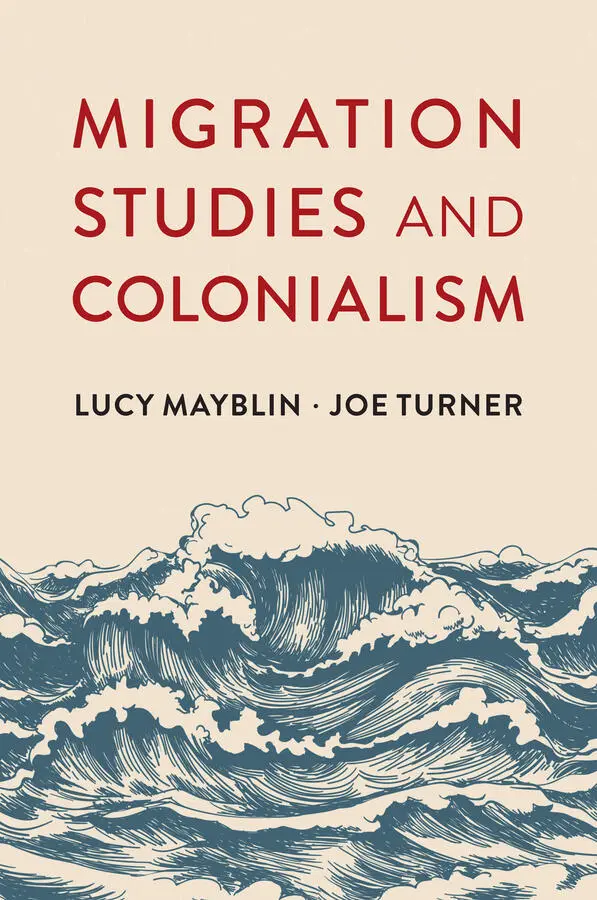
Lucy Mayblin - Migration Studies and Colonialism
Здесь есть возможность читать онлайн «Lucy Mayblin - Migration Studies and Colonialism» — ознакомительный отрывок электронной книги совершенно бесплатно, а после прочтения отрывка купить полную версию. В некоторых случаях можно слушать аудио, скачать через торрент в формате fb2 и присутствует краткое содержание. Жанр: unrecognised, на английском языке. Описание произведения, (предисловие) а так же отзывы посетителей доступны на портале библиотеки ЛибКат.
- Название:Migration Studies and Colonialism
- Автор:
- Жанр:
- Год:неизвестен
- ISBN:нет данных
- Рейтинг книги:5 / 5. Голосов: 1
-
Избранное:Добавить в избранное
- Отзывы:
-
Ваша оценка:
Migration Studies and Colonialism: краткое содержание, описание и аннотация
Предлагаем к чтению аннотацию, описание, краткое содержание или предисловие (зависит от того, что написал сам автор книги «Migration Studies and Colonialism»). Если вы не нашли необходимую информацию о книге — напишите в комментариях, мы постараемся отыскать её.
This book starts from the premise that colonial histories should be central to migration studies and explores what it would mean to really take that seriously. To engage with this task, Lucy Mayblin and Joe Turner argue that scholars need not forge new theories but must learn from and be inspired by the wealth of literature that already exists across the world. Providing a range of inspiring and challenging perspectives on migration, the authors’ aim is to demonstrate what paying attention to colonialism, through using the tools offered by postcolonial, decolonial and related scholarship, can offer those studying international migration today.
Offering a vital intervention in the field, this important book asks scholars and students of migration to explore the histories and continuities of colonialism in order to better understand the present.
Migration Studies and Colonialism — читать онлайн ознакомительный отрывок
Ниже представлен текст книги, разбитый по страницам. Система сохранения места последней прочитанной страницы, позволяет с удобством читать онлайн бесплатно книгу «Migration Studies and Colonialism», без необходимости каждый раз заново искать на чём Вы остановились. Поставьте закладку, и сможете в любой момент перейти на страницу, на которой закончили чтение.
Интервал:
Закладка:
Colonial expansion led to the proliferation of forms of knowledge for making sense of the world, as well as ways of organizing this knowledge (Mignolo 2005). As the social sciences developed through the nineteenth and twentieth centuries, the divisions between the disciplines often followed colonial modes of thinking about the world in relation to ‘modern’ societies and, conversely, ‘traditional’ societies. For example, sociology historically (and to a large extent contemporaneously) dealt with ‘modern’ societies and the conditions of living in modernity (Bhambra 2007), while anthropology and human geography dealt with ‘traditional’ societies and ‘primitive’ peoples (Asad 1979; Deloria 1988). Disciplines such as political science and economics started from the position of understanding politics as a western phenomenon (usually originating in ancient Greece), or the capitalist economy as a product of modernity, and later expanded out from this geographical starting point (Hay 2002; Marx 1990 [1887]; Skinner 1979; Waltz 1959; for debates on this in international politics, see Anievas and Nişancioğlu 2015; Hobson 2004). Modernity, then, has both explicitly preoccupied many social scientists and implicitly provided the underlying framework from which the world today is understood. That is, as comprised of, for example modern and traditional, developed and developing, societies. For migration studies, this dichotomous way of construing the world, distinguishing between developed and developing countries, or more recently the ‘Global North’ and the ‘Global South’, has been the central assumption upon which all else rests.
Postcolonial and decolonial scholars agree that modernity is centrally a concept rooted in the project of European (and later western) self-understanding which went hand-in-hand with colonial expansion. It is about understanding how some societies came to be ‘modern’ (and superior), in relation to ‘others’ who are ‘traditional’ (and inferior). The whole idea of modernity is therefore dependent on the story of the ‘European miracle’. As Gurminder K. Bhambra has argued (2007), this story rests on two fundamental assumptions: rupture and difference. She writes of this in terms of ‘a temporal rupture that distinguishes a traditional, agrarian past from the modern, industrial present; and a fundamental difference that distinguishes Europe from the rest of the world’ (2007: 1, emphasis added). The Renaissance, the French Revolution and the Industrial Revolution are central to this narrative as they demonstrate how modern societies endogenously produced the unique features that distinguished them from elsewhere: rationality and science, art and literature, human rights and democracy, and technological advancement. From Europe, this was first exported to the white settler colonies but has long been seen to have much broader relevance. As Bhambra (2007: 4) points out, ‘the Western Experience has been taken both as the basis for the construction of the concept of modernity and, at the same time, that concept is argued to have a validity that transcends the Western experiences’. But the world was very much globally interconnected through this period, and none of these developments or struggles happened in isolation. Indeed, the story of the ‘European miracle’ itself is selective in that it more often than not ignores colonialism and enslavement and is therefore incomplete.
Central to understanding modernity are the vectors of time and space. Temporally, modernity happened, or happens, at particular times in particular places. The temporal aspect of modernity (its arrival) is usually thought of as occurring within the context of a linear conception of time and progress which originated with the Enlightenment. Thus ‘the present was described as modern and civilized, the past as traditional and barbarian. The more you go towards the past, the closer you get to nature’ (Mignolo 2011a: 152). Europe, therefore, progressed from nature, through tradition, to enlightenment, others did not. But because progress towards modernity occurs within a linear conception of time, Europe (or ‘the West’ as a symbolic geography) will always be ‘ahead’. If others accelerate, they may ‘catch up’. The achievement of modernity is thus a kind of long-drawn-out race. But the rules are not always clear. For example, if a country is seen to have caught up economically, because it has become wealthy, it is likely that other aspects, such as the religiosity of the population, or dominant cultural practices, will be viewed as ‘backward’, indicating that the country (and its nationals) is indeed still ‘behind’ in time (Shimazu 1998).
A linear conception of time allows for the periodization of events and for the tracking of progress from a state of nature to that of civilization. A linear conception of time is therefore a precondition for the western understanding of history. As Zygmunt Bauman explains, ‘the history of time began with modernity. Indeed, modernity is, apart from anything else, perhaps even more than anything else, the history of time : modernity is the time when time has a history’ (Bauman 2000: 110). Europe transcended its past through developing a historical consciousness articulated through the practices of academic history, archaeology, archiving, periodizing and cataloguing. As these conventions were thought to be absent elsewhere, other places were thought to lack a historical consciousness. Other forms of knowledge were therefore inferior, and non-western cultures either lacked history or needed Europeans to properly record their history and recount it to them (Bhambra 2007; Cohn 1996, cited in Bhambra 2007: 22).
Societies outside of Europe did have alternative conceptions of time in general, for example approaching time as cyclical, and alternative ways of making sense of the relationship between past and present events. But this fact did not diminish the assessment by colonizers that these places were without history . This was the case in India. British colonials did not find evidence of the recording of history which correlated with their understanding of what history should look like, and they determined that because Indians had a cyclical conception of time they were incapable of knowing their own history or of deciphering between myth and fact (Thapar 2002). Thapar (2002) argues that in fact early Indian texts indicate both cyclical and linear conceptions of time in operation, but this was not apparent to British colonials during the colonial period, in part because they were making sense of India within the context of colonial worldviews which rendered the inferiority of Indian society an existential necessity.
Mignolo (2011a) draws our attention to the fact that in the first centuries of colonialism the difference between colonial conqueror and the objects of conquest was articulated in terms of barbarism: ‘others’ were barbarians. With the development through the Enlightenment, following Hegel, of ideas of linear time, and thus progress from barbarism, ‘barbarians’ became ‘primitives’. Primitives are still barbarians, but they are very specifically defined in temporal terms: as being of the past and capable of change (enlightenment, civilization) into the future. Over time, and into the present, the concept of linear time has thus facilitated the classification of cultural differences according to their proximity to either modernity (the present and future) or tradition (the past). But as we know from Said (1995 [1978]), places elsewhere to the western academy only exist in these ways to the extent that Occidentals understand them as such. The Orient exists only in the minds (and works) of Occidentals.
Of course, this view of time as linear is only one way in which human beings have theorized the temporal, as noted above. The contemporary western and now globalized understanding of time as linear is relatively recent and is not the approach to time that dominates everywhere. Equally, the emphasis on progress, and particularly on western history as a story of progression towards civilization, necessitates the telling of history in a particular, incomplete way. Spatially, modernity first emerged in Europe as a way of making sense of perceived changes that were happening there in relation to elsewhere . In other words, the European miracle is a place-specific, or parochial, way of understanding world history. This is significant because, as Bhambra (2007: 11) points out, ‘the way in which we understand the past has implications for the social theories we develop to deal with the situations we live in today’. The self-conception of Europeans as modern therefore depends upon the conceptualization of other places as not modern: ‘the translation of geography into chronology was the work of colonization, of the coloniality of knowledge and power’ (Mignolo 2011a: 152).
Читать дальшеИнтервал:
Закладка:
Похожие книги на «Migration Studies and Colonialism»
Представляем Вашему вниманию похожие книги на «Migration Studies and Colonialism» списком для выбора. Мы отобрали схожую по названию и смыслу литературу в надежде предоставить читателям больше вариантов отыскать новые, интересные, ещё непрочитанные произведения.







Обсуждение, отзывы о книге «Migration Studies and Colonialism» и просто собственные мнения читателей. Оставьте ваши комментарии, напишите, что Вы думаете о произведении, его смысле или главных героях. Укажите что конкретно понравилось, а что нет, и почему Вы так считаете.