Lucy Mayblin - Migration Studies and Colonialism
Здесь есть возможность читать онлайн «Lucy Mayblin - Migration Studies and Colonialism» — ознакомительный отрывок электронной книги совершенно бесплатно, а после прочтения отрывка купить полную версию. В некоторых случаях можно слушать аудио, скачать через торрент в формате fb2 и присутствует краткое содержание. Жанр: unrecognised, на английском языке. Описание произведения, (предисловие) а так же отзывы посетителей доступны на портале библиотеки ЛибКат.
- Название:Migration Studies and Colonialism
- Автор:
- Жанр:
- Год:неизвестен
- ISBN:нет данных
- Рейтинг книги:5 / 5. Голосов: 1
-
Избранное:Добавить в избранное
- Отзывы:
-
Ваша оценка:
Migration Studies and Colonialism: краткое содержание, описание и аннотация
Предлагаем к чтению аннотацию, описание, краткое содержание или предисловие (зависит от того, что написал сам автор книги «Migration Studies and Colonialism»). Если вы не нашли необходимую информацию о книге — напишите в комментариях, мы постараемся отыскать её.
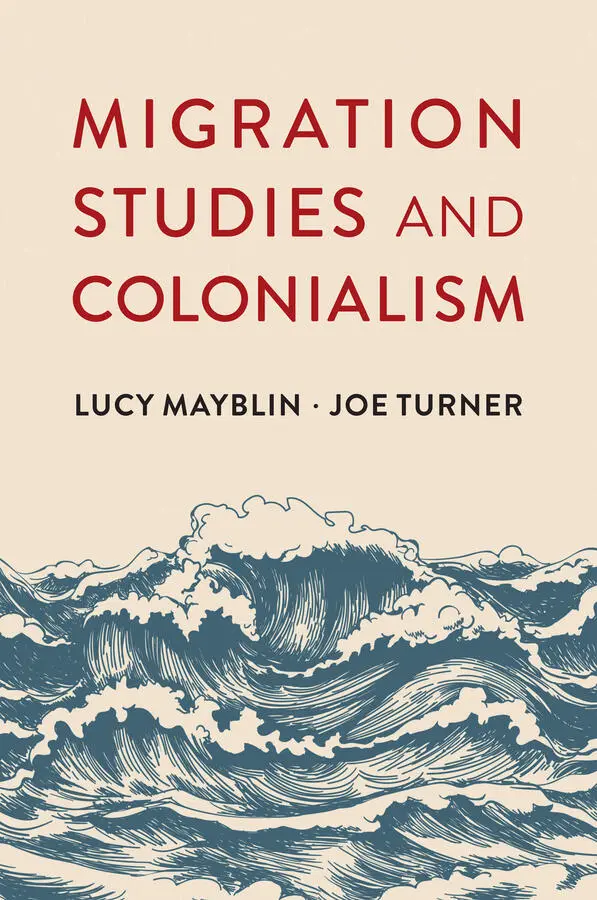
This book starts from the premise that colonial histories should be central to migration studies and explores what it would mean to really take that seriously. To engage with this task, Lucy Mayblin and Joe Turner argue that scholars need not forge new theories but must learn from and be inspired by the wealth of literature that already exists across the world. Providing a range of inspiring and challenging perspectives on migration, the authors’ aim is to demonstrate what paying attention to colonialism, through using the tools offered by postcolonial, decolonial and related scholarship, can offer those studying international migration today.
Offering a vital intervention in the field, this important book asks scholars and students of migration to explore the histories and continuities of colonialism in order to better understand the present.
Migration Studies and Colonialism — читать онлайн ознакомительный отрывок
Ниже представлен текст книги, разбитый по страницам. Система сохранения места последней прочитанной страницы, позволяет с удобством читать онлайн бесплатно книгу «Migration Studies and Colonialism», без необходимости каждый раз заново искать на чём Вы остановились. Поставьте закладку, и сможете в любой момент перейти на страницу, на которой закончили чтение.
Интервал:
Закладка:
In dialogue with Levinas, Maldonado-Torres explains that ‘coloniality survives colonialism’ and this has implications for political and economic power and for knowledge production, but it also affects our ways of being in the world: ‘It is maintained alive in books, in the criteria for academic performance, in cultural patterns, in common sense, in the self-image of peoples, in aspirations of self, and so many other aspects of our modern experience. In a way, as modern subjects we breath[e] coloniality all the time and everyday’ (Maldonado-Torres 2007: 243).
Decolonial scholars are, then, in part, interested in exploring the means by which we can ‘delink’ from coloniality/modernity and in doing so recover alternative knowledge systems (Mignolo 2007). Decoloniality is, therefore, a diverse project which has developed through an intellectual tradition distinct from postcolonialism, but which shares many of the core concerns (see Bhambra 2014).
TWAIL is centred on principally legal concerns from a broadly ‘Third World’ perspective. TWAIL begins from the position that international law is a ‘predatory system that legitimizes, reproduces and sustains the plunder and subordination of the Third World by the West’ (Mutua 1994: 31). Despite the fact that international law is meant to be universally applicable and purportedly delivers global stability, TWAIL scholars argue that the development of international law was ‘essential to the imperial expansion that subordinated non-European peoples and societies to European conquest and domination’ (Mutua 1994: 31). In other words, the very establishment of international law as an international legal framework went hand-in-hand with colonial enterprise (Anghie 2008). TWAIL is deeply connected to movements for decolonization and is seen by many as being inaugurated at the 1955 Asian–African Conference in Bandung, Indonesia (Kanwar 2015). Though it is a wide-ranging intellectual and political project, the TWAIL agenda, according to Mutua (1994: 31), has three foci:
1 ‘to understand, deconstruct, and unpack the uses of international law as a medium for the creation and perpetuation of a racialized hierarchy of international norms and institutions that subordinate non-Europeans to Europeans’;
2 ‘to construct and present an alternative normative legal edifice for international governance’;
3 ‘through scholarship, policy and politics to eradicate the conditions of underdevelopment in the Third World’.
Chimni (2006: 3) argues that ‘international law is the principal language in which domination is coming to be expressed in the era of globalization’ and suggests that part of the (as yet unfulfilled) potential of TWAIL is the promotion of the equal mobility of human beings. A TWAIL perspective, then, draws attention to the ways in which international law does not necessarily offer universal justice precisely because unequal power relations following the patterns of the colonial era are maintained through international law today.
This brief overview gives a flavour of the large bodies of work in postcolonialism, decoloniality and TWAIL which can be drawn on in migration studies in order to think through the legacies of colonialism for migration governance and migrant experiences today.
There are also many other bodies of relevant work which will be drawn upon through the course of the book, including the work of black studies scholars, indigenous scholars, critical race theorists, and decolonial, postcolonial and black feminist and queer scholarship. These bodies of work offer theoretical tools for researchers interested in centring colonialism in migration studies, though it should be noted that they are not always in agreement, or compatible, with each other. We do not seek to smooth the edges of these disjuncts. In this book we nevertheless aim to further explore how such scholarship might contribute to understanding migration-related phenomena, and to showcase the work of scholars who have already taken up this agenda.
Structure of the book
The book is structured as follows. Chapter 2discusses a central concern for scholars working with postcolonial and decolonial theory: modernity. We discuss two key aspects of the conceptual framework of modernity: the temporal and the spatial, and how these aspects are deeply connected to colonial histories. These debates are vital for centring colonialism in migration studies and have significant implications for how migration is researched and understood in, and between, different parts of the world. The chapter also discusses the concept of ‘Eurocentrism’, and how Eurocentric perspectives emerge from, and are fed by, the uneven global politics of knowledge production. The penultimate section discusses a specific idea, that of ‘development’, and how ideas of development follow colonial ways of understanding the world. The final section asks whether Eurocentrism can be overcome since, as Walter Mignolo argues, we are all trapped in the ‘colonial matrix of power’. As a whole, these discussions lay the groundwork for much of what follows in the book and as such the discussions follow through and are elaborated through the subsequent chapters.
Chapter 3demonstrates the relevance of interdisciplinary work on race to the central questions of contemporary migration studies. We thus explore the connections between colonial racism and mobility and explain how an analysis of race can help us understand contemporary migration and mobility. The chapter focuses on the centrality of race to the shaping of the modern world through European colonialism. Here we demonstrate how race was bound to colonial rule and imperial capitalism and, as importantly, how systems of domination relied on the management of mobility globally. We tie the more ‘historical’ way that race related to the control of movement to the modern push towards state immigration regimes and explore what this means for studies of migration. We also examine how different bodies of scholarship have theorized race. Race is foregrounded here as a ‘sociopolitical fact of domination’ (De Genova 2018: 1770). Throughout the chapter, we demonstrate in more detail how race informs the politics of mobility, but also how an analytics of race helps us understand migration in a more rigorous and historically accurate manner. In short, we are better able to understand what underpins mobility, what structures responses to certain people moving and how people experience migration if we centre race and racialization in our analysis.
Chapter 4focuses on questions of sovereignty and citizenship. While sovereignty is typically defined as ‘authority over a territory occupied by a relatively fixed population, supposedly necessary to protect that territory and its citizens from external [and internal] threats’ (Leigh and Weber 2018, cited in Nisancioglu 2019: 2), an engagement with colonial histories, and the colonial present, significantly complicates this definition. This is in part because the myth of equality between sovereign states is brought into question, and in part because the sovereignty of settler-colonial states especially is directly challenged (Mathieu 2018; Moreton-Robinson 2007, 2015). This chapter therefore explores the relationship between ideas of migration, sovereignty and citizenship when set within the context of colonial histories and presents. It does this through an engagement with three very different areas of scholarship which have centred colonialism in relation to such issues: connected sociologies (postcolonial), migration as decolonization (TWAIL), and indigenous studies. Together, these interventions present modes of thinking about migration in the context of citizenship and sovereignty regimes which denaturalize their formation today.
All of the perspectives discussed in chapter 4take seriously the importance of colonialisms of various kinds in shaping the present, and they concur that what results are racially grounded global inequalities and injustices. But between them there are contradictions and disconnections. This in part arises from the different modes of colonial relations that are foregrounded in the work of scholars. These different emphases do not necessarily sit easily together, as the discussion on ‘no borders’ at the end of the chapter makes clear. It is not our intention to smooth over these differences but to draw attention to the multiple possibilities raised by a commitment to centring colonialism and then the subsequent importance of local contexts in making sense of them in place.
Читать дальшеИнтервал:
Закладка:
Похожие книги на «Migration Studies and Colonialism»
Представляем Вашему вниманию похожие книги на «Migration Studies and Colonialism» списком для выбора. Мы отобрали схожую по названию и смыслу литературу в надежде предоставить читателям больше вариантов отыскать новые, интересные, ещё непрочитанные произведения.







Обсуждение, отзывы о книге «Migration Studies and Colonialism» и просто собственные мнения читателей. Оставьте ваши комментарии, напишите, что Вы думаете о произведении, его смысле или главных героях. Укажите что конкретно понравилось, а что нет, и почему Вы так считаете.