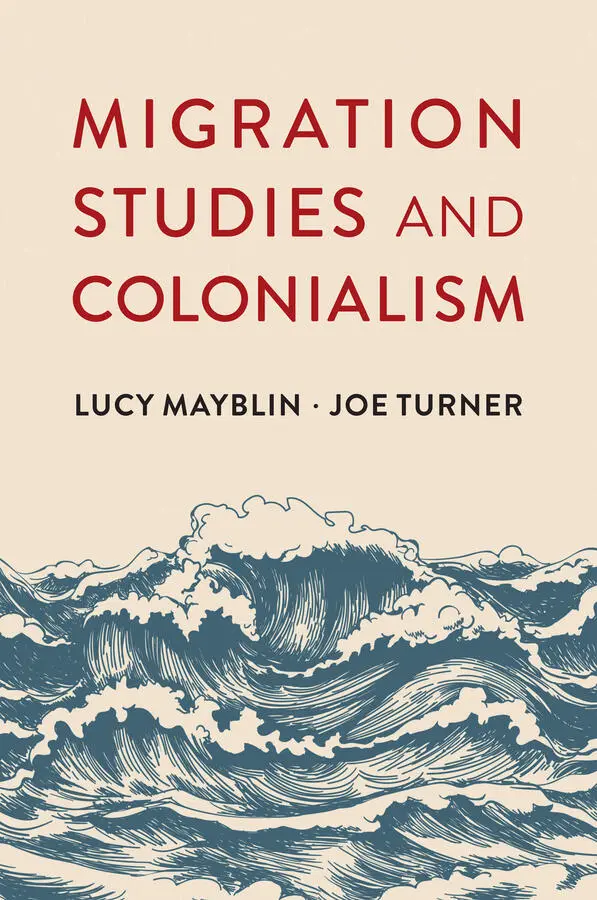
Lucy Mayblin - Migration Studies and Colonialism
Здесь есть возможность читать онлайн «Lucy Mayblin - Migration Studies and Colonialism» — ознакомительный отрывок электронной книги совершенно бесплатно, а после прочтения отрывка купить полную версию. В некоторых случаях можно слушать аудио, скачать через торрент в формате fb2 и присутствует краткое содержание. Жанр: unrecognised, на английском языке. Описание произведения, (предисловие) а так же отзывы посетителей доступны на портале библиотеки ЛибКат.
- Название:Migration Studies and Colonialism
- Автор:
- Жанр:
- Год:неизвестен
- ISBN:нет данных
- Рейтинг книги:5 / 5. Голосов: 1
-
Избранное:Добавить в избранное
- Отзывы:
-
Ваша оценка:
Migration Studies and Colonialism: краткое содержание, описание и аннотация
Предлагаем к чтению аннотацию, описание, краткое содержание или предисловие (зависит от того, что написал сам автор книги «Migration Studies and Colonialism»). Если вы не нашли необходимую информацию о книге — напишите в комментариях, мы постараемся отыскать её.
This book starts from the premise that colonial histories should be central to migration studies and explores what it would mean to really take that seriously. To engage with this task, Lucy Mayblin and Joe Turner argue that scholars need not forge new theories but must learn from and be inspired by the wealth of literature that already exists across the world. Providing a range of inspiring and challenging perspectives on migration, the authors’ aim is to demonstrate what paying attention to colonialism, through using the tools offered by postcolonial, decolonial and related scholarship, can offer those studying international migration today.
Offering a vital intervention in the field, this important book asks scholars and students of migration to explore the histories and continuities of colonialism in order to better understand the present.
Migration Studies and Colonialism — читать онлайн ознакомительный отрывок
Ниже представлен текст книги, разбитый по страницам. Система сохранения места последней прочитанной страницы, позволяет с удобством читать онлайн бесплатно книгу «Migration Studies and Colonialism», без необходимости каждый раз заново искать на чём Вы остановились. Поставьте закладку, и сможете в любой момент перейти на страницу, на которой закончили чтение.
Интервал:
Закладка:
Intellectually, Eurocentrism is an orientation which puts some places (Europe and ‘the West’ more broadly) at the centre of world history as well as of contemporary knowledge production. Only upon entry into modernity do other places enter that world history (Dussel 1995). Eurocentrism therefore requires us to ignore connected histories, colonial interconnections and the actual role of the non-West in world history. But it also requires us to ignore non-European philosophical traditions and intellectual projects oriented to making sense of the world in which they found themselves – just as Europe’s philosophers were doing. Eurocentrism is about an orientation to a ‘normal’ political, philosophical, economic and historical reference point. That reference point may not be explicit; it may be implicit. But it would suggest, for example, that in thinking through moral arguments for immigrant inclusion or exclusion globally we look only at European-origin philosophers.
Eurocentrism is not therefore simply about a disproportionate focus on geographically European societies. Amin (1988: 185) charges that Eurocentrism incorporates ‘an inability to see anything other than the lives of those who are comfortably installed in the modern world’. Not seeing here is not the same as ignoring. Rather, it is not seeing people as themselves but instead seeing against the measuring-stick of the West. Gayatri Chakravorty Spivak (1988) has made an important contribution to this discussion in elaborating beyond the inability to ‘see’ to an inability to represent more broadly. In her seminal article ‘Can the Subaltern Speak?’ (also discussed in the Introduction), Spivak problematized the way in which the Third World subject is represented in western discourse. She argues that while western intellectuals often express a belief that subaltern groups understand their oppression and can speak for themselves, such an argument ignores the inaccessibility of the subaltern as a ‘subject’. For her, the subaltern is destined to remain mute as a result of mistranslations emergent from the relations of power involved in the colonial encounter. The ‘true’ self-conscious voice of the subaltern is therefore inaccessible because the subaltern, by virtue of being the subaltern, cannot speak in the ways demanded of her by western academics. Spivak therefore argues that academics too often present themselves either as objective observers of others or as allowing the oppressed to speak for themselves, rendering scholarly representations as unproblematic. What this hides, Spivak observes, is the economic, cultural and intellectual power relations that are at play in such representations, as well as the historically rooted institutional contexts, categories and worldviews in which academic observers are situated.
Singaporean scholar Sin Yee Koh (2015) argues that Eurocentrism in migration studies manifests itself in, amongst other things, a disproportionate focus on immigrant-receiving states in western countries and a dearth of studies which focus on the perspectives of sending contexts, except as a developmental concern. The continuity (as opposed to contemporary novelty) of migration patterns from former colonies in Asia to former metropoles in Europe, as well as between former colonies within Asia, is a particular area of scholarly silence, according to Koh. But, at the same time, concepts which are derived from ‘the Anglo-western experience’, such as typologies of different types of migrant, ideas of liberal citizenship or ideas of ‘development’ (discussed further below), are applied unthinkingly in other places as though they are universal and not context specific.
North, South, East and West in colonial modernity
One of the challenges of discussing Eurocentrism is the tendency to see it as having a bounded geographical content, in other words, as referring to Europe and things from the geographical space of Europe exclusively. This is true even of more fuzzy binary categories such as the ‘Global North’ and the ‘Global South’, ‘developed’ and ‘developing’, or the slightly more disaggregated ‘First World’ (wealthy capitalist countries), ‘Second World’ (post-socialist) and ‘Third World’ (postcolonial). The latter rubric mimics the East/West dichotomy in that the Second and Third World only make sense in their relation to the First World, as post-socialist or postcolonial. The Cold War has ended and yet the ‘three worlds’ thesis continues to resonate. Indeed, while ‘the East’ is less often used, ‘the West’ is in common parlance. Some people, following Bangladeshi photographer and activist Shahidul Alam, use the distinction ‘majority world’ (less affluent) and ‘minority world’ (more affluent) in order to draw attention to the fact that those who hold most of the wealth are in fact the minority of the world’s population. Rather than arguing that one of these typologies is better, or more geographically accurate, and should therefore be viewed as superior to others, we understand all of these labels as shifting symbolic geographies which, like ‘the Orient’, rarely map onto actual places. They are deployed by different actors as necessary conceptual generalizations to help them (and us) to articulate particular ideas about the world and the various people and places in it. They hold social and political meaning, but they should not be mistaken for ‘real’ places. Indeed, this conceptual fuzziness can open up fertile terrain for contemplation over the ‘common-sense’ content of these ways of articulating the world.
As noted in the introductory chapter, the separation of the world into either three groups in the ‘three worlds’ thesis, or two in the West/East, North/South, developed/developing, minority/majority dichotomies, is central to the academic division of labour in the social sciences (Bhambra 2007; Chari and Verdery 2009). While disciplines such as sociology focus on First World, western, developed, minority-world, Global North societies, disciplines such as development studies and anthropology focus on its antithesis. The Second World is then left to area studies that are conceptualized as in ‘transition’ (Baker 2018; Kangas and Salmenniemi 2016). Pletsch (1981) suggests that this division of intellectual labour emerged in the 1950s and is indebted to the dominance and mainstreaming of modernization theory in, particularly, US research institutions. For him, the two key axes emerging from this period, communist/free and traditional/modern, can both be understood as relations of modernity. They locate modernity (science, rationality, freedom) in the First World, with the Second World and Third World both ruled by different forms of irrationality: ideology and propaganda in the former; and traditionalism, economic backwardness and religiosity in the latter. The Second World can thus ‘transition’ into modernity by abandoning communist ideology, while the Third World can modernize through civilization; both can ‘progress’ through capitalism.
Migration studies has the potential to disrupt such categorizations through its knowledge of interconnection, transnationalism, complexity and hybridity. More often, however, the ‘three worlds’ lens is applied, with scholars offering expertise in one of the worlds, and disciplinary affiliations accordingly fitting into one of the ‘modern/developed’ disciplines, those concerned with developing countries and those exploring post-socialist contexts from the perspective of post-socialist area studies. But what if we ruminate on the nature of colonial modernity and what it might mean for how we carve up our analysis of the world? For example, Chari and Verdery (2009) have argued, in light of the insights of Pletsch (1981) noted above, that in the post-Cold War period we need to look between and beyond the ‘posts’ of post-socialism and postcolonialism. They write: ‘an integrated analytical field ought to explore intertwined histories of capital and empire’ and in doing so interrogate ‘the ongoing effects of the Cold War’s Three-Worlds ideology’ (2009: 19). The Cold War, they point out, was not just about analytically organizing the world but also about representing it.
Читать дальшеИнтервал:
Закладка:
Похожие книги на «Migration Studies and Colonialism»
Представляем Вашему вниманию похожие книги на «Migration Studies and Colonialism» списком для выбора. Мы отобрали схожую по названию и смыслу литературу в надежде предоставить читателям больше вариантов отыскать новые, интересные, ещё непрочитанные произведения.







Обсуждение, отзывы о книге «Migration Studies and Colonialism» и просто собственные мнения читателей. Оставьте ваши комментарии, напишите, что Вы думаете о произведении, его смысле или главных героях. Укажите что конкретно понравилось, а что нет, и почему Вы так считаете.