Halogen Bonding in Solution
Здесь есть возможность читать онлайн «Halogen Bonding in Solution» — ознакомительный отрывок электронной книги совершенно бесплатно, а после прочтения отрывка купить полную версию. В некоторых случаях можно слушать аудио, скачать через торрент в формате fb2 и присутствует краткое содержание. Жанр: unrecognised, на английском языке. Описание произведения, (предисловие) а так же отзывы посетителей доступны на портале библиотеки ЛибКат.
- Название:Halogen Bonding in Solution
- Автор:
- Жанр:
- Год:неизвестен
- ISBN:нет данных
- Рейтинг книги:5 / 5. Голосов: 1
-
Избранное:Добавить в избранное
- Отзывы:
-
Ваша оценка:
Halogen Bonding in Solution: краткое содержание, описание и аннотация
Предлагаем к чтению аннотацию, описание, краткое содержание или предисловие (зависит от того, что написал сам автор книги «Halogen Bonding in Solution»). Если вы не нашли необходимую информацию о книге — напишите в комментариях, мы постараемся отыскать её.
Halogen Bonding in Solution
Halogen Bonding in Solution
Halogen Bonding in Solution — читать онлайн ознакомительный отрывок
Ниже представлен текст книги, разбитый по страницам. Система сохранения места последней прочитанной страницы, позволяет с удобством читать онлайн бесплатно книгу «Halogen Bonding in Solution», без необходимости каждый раз заново искать на чём Вы остановились. Поставьте закладку, и сможете в любой момент перейти на страницу, на которой закончили чтение.
Интервал:
Закладка:
1.5.3.4 Self‐healing Polymers
Select self‐healing polymers employ reversible networks of noncovalent interactions and are of topical interest for several real‐world applications. For example, using halogen bonds in self‐healing polymers allows for the creation of hard coatings with healing properties. The polymers are “repaired” by reorganizing noncovalent interactions to maintain structural and mechanical integrity and can sustain many healing cycles while keeping their mechanical robustness. The first examples of halogen bond self‐healing polymers were developed by Schubert and Hager in 2017 [187,188]. Cross‐linking between iodotriazole and iodotriazolium halogen bond donors and tetra‐ N ‐butylammonium acetate polymeric salt acceptors ( Figure 1.21) in these systems was revealed by a characteristic shift in the C–I band in the Raman spectrum. The self‐healing behavior in these polymers was indicated by scratch‐healing tests. Future studies of self‐healing polymers that incorporate halogen bonding are being directed at maximizing the self‐healing mechanism. Given that there are few examples, the field will likely expand to include a wider variety of self‐healing polymer systems.
1.5.4 Supramolecular Gels
Low molecular weight supramolecular gels can be used for sensing, cell growth media, drug delivery, and stimuli‐responsive optical/electronic materials. Hydrogen bond interactions are commonly used to form 1D or 2D fibrils that are sensitive to competing noncovalent interactions. These competing interactions can therefore be used to control gel formation or gel strength. Metrangolo and Resnati created 1,4‐diiodotetrafluorobenzene and 1,4‐bis(3‐pyridylureido)butane mixtures whose crystal structure revealed a halogen bonding diiodoperfluorobenzene donor, pyridine acceptor, and hydrogen bonding urea donor–acceptor lattice. This combination of molecules resulted in the formation of a supramolecular polymeric gel in dimethyl sulfoxide–water mixtures [189]. This was the first example using a halogen bond to form a supramolecular gel in polar media, suggesting that halogen bonds can operate in the presence of polar solvents and be used for gel‐based materials [190]. The linearity of the halogen bond has also been exploited to develop macroscale materials [191]. By using a halogen bonding 1‐iodoperfluoroalkane donor with a polyethylene glycol‐based ammonium chloride end‐capped acceptor, a star‐shaped polymer was created, which formed millimeter‐sized films without any other external templating forces. Even in the few reported systems, the halogen bond has been versatile enough to produce polymeric gels in competitive media and strong enough to generate millimeter scale assemblies.
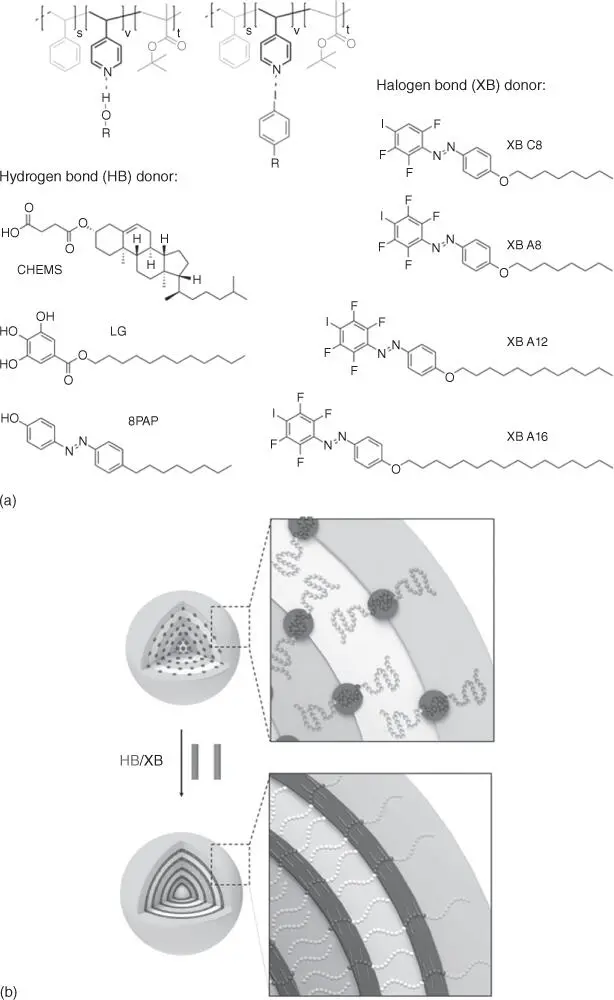
Figure 1.20(a) Chemical structure of the halogen bond and hydrogen bond donors used in nanoparticle formation. (b) Tuning of the poly(4‐vinylpyridine) (P4VP) volume with halogen bond and hydrogen bond donors and transition from lamella–sphere to lamella–lamella morphology.
Source: From Quintieri et al. [186]. © 2018 MDPI.
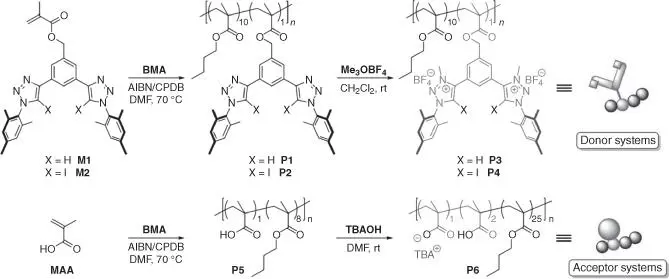
Figure 1.21Monomers M1and M2were subjected to RAFT polymerization with butyl methacrylate (BMA) to prepare the donor‐containing copolymers P1and P2, which were methylated to obtain P3and P4. Acceptor copolymers P5and P6were obtained by RAFT polymerization of BMA with methyl methacrylate (MAA) and subsequent treatment with TBAOH.
Source: From Tepper et al. [187]. © 2017 John Wiley & Sons
.
1.5.5 Materials Conclusion
Despite the early stage of development, materials scientists have used the halogen bond to construct a diverse range of LCs, ionic liquids, self‐healing polymers, and macroscopic self‐assembled gels. These initial materials provide perspective for the detailed discussions of solution‐based halogen bonding found in subsequent chapters. However, halogen bond‐based materials are still largely inspired and derived from hydrogen bond‐based materials. Surely, combining the ingenuity of the chemist with the directionality, tunability, solvent resistance, and lipophilicity of the halogen bond will produce unique materials for a variety of exciting applications. Future studies will improve the properties of halogen bonding materials and will be used to gain a greater understanding of the noncovalent interactions available to the chemist.
1.6 Conclusion
From intellectual curiosity to versatile supramolecular tool, the ascension of the halogen bond has been significant. In less than 20 years since the “rediscovery” concept article, the works of many scientists have produced a solid foundational understanding of the halogen bond. The wide breadth of fundamental studies of the halogen bond across all phases (solid, solution, gas, and in silico ) has resulted in extensive (and growing) application across diverse fields. Furthermore, the success of the halogen bond has inspired a renaissance of other σ‐hole‐type interactions (e.g. chalcogen, pnictogen, and tetrel bonds) that have developed rapidly, as concepts, nomenclature, and fundamentals parallel the halogen bond.
The rise of these noncovalent forces has expanded the supramolecular landscape. As such, readers should continue to expect comparative investigations on how the halogen bond “stacks up” against other noncovalent interactions – some of which will be discussed in later chapters. These and other fundamental studies will continue to refine our understanding of the halogen bond. As the field advances, enriched understanding and computational models will lead to improved molecular designs – the prospects of which are vast. The intent of this introduction has been to provide a deeper understanding of the halogen bond that can be used to contextualize the solution discussions found in later chapters. The following chapters highlight fundamental and functional studies of the halogen bond in solution.
Acknowledgments
O.B.B., D.A.D., and E.A.J. are thankful for the support from National Science Foundation (NSF) CAREER CHE‐1555324. O.B.B., D.A.D., and E.A.J. are thankful for X‐ray core facility support by the Center for Biomolecular Structure and Dynamics CoBRE (NIH NIGMS grant P20GM103546) and the University of Montana (UM).
References
1 1 Guo, N., Maurice, R., Teze, D. et al. (2018). Nat. Chem. 10: 1–7.
2 2 Desiraju, G.R., Ho, P.S., Kloo, L. et al. (2013). Pure Appl. Chem. 85: 1711–1713.
3 3 Von, P., Schleyer, R., and West, R. (1959). J. Am. Chem. Soc. 81: 3164–3165.
4 4 Ramasubbu, N., Parthasarathy, R., and Murray‐Rust, P. (1986). J. Am. Chem. Soc. 108: 4308–4314.
5 5 Brinck, T., Murray, J.S., and Politzer, P. (1992). Int. J. Quantum Chem. 44: 57–64.
6 6 Murray, J.S., Paulsen, K., and Politzer, P. (1994). Proc. Indian Acad. Sci. 106: 267–275.
7 7 Cavallo, G., Metrangolo, P., Milani, R. et al. (2016). Chem. Rev. 116: 2478–2601.
8 8 Clark, T., Hennemann, M., Murray, J.S., and Politzer, P. (2007). J. Mol. Model. 13: 291–296.
9 9 Alvarez, S. (2013). Dalton Trans. 42: 8617.
10 10 Shannon, R.D. (1976). Acta Crystallogr. Sect. A 32: 751–767.
11 11 Metrangolo, P., Meyer, F., Pilati, T. et al. (2008). Angew. Chem. Int. Ed. 47: 6114–6127.
Читать дальшеИнтервал:
Закладка:
Похожие книги на «Halogen Bonding in Solution»
Представляем Вашему вниманию похожие книги на «Halogen Bonding in Solution» списком для выбора. Мы отобрали схожую по названию и смыслу литературу в надежде предоставить читателям больше вариантов отыскать новые, интересные, ещё непрочитанные произведения.












Обсуждение, отзывы о книге «Halogen Bonding in Solution» и просто собственные мнения читателей. Оставьте ваши комментарии, напишите, что Вы думаете о произведении, его смысле или главных героях. Укажите что конкретно понравилось, а что нет, и почему Вы так считаете.