Halogen Bonding in Solution
Здесь есть возможность читать онлайн «Halogen Bonding in Solution» — ознакомительный отрывок электронной книги совершенно бесплатно, а после прочтения отрывка купить полную версию. В некоторых случаях можно слушать аудио, скачать через торрент в формате fb2 и присутствует краткое содержание. Жанр: unrecognised, на английском языке. Описание произведения, (предисловие) а так же отзывы посетителей доступны на портале библиотеки ЛибКат.
- Название:Halogen Bonding in Solution
- Автор:
- Жанр:
- Год:неизвестен
- ISBN:нет данных
- Рейтинг книги:5 / 5. Голосов: 1
-
Избранное:Добавить в избранное
- Отзывы:
-
Ваша оценка:
Halogen Bonding in Solution: краткое содержание, описание и аннотация
Предлагаем к чтению аннотацию, описание, краткое содержание или предисловие (зависит от того, что написал сам автор книги «Halogen Bonding in Solution»). Если вы не нашли необходимую информацию о книге — напишите в комментариях, мы постараемся отыскать её.
Halogen Bonding in Solution
Halogen Bonding in Solution
Halogen Bonding in Solution — читать онлайн ознакомительный отрывок
Ниже представлен текст книги, разбитый по страницам. Система сохранения места последней прочитанной страницы, позволяет с удобством читать онлайн бесплатно книгу «Halogen Bonding in Solution», без необходимости каждый раз заново искать на чём Вы остановились. Поставьте закладку, и сможете в любой момент перейти на страницу, на которой закончили чтение.
Интервал:
Закладка:
Source: From Wolters and Bickelhaupt [149]. © 2012 John Wiley & Sons.
1.4.6 Dispersion and Polarization Component
London dispersion and polarization effects on the halogen bond can be important given the polarizability of larger halogens (e.g. I and Br) and the fact that interacting partners are frequently closer than the sum of the vdW radii. Dispersion interactions resulting from a temporary dipole and another dipole between the halogen and Lewis base provide a small but attractive force that contributes greatly in systems without large electropositive σ‐holes [153].
Lump–hole theory [154] is an alternative electrostatic model that describes a depletion of negative charge at the end of the halogen and accounts for dispersion and polarization. For example, Hobza and coworkers showed that a CH 3Cl molecule can form a halogen bond with OCH 2despite that the Cl never forms an electropositive σ‐hole [155]. Obviously, σ‐hole theory does not account for weak halogen bond formation in CH 3Cl as dispersion dominates the interaction in this case.
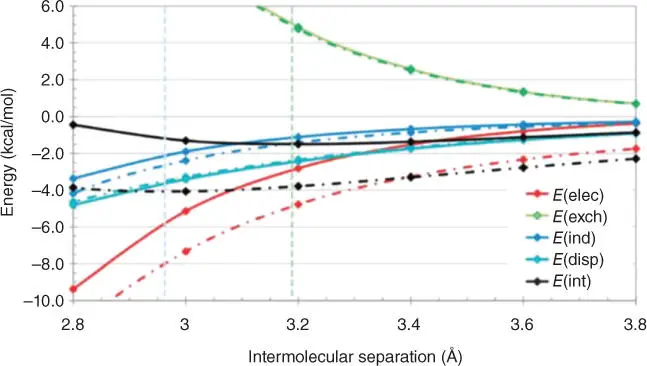
Figure 1.16DFT–SAPT decomposition analysis of H 3CBr⋯NH 3(solid lines) and F 3CBr⋯NH 3complexes (dashed lines) (kcal/mol). Potential energy minima are shown as vertical dashed lines (H 3CBr⋯NH 3is green, and F 3CBr⋯NH 3is light blue). The components are reported as follows: electrostatics ( E (elec)), induction or polarization ( E (ind)), dispersion ( E (disp)), and exchange ( E (exch)), and total binding energies ( E (int)).
Source: From Riley and Hobza [153]. © 2013 Royal Society of Chemistry.
1.4.7 Decomposition
With decomposition analysis of intermolecular forces, contributions of electrostatics, induction or polarization, dispersion, and exchange repulsion are quantified. Decomposition of the halogen bond has allowed researchers to obtain a more complete view of the halogen bond. Symmetry‐adapted perturbation theory (SAPT) [156] and the density functional theory version (DFT–SAPT) [157] are used to describe the bonding components of the halogen bond. Total decomposition of the H 3CBr⋯NH 3and F 3CBr⋯NH 3halogen bond adducts ( Figure 1.16) reveals notable differences between the two [153]. Specifically, the CH 3derivative was largely driven by inductive and dispersive forces, whereas the inclusion of CF 3groups led to a significantly larger electrostatic contribution.
1.4.8 Biological Computation of Halogen Bonding
Utilizing the halogen bond in biological settings is still novel. Currently, researchers are evaluating the influence of halogen bonding in protein stability, substrate binding, and drug design. Although nature seldom employs the halogen bond [158], medicinal chemists have found that the hydrophobicity of the halogen and directionality of the halogen bond could improve drug delivery and specificity. Drug design is time and cost intensive. To reduce this, medicinal chemists frequently turn to computational chemistry to identify target systems. However, specialized tools for modeling the halogen bond are still rare in the field.
Ho has been at the forefront of studying halogen bonding in biochemical systems. Using experiments, computations, and PDB searches, his group revealed that halogen bonds can stabilize ligand binding and molecular folding in proteins and nucleic acids [159]. An initial survey of the PDB found 113 different interactions when searching for short halogen‐Lewis base interactions. To date, more than 790 structures featuring the halogen bond in the PDB have been found [160]. A review by Ho et al. has also summarized current computational designs for halogen bonding drug candidates [161]. Using the structure of a protein and its binding pocket, their methodology identifies possible halogen bond acceptors within the pocket and predicts optimal positions to place the halogen bond donor. This tactic allows medicinal chemists to predict which donor to incorporate and where to place it on a substrate. Hobza has used another approach by employing the semiempirical family of PM6 functions to make halogen bond computations accessible without using computationally expensive quantum mechanical (QM) calculations [162,163]. Using this method, they demonstrated that reasonable modeling can be achieved using lower levels of theory on non‐halogen bonding components.
Other methodologies for studying the halogen bond in biology are effective and highly utilized. For example, Boeckler developed an evaluation tool called XBScore, which rates halogen bond interactions in proteins using QM/molecular mechanics (MM) calculations [164]. QM/MM uses computationally cheap MM to model most of the protein and expensive QM to model the binding site and halogen bonding substrate [165]. In comparison, other techniques like optimized potentials for liquid simulations‐all atoms (OPLS‐AA) [166] or assisted model building with energy refinement (AMBER) [167] have used a positive extra point approach by adding a pseudoatom at the halogen atom surface to inexpensively simulate a σ‐hole. Ho further developed these force field systems by deriving MM/MD equations specifically for the halogen bond [168]. The above computational techniques highlight how the ingenuity of the chemists has overcome limitations of computational power to provide reasonable predictions in a timely fashion.
1.4.9 Computational Conclusion
To date, researchers have generated a variety of computational and experimental tools to study the halogen bond, and they are constantly being improved. One can look at the aphorism by the statistician George Box, which states, “All models are wrong, but some are useful.” Computational models depend on the experimental systems they come from and make assumptions to limit the computational resources required. However, these limitations are being lifted to obtain useful information for drug design and fundamental interaction studies. Future halogen bonding computational models will be developed, which combine the better processing power of future hardware with a greater understanding of the principles that make up the halogen bond. Computational studies of the halogen bond and other noncovalent interactions will be necessary for rational molecular design across many synthetic fields. Furthermore, these studies provide a strong foundation to understand the solution‐based halogen bonding presented in later chapters of this book.
1.5 Materials
1.5.1 Introduction
Materials like liquid crystals (LCs), polymers, and gels frequently exhibit properties governed by noncovalent forces, most often the hydrogen bond. As expected, the distinct characteristics of the halogen bond, such as high directionality, strength, polarizability, and hydrophobicity, provide enticing prospects for the development of novel materials. In this section, select examples of halogen bonding materials are presented. For more information pertaining to halogen bond materials, recent reviews have been published [7,169].
1.5.2 Liquid Crystals
The LC state is a mesophase, having properties of both crystalline solids and isotropic liquids, with extensive real‐world applications. A variety of different noncovalent interactions are employed to achieve desired LC properties (e.g. low temperature formation, unique light modification, predictable phase transition, etc.), but hydrogen bonding is by far the most common [170]. The success of hydrogen bond‐mediated LCs is largely attributed to its directionality, thereby inspiring evaluations using the more stringent halogen bond. In fact, LCs incorporating halogen bonds have exhibited unique properties dissimilar to hydrogen bonding derivatives. This section provides select examples of how the halogen bond has been applied to produce different classes of LCs. For further reference, a recent review of the topic has been published [171].
Читать дальшеИнтервал:
Закладка:
Похожие книги на «Halogen Bonding in Solution»
Представляем Вашему вниманию похожие книги на «Halogen Bonding in Solution» списком для выбора. Мы отобрали схожую по названию и смыслу литературу в надежде предоставить читателям больше вариантов отыскать новые, интересные, ещё непрочитанные произведения.












Обсуждение, отзывы о книге «Halogen Bonding in Solution» и просто собственные мнения читателей. Оставьте ваши комментарии, напишите, что Вы думаете о произведении, его смысле или главных героях. Укажите что конкретно понравилось, а что нет, и почему Вы так считаете.